Comparison studies on the physicochemical properties and antimicrobial activities of copper (I) oxide nanoparticles synthesized using bulk and microfluidic methods
{"title":"Comparison studies on the physicochemical properties and antimicrobial activities of copper (I) oxide nanoparticles synthesized using bulk and microfluidic methods","authors":"Thanh-Qua Nguyen, Vinh-Tien Nguyen, Nhat-Kha Dao, Van-Toi Vo, Khanh Son Trinh","doi":"10.1007/s11696-024-03750-6","DOIUrl":null,"url":null,"abstract":"<div><p>Microfluidic (MF) technology offers significant advantages for nanomaterial synthesis due to precise process control and automation. This study compares the physicochemical properties and antimicrobial activities of copper (I) oxide nanoparticles (Cu<sub>2</sub>O NPs) synthesized using conventional batch and MF methods, with glucose as a reducing agent for CuSO<sub>4</sub> and starch as a capping agent. The reaction was carried out with NaOH concentrations ranging from 0.06 to 0.5 M. In the range of 0.08–0.15 M NaOH, X-ray diffraction analysis and scanning electron microscope images revealed smaller particles (< 100 nm), with the MF method producing more uniform particles. Dynamic light scattering results showed larger particles formed outside this NaOH concentration range. The conventional batch method produced more stable Cu<sub>2</sub>O NPs, while MF NPs tended to agglomerate over time. Zeta potentials of all Cu<sub>2</sub>O NPs were higher than −20 mV, indicating stabilization by polymeric starch adsorption. Antimicrobial activity was evaluated by incubating <i>Escherichia coli</i> and <i>Colletotrichum gloeosporioides</i> with Cu<sub>2</sub>O NPs. Batch Cu<sub>2</sub>O NPs exhibited higher antimicrobial activity than MF Cu<sub>2</sub>O NPs. The highest inactivation was achieved with 0.15 M NaOH batch Cu<sub>2</sub>O NPs, showing a 5.55 log reduction of <i>E. coli</i> and 96% growth inactivation of <i>C. gloeosporioides</i>.</p></div>","PeriodicalId":513,"journal":{"name":"Chemical Papers","volume":"78 18","pages":"9385 - 9397"},"PeriodicalIF":2.5000,"publicationDate":"2024-11-04","publicationTypes":"Journal Article","fieldsOfStudy":null,"isOpenAccess":false,"openAccessPdf":"","citationCount":"0","resultStr":null,"platform":"Semanticscholar","paperid":null,"PeriodicalName":"Chemical Papers","FirstCategoryId":"92","ListUrlMain":"https://link.springer.com/article/10.1007/s11696-024-03750-6","RegionNum":4,"RegionCategory":"化学","ArticlePicture":[],"TitleCN":null,"AbstractTextCN":null,"PMCID":null,"EPubDate":"","PubModel":"","JCR":"Q2","JCRName":"Engineering","Score":null,"Total":0}
引用次数: 0
Abstract
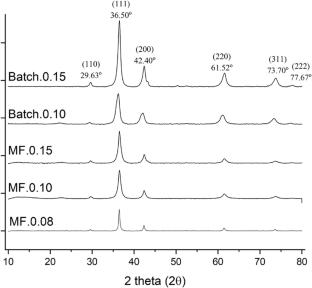
Microfluidic (MF) technology offers significant advantages for nanomaterial synthesis due to precise process control and automation. This study compares the physicochemical properties and antimicrobial activities of copper (I) oxide nanoparticles (Cu2O NPs) synthesized using conventional batch and MF methods, with glucose as a reducing agent for CuSO4 and starch as a capping agent. The reaction was carried out with NaOH concentrations ranging from 0.06 to 0.5 M. In the range of 0.08–0.15 M NaOH, X-ray diffraction analysis and scanning electron microscope images revealed smaller particles (< 100 nm), with the MF method producing more uniform particles. Dynamic light scattering results showed larger particles formed outside this NaOH concentration range. The conventional batch method produced more stable Cu2O NPs, while MF NPs tended to agglomerate over time. Zeta potentials of all Cu2O NPs were higher than −20 mV, indicating stabilization by polymeric starch adsorption. Antimicrobial activity was evaluated by incubating Escherichia coli and Colletotrichum gloeosporioides with Cu2O NPs. Batch Cu2O NPs exhibited higher antimicrobial activity than MF Cu2O NPs. The highest inactivation was achieved with 0.15 M NaOH batch Cu2O NPs, showing a 5.55 log reduction of E. coli and 96% growth inactivation of C. gloeosporioides.
Chemical PapersChemical Engineering-General Chemical Engineering
CiteScore
3.30
自引率
4.50%
发文量
590
期刊介绍:
Chemical Papers is a peer-reviewed, international journal devoted to basic and applied chemical research. It has a broad scope covering the chemical sciences, but favors interdisciplinary research and studies that bring chemistry together with other disciplines.



 京公网安备 11010802042870号
京ICP备2023020795号-1
京公网安备 11010802042870号
京ICP备2023020795号-1

 分享
分享
 求助内容:
求助内容: 应助结果提醒方式:
 扫码关注我们
