Isabel R. Rooper BA, Marquita W. Lewis-Thames PhD, MPH, MS, Andrea K. Graham PhD
{"title":"Beyond usability: Designing digital health interventions for implementation with older adults","authors":"Isabel R. Rooper BA, Marquita W. Lewis-Thames PhD, MPH, MS, Andrea K. Graham PhD","doi":"10.1111/jgs.19286","DOIUrl":null,"url":null,"abstract":"<p>Addressing the health needs of the growing older adult population is a pressing public health issue, especially given the healthcare challenges older adults experience, such as poorly coordinated care and increasing costs of in-person services. Digital health interventions (DHIs), which encompass mobile apps, websites, and text messaging, are a promising, low-cost modality to address these challenges. Emerging evidence shows older adults are curious about digital technologies and DHIs are efficacious among them,<span><sup>1, 2</sup></span> although rigorous efficacy research is still limited. Despite this promise, scoping reviews show that older adults adopt and use DHIs at low and inconsistent rates<span><sup>3</sup></span> and that barriers to adoption and usage remain.<span><sup>4</sup></span> For example, older adults have low awareness of DHIs<span><sup>5</sup></span> and can experience low self-efficacy regarding their ability to use DHIs.<span><sup>5</sup></span> Further, when older adults overcome these barriers and adopt DHIs, they report DHIs have low perceived usefulness<span><sup>3, 6</sup></span> (i.e., low acceptability), which deters ongoing use.</p><p>These are problems of implementation. Implementation factors, such as how DHIs integrate into older adults' lives and the day-to-day contexts in which they receive care, have not yet been adequately considered for DHIs for older adults. Neglecting implementation considerations has led to DHIs that older adults cannot adopt or do not use. Furthermore, older adults are often excluded from the process of designing DHIs,<span><sup>7</sup></span> as are important contextual considerations, such as the involvement of multiple caregivers and clinicians in their care. To overcome these implementation challenges, we must reconsider how DHIs are designed, introduced, and delivered to older adults.</p><p>Human-centered design is a well-established methodology that centralizes the perspectives of all target users throughout the design process to increase uptake and engagement of digital solutions. This makes human-centered design an apt approach for designing digital tools to overcome implementation problems and account for older adults' individual and contextual considerations, as shown in Figure 1. To date, significant attention has been directed at addressing DHI usability among older adults (e.g., increasing color contrast and font size). However, usability alone will not solve the broader implementation problems of low DHI adoption and acceptability. With strides underway to enable DHI reimbursement and greater accessibility within health care, the time is ripe to embrace a different approach. To realize the true promise of DHIs among older adults, we must design for implementation.</p><p>Designing for implementation requires deeply understanding and accounting for the specific needs and day-to-day circumstances of older adults. For instance, compared with younger adults, older adults often face unique health challenges, such as frequently managing multiple chronic conditions and having reduced mobility. Older adults also often experience unique role transitions (e.g., retirement), isolation, and cognitive changes. Consequently, the clinical recommendations and features of DHIs must account for these distinctive circumstances. For example, DHIs typically target a singular primary health problem (e.g., depression, diabetes). Yet this approach may not be as useful for older adults compared with a DHI that can support users in managing multiple health issues concurrently, and/or that accounts for other healthcare recommendations that older adults may be balancing. Further, the standard “there's an app for that” approach may contribute to lower adoption in this population, because the high treatment burden associated with multimorbidity, coupled with cognitive decline, may reduce older adults' self-efficacy and therefore willingness to adopt and use multiple DHIs.</p><p>Human-centered design can help DHI designers learn the unique factors in older adults' lives that impact DHI implementation and prioritize features that would be most useful and acceptable. Given that older adults comprise a highly heterogenous population in terms of health, social, and technology needs and preferences, human-centered design methods can help DHI designers grasp the range of those experiences and design DHIs accordingly. Adopting a design for implementation approach can also help designers learn optimal pathways to introduce DHIs to older adults (i.e., dissemination strategies) to promote DHI awareness and adoption.</p><p>Designing DHIs for implementation also means accounting for the other individuals who are engaged in older adults' care. One such group are informal caregivers, including loved ones and family members, who are often a primary source of support for older adults as they age.<span><sup>8</sup></span> The involvement of informal caregivers is unique compared with younger adults, making this an important implementation consideration so that DHIs integrate into older adults' routine contexts (e.g., at home). Specifically, informal caregivers often assist older adults in health monitoring and decision-making, and help them implement clinical recommendations within their daily routines. Consequently, caregivers could be involved with using a DHI (e.g., by inputting information) or be impacted by a DHI (e.g., by receiving information to facilitate their role providing health monitoring and support).</p><p>Caregivers may also be key partners for addressing implementation problems of low DHI awareness and adoption. It is important to consider their perspectives during design processes because caregivers may act as gatekeepers to older adults' adoption of a DHI, or could alternatively facilitate adoption by providing technical support and encouragement to improve older adults' self-efficacy to use digital tools.</p><p>Consequently, designers would benefit from engaging informal caregivers in DHI design processes to identify implementation considerations such as these. This entails learning ways that caregivers perceive a DHI could fit into older adults' daily lives and bridge care gaps, as well as how a DHI could support their own role within older adults' care management. Older adults would also necessarily remain involved in these design processes, to learn what and how much information from the DHI they want shared with their informal caregivers, because privacy and independence are highly important to older adults.</p><p>Clinicians play another integral role in older adults' care management, making them critical informants when designing DHIs for implementation. Compared with younger adults, older adults more frequently have multiple clinicians collaborating on their care; they also experience more frequent transitions between care settings and/or clinics, due to factors such as their chronic health conditions and acute health events. This context creates unique opportunities for DHIs to add value by integrating into existing care systems. Specifically, DHIs have the potential to be a valuable throughput for remote patient monitoring, which may reduce requisite in-person visits, benefiting patients with reduced mobility, and facilitate information-sharing across clinicians and clinical services, which can improve care coordination.<span><sup>9</sup></span> Yet clinicians may be (justifiably) wary of implementing new tools in their practice that pose additional burden without adequate design considerations of if and how such tools fit within existing workflows. Additionally, because clinicians are trusted sources from whom older adults regularly seek health information, they are well-positioned to improve low DHI awareness and adoption rates by introducing older adults to DHIs and building their self-efficacy through DHI endorsements and/or training. However, clinicians' referral decisions may be shaped by concerns about DHI efficacy—which research must continue investigating—as well as the perception among some clinicians that DHIs are not appropriate for older adults, a bias that has reduced DHI referrals to older adults.<span><sup>10</sup></span>\n </p><p>To address these implementation barriers and design DHIs that integrate into clinical contexts, engagement with clinicians during the design process is critical. Specifically, designing DHIs with clinicians and within the settings where DHIs will be implemented can improve clinicians' acceptance of DHIs<span><sup>5</sup></span> and their delivery to older adults. Design work can inform opportunities to deliver value for clinicians without overtaxing them by learning what information clinicians want from DHIs and identifying optimal workflows to support DHI implementation, namely including referral processes (e.g., when during the clinical encounter to offer a DHI) and clinical protocols related to patient engagement and monitoring (e.g., responsibilities when concerning data are reported in the DHI). Integrating DHI data into patients' electronic health records is a key opportunity, which can be optimized through designing for implementation (e.g., by mapping requirements for DHI integration). Additionally, design efforts should explore implementation strategies to improve clinicians' perceptions of DHIs for older adults, given that clinicians' perceptions of interventions impact referral decisions.<span><sup>11</sup></span>\n </p><p>Additional members of the healthcare system also offer critical insights for DHI design and implementation. DHI design processes would benefit from engagement with healthcare leaders, who may make decisions about adopting DHIs; payors, who make decisions about reimbursing DHIs; compliance teams, who oversee regulatory and liability-related considerations and ethical safeguards associated with integrating new interventions into practice (including potential conflicts of interest depending on a clinician's relationship with or knowledge of a DHI); and informatics professionals, whose expertise is required to facilitate referral pathways to the DHI, as well as data sharing (e.g., via patients' electronic health records).</p><p>IRR and AKG conceptualized the manuscript, prepared the first draft, and reviewed and edited subsequent drafts; MLT provided critical review and editing of subsequent drafts.</p><p>The authors have no conflicts of interest to declare.</p><p>Not applicable.</p><p>This manuscript was not funded by a specific grant from any funding agency.</p>","PeriodicalId":17240,"journal":{"name":"Journal of the American Geriatrics Society","volume":"73 5","pages":"1648-1652"},"PeriodicalIF":4.5000,"publicationDate":"2024-11-28","publicationTypes":"Journal Article","fieldsOfStudy":null,"isOpenAccess":false,"openAccessPdf":"https://onlinelibrary.wiley.com/doi/epdf/10.1111/jgs.19286","citationCount":"0","resultStr":null,"platform":"Semanticscholar","paperid":null,"PeriodicalName":"Journal of the American Geriatrics Society","FirstCategoryId":"3","ListUrlMain":"https://agsjournals.onlinelibrary.wiley.com/doi/10.1111/jgs.19286","RegionNum":2,"RegionCategory":"医学","ArticlePicture":[],"TitleCN":null,"AbstractTextCN":null,"PMCID":null,"EPubDate":"","PubModel":"","JCR":"Q1","JCRName":"GERIATRICS & GERONTOLOGY","Score":null,"Total":0}
引用次数: 0
Abstract
Addressing the health needs of the growing older adult population is a pressing public health issue, especially given the healthcare challenges older adults experience, such as poorly coordinated care and increasing costs of in-person services. Digital health interventions (DHIs), which encompass mobile apps, websites, and text messaging, are a promising, low-cost modality to address these challenges. Emerging evidence shows older adults are curious about digital technologies and DHIs are efficacious among them,1, 2 although rigorous efficacy research is still limited. Despite this promise, scoping reviews show that older adults adopt and use DHIs at low and inconsistent rates3 and that barriers to adoption and usage remain.4 For example, older adults have low awareness of DHIs5 and can experience low self-efficacy regarding their ability to use DHIs.5 Further, when older adults overcome these barriers and adopt DHIs, they report DHIs have low perceived usefulness3, 6 (i.e., low acceptability), which deters ongoing use.
These are problems of implementation. Implementation factors, such as how DHIs integrate into older adults' lives and the day-to-day contexts in which they receive care, have not yet been adequately considered for DHIs for older adults. Neglecting implementation considerations has led to DHIs that older adults cannot adopt or do not use. Furthermore, older adults are often excluded from the process of designing DHIs,7 as are important contextual considerations, such as the involvement of multiple caregivers and clinicians in their care. To overcome these implementation challenges, we must reconsider how DHIs are designed, introduced, and delivered to older adults.
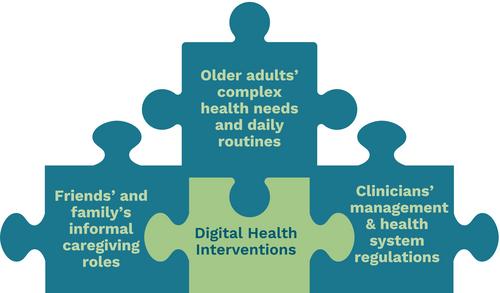
Human-centered design is a well-established methodology that centralizes the perspectives of all target users throughout the design process to increase uptake and engagement of digital solutions. This makes human-centered design an apt approach for designing digital tools to overcome implementation problems and account for older adults' individual and contextual considerations, as shown in Figure 1. To date, significant attention has been directed at addressing DHI usability among older adults (e.g., increasing color contrast and font size). However, usability alone will not solve the broader implementation problems of low DHI adoption and acceptability. With strides underway to enable DHI reimbursement and greater accessibility within health care, the time is ripe to embrace a different approach. To realize the true promise of DHIs among older adults, we must design for implementation.
Designing for implementation requires deeply understanding and accounting for the specific needs and day-to-day circumstances of older adults. For instance, compared with younger adults, older adults often face unique health challenges, such as frequently managing multiple chronic conditions and having reduced mobility. Older adults also often experience unique role transitions (e.g., retirement), isolation, and cognitive changes. Consequently, the clinical recommendations and features of DHIs must account for these distinctive circumstances. For example, DHIs typically target a singular primary health problem (e.g., depression, diabetes). Yet this approach may not be as useful for older adults compared with a DHI that can support users in managing multiple health issues concurrently, and/or that accounts for other healthcare recommendations that older adults may be balancing. Further, the standard “there's an app for that” approach may contribute to lower adoption in this population, because the high treatment burden associated with multimorbidity, coupled with cognitive decline, may reduce older adults' self-efficacy and therefore willingness to adopt and use multiple DHIs.
Human-centered design can help DHI designers learn the unique factors in older adults' lives that impact DHI implementation and prioritize features that would be most useful and acceptable. Given that older adults comprise a highly heterogenous population in terms of health, social, and technology needs and preferences, human-centered design methods can help DHI designers grasp the range of those experiences and design DHIs accordingly. Adopting a design for implementation approach can also help designers learn optimal pathways to introduce DHIs to older adults (i.e., dissemination strategies) to promote DHI awareness and adoption.
Designing DHIs for implementation also means accounting for the other individuals who are engaged in older adults' care. One such group are informal caregivers, including loved ones and family members, who are often a primary source of support for older adults as they age.8 The involvement of informal caregivers is unique compared with younger adults, making this an important implementation consideration so that DHIs integrate into older adults' routine contexts (e.g., at home). Specifically, informal caregivers often assist older adults in health monitoring and decision-making, and help them implement clinical recommendations within their daily routines. Consequently, caregivers could be involved with using a DHI (e.g., by inputting information) or be impacted by a DHI (e.g., by receiving information to facilitate their role providing health monitoring and support).
Caregivers may also be key partners for addressing implementation problems of low DHI awareness and adoption. It is important to consider their perspectives during design processes because caregivers may act as gatekeepers to older adults' adoption of a DHI, or could alternatively facilitate adoption by providing technical support and encouragement to improve older adults' self-efficacy to use digital tools.
Consequently, designers would benefit from engaging informal caregivers in DHI design processes to identify implementation considerations such as these. This entails learning ways that caregivers perceive a DHI could fit into older adults' daily lives and bridge care gaps, as well as how a DHI could support their own role within older adults' care management. Older adults would also necessarily remain involved in these design processes, to learn what and how much information from the DHI they want shared with their informal caregivers, because privacy and independence are highly important to older adults.
Clinicians play another integral role in older adults' care management, making them critical informants when designing DHIs for implementation. Compared with younger adults, older adults more frequently have multiple clinicians collaborating on their care; they also experience more frequent transitions between care settings and/or clinics, due to factors such as their chronic health conditions and acute health events. This context creates unique opportunities for DHIs to add value by integrating into existing care systems. Specifically, DHIs have the potential to be a valuable throughput for remote patient monitoring, which may reduce requisite in-person visits, benefiting patients with reduced mobility, and facilitate information-sharing across clinicians and clinical services, which can improve care coordination.9 Yet clinicians may be (justifiably) wary of implementing new tools in their practice that pose additional burden without adequate design considerations of if and how such tools fit within existing workflows. Additionally, because clinicians are trusted sources from whom older adults regularly seek health information, they are well-positioned to improve low DHI awareness and adoption rates by introducing older adults to DHIs and building their self-efficacy through DHI endorsements and/or training. However, clinicians' referral decisions may be shaped by concerns about DHI efficacy—which research must continue investigating—as well as the perception among some clinicians that DHIs are not appropriate for older adults, a bias that has reduced DHI referrals to older adults.10
To address these implementation barriers and design DHIs that integrate into clinical contexts, engagement with clinicians during the design process is critical. Specifically, designing DHIs with clinicians and within the settings where DHIs will be implemented can improve clinicians' acceptance of DHIs5 and their delivery to older adults. Design work can inform opportunities to deliver value for clinicians without overtaxing them by learning what information clinicians want from DHIs and identifying optimal workflows to support DHI implementation, namely including referral processes (e.g., when during the clinical encounter to offer a DHI) and clinical protocols related to patient engagement and monitoring (e.g., responsibilities when concerning data are reported in the DHI). Integrating DHI data into patients' electronic health records is a key opportunity, which can be optimized through designing for implementation (e.g., by mapping requirements for DHI integration). Additionally, design efforts should explore implementation strategies to improve clinicians' perceptions of DHIs for older adults, given that clinicians' perceptions of interventions impact referral decisions.11
Additional members of the healthcare system also offer critical insights for DHI design and implementation. DHI design processes would benefit from engagement with healthcare leaders, who may make decisions about adopting DHIs; payors, who make decisions about reimbursing DHIs; compliance teams, who oversee regulatory and liability-related considerations and ethical safeguards associated with integrating new interventions into practice (including potential conflicts of interest depending on a clinician's relationship with or knowledge of a DHI); and informatics professionals, whose expertise is required to facilitate referral pathways to the DHI, as well as data sharing (e.g., via patients' electronic health records).
IRR and AKG conceptualized the manuscript, prepared the first draft, and reviewed and edited subsequent drafts; MLT provided critical review and editing of subsequent drafts.
The authors have no conflicts of interest to declare.
Not applicable.
This manuscript was not funded by a specific grant from any funding agency.
期刊介绍:
Journal of the American Geriatrics Society (JAGS) is the go-to journal for clinical aging research. We provide a diverse, interprofessional community of healthcare professionals with the latest insights on geriatrics education, clinical practice, and public policy—all supporting the high-quality, person-centered care essential to our well-being as we age. Since the publication of our first edition in 1953, JAGS has remained one of the oldest and most impactful journals dedicated exclusively to gerontology and geriatrics.





 京公网安备 11010802042870号
京ICP备2023020795号-1
京公网安备 11010802042870号
京ICP备2023020795号-1

 分享
分享

 求助内容:
求助内容: 应助结果提醒方式:
 扫码关注我们
