Interspecific competition and adaptation of anammox bacteria at different salinities: Experimental validation of the Monod growth model with salinity inhibition
{"title":"Interspecific competition and adaptation of anammox bacteria at different salinities: Experimental validation of the Monod growth model with salinity inhibition","authors":"Satoshi Okabe , Akimichi Kamizono , Seiya Kawasaki , Kanae Kobayashi , Mamoru Oshiki","doi":"10.1016/j.watres.2024.122883","DOIUrl":null,"url":null,"abstract":"<div><div>Ecological niche segregation of anaerobic ammonium oxidizing (anammox) bacteria under saline environments remains unresolved despite its ecological and practical importance. In this study, niche segregation by salinity for <em>Ca</em>. Brocadia sinica, <em>Ca</em>. Jettenia caeni, <em>Ca</em>. Kuenenia stuttgartiensis and <em>Ca</em>. Scalindua sp. was systematically studied. The inhibitory effect of salinity on specific anammox activity (SAA) was measured experimentally and model-fitted to obtain the salinity-dependent maximum specific growth rates (µ<sub>max</sub>). The resulting µ<sub>max</sub> were incorporated into a Monod growth model with nitrite as the limiting substrate to predict which anammox bacterial species would dominate at a given salinity. The model predictions revealed that there were threshold salinity ranges where specific growth rates were comparable and the determining factor for the dominant species was the availability of nitrite. <em>Ca</em>. B sinica, <em>Ca</em>. J. caeni, and <em>Ca</em>. K. stuttgartiensis could compete at 0 - 0.5% salinity, while <em>Ca</em>. K. stuttgartiensis and <em>Ca</em>. Scalindua sp. could coexist at around 2% salinity. The model prediction was validated by conducting interspecific competition experiments among the four anammox species in nitrite-limiting membrane bioreactors (MBRs) under different salinity concentrations. The interspecific competition experiments showed that <em>Ca</em>. K. stuttgartiensis with relatively high affinity for nitrite was dominant at a wide range of salinities from 0.25 to 1.75%. Outside this salinity range, <em>Ca</em>. B. sinica was dominant at salinity 0 %, and <em>Ca</em>. Scalindua sp. outcompeted exclusively the other species due to its high salinity tolerance at salinities above 2.0%. These experimental results are in good agreement with the model predictions, demonstrating the validity of the Monod model in accounting for salinity inhibition and reflecting the salinity-dependent distributions of anammox bacteria reported in a variety of engineered and natural saline environments.</div></div>","PeriodicalId":443,"journal":{"name":"Water Research","volume":"271 ","pages":"Article 122883"},"PeriodicalIF":12.4000,"publicationDate":"2025-03-01","publicationTypes":"Journal Article","fieldsOfStudy":null,"isOpenAccess":false,"openAccessPdf":"","citationCount":"0","resultStr":null,"platform":"Semanticscholar","paperid":null,"PeriodicalName":"Water Research","FirstCategoryId":"93","ListUrlMain":"https://www.sciencedirect.com/science/article/pii/S0043135424017834","RegionNum":1,"RegionCategory":"环境科学与生态学","ArticlePicture":[],"TitleCN":null,"AbstractTextCN":null,"PMCID":null,"EPubDate":"2024/11/29 0:00:00","PubModel":"Epub","JCR":"Q1","JCRName":"ENGINEERING, ENVIRONMENTAL","Score":null,"Total":0}
引用次数: 0
Abstract
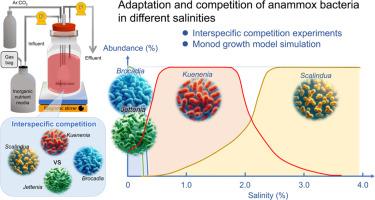
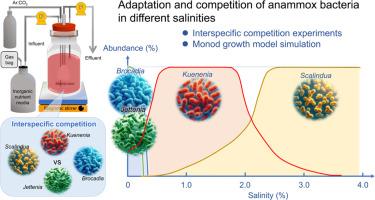
Ecological niche segregation of anaerobic ammonium oxidizing (anammox) bacteria under saline environments remains unresolved despite its ecological and practical importance. In this study, niche segregation by salinity for Ca. Brocadia sinica, Ca. Jettenia caeni, Ca. Kuenenia stuttgartiensis and Ca. Scalindua sp. was systematically studied. The inhibitory effect of salinity on specific anammox activity (SAA) was measured experimentally and model-fitted to obtain the salinity-dependent maximum specific growth rates (µmax). The resulting µmax were incorporated into a Monod growth model with nitrite as the limiting substrate to predict which anammox bacterial species would dominate at a given salinity. The model predictions revealed that there were threshold salinity ranges where specific growth rates were comparable and the determining factor for the dominant species was the availability of nitrite. Ca. B sinica, Ca. J. caeni, and Ca. K. stuttgartiensis could compete at 0 - 0.5% salinity, while Ca. K. stuttgartiensis and Ca. Scalindua sp. could coexist at around 2% salinity. The model prediction was validated by conducting interspecific competition experiments among the four anammox species in nitrite-limiting membrane bioreactors (MBRs) under different salinity concentrations. The interspecific competition experiments showed that Ca. K. stuttgartiensis with relatively high affinity for nitrite was dominant at a wide range of salinities from 0.25 to 1.75%. Outside this salinity range, Ca. B. sinica was dominant at salinity 0 %, and Ca. Scalindua sp. outcompeted exclusively the other species due to its high salinity tolerance at salinities above 2.0%. These experimental results are in good agreement with the model predictions, demonstrating the validity of the Monod model in accounting for salinity inhibition and reflecting the salinity-dependent distributions of anammox bacteria reported in a variety of engineered and natural saline environments.
厌氧氨氧化(anammox)细菌在盐碱环境下的生态位分离虽然具有重要的生态学和实际意义,但仍未得到解决。本研究系统地研究了盐胁迫下草甘膦(Ca. Brocadia sinica, Ca. Jettenia caeni)、库恩尼亚(Ca. Kuenenia stuttgartiensis)和Scalindua sp.的生态位分离。盐度对特定厌氧氨氧化活性(SAA)的抑制作用通过实验测量和模型拟合得到盐度依赖性最大特定生长速率(µmax)。将所得的µmax纳入以亚硝酸盐为限制底物的Monod生长模型中,以预测在给定盐度下哪些厌氧氨氧化细菌种类将占主导地位。模型预测显示,存在特定生长速率可比较的阈值盐度范围,优势种的决定因素是亚硝酸盐的可用性。Ca. B . sinica、Ca. J. caeni和Ca. K. stuttgartiensis可以在0 ~ 0.5%盐度下竞争,而Ca. K. stuttgartiensis和Ca. Scalindua sp.可以在2%盐度左右共存。通过在亚硝酸盐限制膜生物反应器(MBRs)中对4种厌氧氨氧化菌进行不同盐度浓度下的种间竞争实验,验证了模型预测的有效性。种间竞争实验表明,在0.25 ~ 1.75%的盐度范围内,对亚硝酸盐亲和力较高的斯图加蒂Ca. K. stuttgartiensis具有优势。在此盐度范围之外,Ca. B. sinica在盐度为0%时占优势,而Ca. Scalindua sp.在盐度高于2.0%时具有较高的耐盐性,因此在竞争中独占鳌头。这些实验结果与模型预测一致,证明了Monod模型在考虑盐度抑制方面的有效性,并反映了在各种工程和天然盐环境中厌氧氨氧化菌的盐度依赖分布。
期刊介绍:
Water Research, along with its open access companion journal Water Research X, serves as a platform for publishing original research papers covering various aspects of the science and technology related to the anthropogenic water cycle, water quality, and its management worldwide. The audience targeted by the journal comprises biologists, chemical engineers, chemists, civil engineers, environmental engineers, limnologists, and microbiologists. The scope of the journal include:
•Treatment processes for water and wastewaters (municipal, agricultural, industrial, and on-site treatment), including resource recovery and residuals management;
•Urban hydrology including sewer systems, stormwater management, and green infrastructure;
•Drinking water treatment and distribution;
•Potable and non-potable water reuse;
•Sanitation, public health, and risk assessment;
•Anaerobic digestion, solid and hazardous waste management, including source characterization and the effects and control of leachates and gaseous emissions;
•Contaminants (chemical, microbial, anthropogenic particles such as nanoparticles or microplastics) and related water quality sensing, monitoring, fate, and assessment;
•Anthropogenic impacts on inland, tidal, coastal and urban waters, focusing on surface and ground waters, and point and non-point sources of pollution;
•Environmental restoration, linked to surface water, groundwater and groundwater remediation;
•Analysis of the interfaces between sediments and water, and between water and atmosphere, focusing specifically on anthropogenic impacts;
•Mathematical modelling, systems analysis, machine learning, and beneficial use of big data related to the anthropogenic water cycle;
•Socio-economic, policy, and regulations studies.



 京公网安备 11010802042870号
京ICP备2023020795号-1
京公网安备 11010802042870号
京ICP备2023020795号-1

 分享
分享
 求助内容:
求助内容: 应助结果提醒方式:
 扫码关注我们
