Daniel S. Doretto, Paula C. R. Corsato, Christian O. Silva, James C. Pessoa, Luis C. S. Vieira, William R. de Araújo, Flávio M. Shimizu, Maria H. O. Piazzetta, Angelo L. Gobbi, Iris R. S. Ribeiro, Renato S. Lima
{"title":"Ultradense Electrochemical Chip and Machine Learning for High-Throughput, Accurate Anticancer Drug Screening","authors":"Daniel S. Doretto, Paula C. R. Corsato, Christian O. Silva, James C. Pessoa, Luis C. S. Vieira, William R. de Araújo, Flávio M. Shimizu, Maria H. O. Piazzetta, Angelo L. Gobbi, Iris R. S. Ribeiro, Renato S. Lima","doi":"10.1021/acssensors.4c02298","DOIUrl":null,"url":null,"abstract":"Despite the potentialities of electrochemical sensors, these devices still encounter challenges in devising high-throughput and accurate drug susceptibility testing. The lack of platforms for providing these analyses over the preclinical trials of drug candidates remains a significant barrier to developing medicines. In this way, ultradense electrochemical chips are combined with machine learning (ML) to enable high-throughput, user-friendly, and accurate determination of the viability of 2D tumor cells (breast and colorectal) aiming at drug susceptibility assays. The effect of doxorubicin (anticancer drug model) was assessed through cell detachment electrochemical assays by interrogating Ru(NH<sub>3</sub>)<sub>6</sub><sup>3+</sup> with square wave voltammetry (SWV). This positive probe is presumed to imply sensitive monitoring of the on-sensor cellular death because of its electrostatic preconcentration in the so-called nanogap zone between the electrode surface and adherent cells. High-throughput assays were obtained by merging fast individual SWV measurements (9 s) with the ability of chips to yield analyses of Ru(NH<sub>3</sub>)<sub>6</sub><sup>3+</sup> in series. The approach’s applicability was demonstrated across two analysis formats, drop-casting and microfluidic assays. One should also mention that fitting a multivariate descriptor from selected input data via ML proved to be essential to providing accurate determinations (98 to 104%) of cell viability and half-maximal lethal concentration of the drug. The achieved results underscore the potential of the method in steering electrochemical sensors toward enabling high-throughput drug screening in practical applications.","PeriodicalId":24,"journal":{"name":"ACS Sensors","volume":"259 1","pages":""},"PeriodicalIF":9.1000,"publicationDate":"2024-11-29","publicationTypes":"Journal Article","fieldsOfStudy":null,"isOpenAccess":false,"openAccessPdf":"","citationCount":"0","resultStr":null,"platform":"Semanticscholar","paperid":null,"PeriodicalName":"ACS Sensors","FirstCategoryId":"92","ListUrlMain":"https://doi.org/10.1021/acssensors.4c02298","RegionNum":1,"RegionCategory":"化学","ArticlePicture":[],"TitleCN":null,"AbstractTextCN":null,"PMCID":null,"EPubDate":"","PubModel":"","JCR":"Q1","JCRName":"CHEMISTRY, ANALYTICAL","Score":null,"Total":0}
引用次数: 0
Abstract
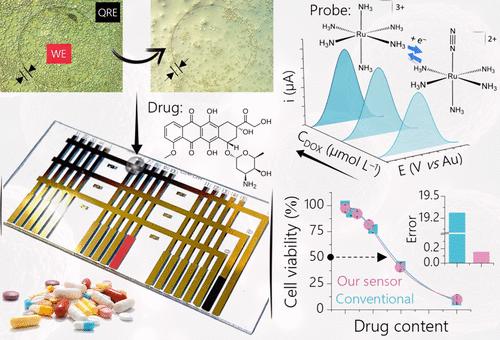
Despite the potentialities of electrochemical sensors, these devices still encounter challenges in devising high-throughput and accurate drug susceptibility testing. The lack of platforms for providing these analyses over the preclinical trials of drug candidates remains a significant barrier to developing medicines. In this way, ultradense electrochemical chips are combined with machine learning (ML) to enable high-throughput, user-friendly, and accurate determination of the viability of 2D tumor cells (breast and colorectal) aiming at drug susceptibility assays. The effect of doxorubicin (anticancer drug model) was assessed through cell detachment electrochemical assays by interrogating Ru(NH3)63+ with square wave voltammetry (SWV). This positive probe is presumed to imply sensitive monitoring of the on-sensor cellular death because of its electrostatic preconcentration in the so-called nanogap zone between the electrode surface and adherent cells. High-throughput assays were obtained by merging fast individual SWV measurements (9 s) with the ability of chips to yield analyses of Ru(NH3)63+ in series. The approach’s applicability was demonstrated across two analysis formats, drop-casting and microfluidic assays. One should also mention that fitting a multivariate descriptor from selected input data via ML proved to be essential to providing accurate determinations (98 to 104%) of cell viability and half-maximal lethal concentration of the drug. The achieved results underscore the potential of the method in steering electrochemical sensors toward enabling high-throughput drug screening in practical applications.
期刊介绍:
ACS Sensors is a peer-reviewed research journal that focuses on the dissemination of new and original knowledge in the field of sensor science, particularly those that selectively sense chemical or biological species or processes. The journal covers a broad range of topics, including but not limited to biosensors, chemical sensors, gas sensors, intracellular sensors, single molecule sensors, cell chips, and microfluidic devices. It aims to publish articles that address conceptual advances in sensing technology applicable to various types of analytes or application papers that report on the use of existing sensing concepts in new ways or for new analytes.



 京公网安备 11010802042870号
京ICP备2023020795号-1
京公网安备 11010802042870号
京ICP备2023020795号-1

 分享
分享
 求助内容:
求助内容: 应助结果提醒方式:
 扫码关注我们
