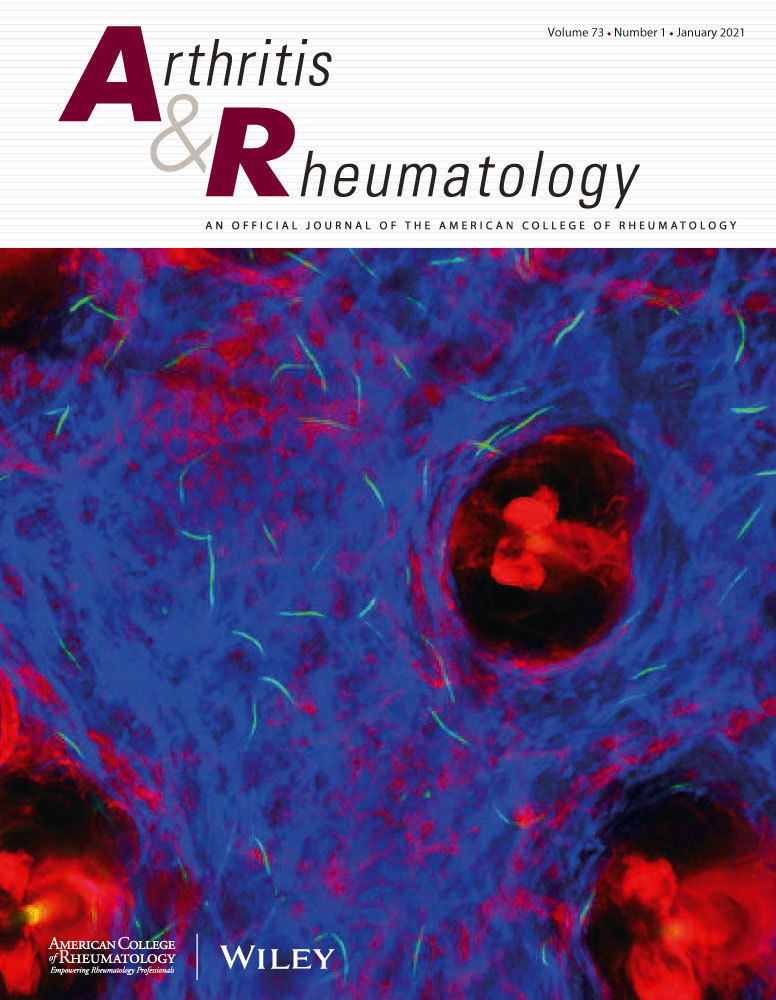
Vibha Jha, Brian M. Freed, Elizabeth R. Sunderhaus, Jessica E. Lee, Edward B. Prage, Manjula Miglani, Edward F. Rosloniec, Jennifer L. Matsuda, Marilyne G. Coulombe, Amy S. McKee, Christina L. Roark
{"title":"Substitution of Glutamic Acid at Position 71 of DRβ1*04:01 and Collagen-Specific Tolerance Without Alloreactivity","authors":"Vibha Jha, Brian M. Freed, Elizabeth R. Sunderhaus, Jessica E. Lee, Edward B. Prage, Manjula Miglani, Edward F. Rosloniec, Jennifer L. Matsuda, Marilyne G. Coulombe, Amy S. McKee, Christina L. Roark","doi":"10.1002/art.43067","DOIUrl":null,"url":null,"abstract":"<div>\n \n <section>\n \n <h3> Objective</h3>\n \n <p>The <i>DRB1</i> locus is strongly associated with both susceptibility and resistance to rheumatoid arthritis (RA). <i>DRB1</i> alleles encoding the VKA or VRA epitope in positions 11, 71, and 74 confer the highest risk of developing RA, whereas the allele encoding VEA is protective. We therefore investigated the feasibility of creating antigen-specific tolerance without inducing alloreactivity by replacing lysine with glutamic acid at position 71 in <i>DRβ1</i>*04:01.</p>\n </section>\n \n <section>\n \n <h3> Methods</h3>\n \n <p>Individual <i>DRB1</i> alleles and the <i>DRB1</i>*04:01<sup>K71E</sup> allele were cloned into T2 cell lines to measure binding of biotinylated peptides. Transgenic animals expressing <i>DRB1</i>*04:01, <i>DRB1</i>*01:01, or <i>DRB1</i>*04:01<sup>K71E</sup> were injected with collagen to measure T cell proliferation. Skin and bone marrow transplants between <i>DRB1</i>*04:01<sup>K71E</sup> and <i>DRB1</i>*04:01 mice were performed to determine if the single amino acid change at position 71 would be recognized as foreign. <i>DRB1</i>*04:01 mice transplanted with <i>DRB1</i>*04:01<sup>K71E</sup> bone marrow were injected with collagen to test if resistance to collagen sensitization could be transferred.</p>\n </section>\n \n <section>\n \n <h3> Results</h3>\n \n <p>Replacing lysine (K) at position 71 in <i>DRβ1</i>*04:01 with glutamic acid (E) blocked collagen peptide binding and rendered the <i>DRB1</i>*04:01<sup>K71E</sup> mice resistant to collagen sensitization. Skin and bone marrow transplants from <i>DRB1</i>*04:01<sup>K71E</sup> mice were not rejected by <i>DRB1</i>*04:01 mice, suggesting the single E<sup>71</sup> difference was not recognized as allogeneic. Bone marrow from <i>DRB1</i>*04:01<sup>K71E</sup> mice adoptively transferred antigen-specific tolerance to collagen to <i>DRB1</i>*04:01 mice.</p>\n </section>\n \n <section>\n \n <h3> Conclusion</h3>\n \n <p>These studies demonstrate that editing a single amino acid in <i>DRβ1</i>*04:01 blocks collagen peptide binding without inducing alloreactivity and could therefore represent a gene therapy approach to induce antigen-specific passive tolerance.</p>\n </section>\n </div>","PeriodicalId":129,"journal":{"name":"Arthritis & Rheumatology","volume":"77 5","pages":"526-535"},"PeriodicalIF":10.9000,"publicationDate":"2024-11-28","publicationTypes":"Journal Article","fieldsOfStudy":null,"isOpenAccess":false,"openAccessPdf":"https://onlinelibrary.wiley.com/doi/epdf/10.1002/art.43067","citationCount":"0","resultStr":null,"platform":"Semanticscholar","paperid":null,"PeriodicalName":"Arthritis & Rheumatology","FirstCategoryId":"3","ListUrlMain":"https://acrjournals.onlinelibrary.wiley.com/doi/10.1002/art.43067","RegionNum":1,"RegionCategory":"医学","ArticlePicture":[],"TitleCN":null,"AbstractTextCN":null,"PMCID":null,"EPubDate":"","PubModel":"","JCR":"Q1","JCRName":"RHEUMATOLOGY","Score":null,"Total":0}
引用次数: 0
Abstract
Objective
The DRB1 locus is strongly associated with both susceptibility and resistance to rheumatoid arthritis (RA). DRB1 alleles encoding the VKA or VRA epitope in positions 11, 71, and 74 confer the highest risk of developing RA, whereas the allele encoding VEA is protective. We therefore investigated the feasibility of creating antigen-specific tolerance without inducing alloreactivity by replacing lysine with glutamic acid at position 71 in DRβ1*04:01.
Methods
Individual DRB1 alleles and the DRB1*04:01K71E allele were cloned into T2 cell lines to measure binding of biotinylated peptides. Transgenic animals expressing DRB1*04:01, DRB1*01:01, or DRB1*04:01K71E were injected with collagen to measure T cell proliferation. Skin and bone marrow transplants between DRB1*04:01K71E and DRB1*04:01 mice were performed to determine if the single amino acid change at position 71 would be recognized as foreign. DRB1*04:01 mice transplanted with DRB1*04:01K71E bone marrow were injected with collagen to test if resistance to collagen sensitization could be transferred.
Results
Replacing lysine (K) at position 71 in DRβ1*04:01 with glutamic acid (E) blocked collagen peptide binding and rendered the DRB1*04:01K71E mice resistant to collagen sensitization. Skin and bone marrow transplants from DRB1*04:01K71E mice were not rejected by DRB1*04:01 mice, suggesting the single E71 difference was not recognized as allogeneic. Bone marrow from DRB1*04:01K71E mice adoptively transferred antigen-specific tolerance to collagen to DRB1*04:01 mice.
Conclusion
These studies demonstrate that editing a single amino acid in DRβ1*04:01 blocks collagen peptide binding without inducing alloreactivity and could therefore represent a gene therapy approach to induce antigen-specific passive tolerance.
期刊介绍:
Arthritis & Rheumatology is the official journal of the American College of Rheumatology and focuses on the natural history, pathophysiology, treatment, and outcome of rheumatic diseases. It is a peer-reviewed publication that aims to provide the highest quality basic and clinical research in this field. The journal covers a wide range of investigative areas and also includes review articles, editorials, and educational material for researchers and clinicians. Being recognized as a leading research journal in rheumatology, Arthritis & Rheumatology serves the global community of rheumatology investigators and clinicians.