Dispersive solid phase extraction and quadruple isotope dilution–mass spectrometry combination for the accurate and sensitive quantification of capsaicin in pepper, domestic wastewater and human saliva samples by GC–MS system
Süleyman Bodur , Sezin Erarpat Bodur , Selim Gürsoy , Merve Fırat Ayyıldız , Bedrihan Kartoğlu , Hilal Akbıyık , Ömer Tahir Günkara , Sezgin Bakırdere
{"title":"Dispersive solid phase extraction and quadruple isotope dilution–mass spectrometry combination for the accurate and sensitive quantification of capsaicin in pepper, domestic wastewater and human saliva samples by GC–MS system","authors":"Süleyman Bodur , Sezin Erarpat Bodur , Selim Gürsoy , Merve Fırat Ayyıldız , Bedrihan Kartoğlu , Hilal Akbıyık , Ömer Tahir Günkara , Sezgin Bakırdere","doi":"10.1016/j.microc.2024.112246","DOIUrl":null,"url":null,"abstract":"<div><div>In the presented study, reduced graphene oxide/Fe<sub>3</sub>O<sub>4</sub> (rGO/Fe<sub>3</sub>O<sub>4</sub>) nanocomposites based dispersive solid phase extraction (DSPE) – gas chromatography–mass spectrometry (GC–MS) method was developed for the determination of capsaicin in domestic wastewater (DW), pepper (PP) and human saliva (HS) samples. All important parameters of the DSPE method affected the preconcentration factor were carefully optimized to achieve high signal to noise ratio for the analyte. After the optimization studies, the system analytical performance of DSPE-GC–MS system was evaluated using the aqueous standard solution of capsaicin. Limit of detection (LOD), limit of quantitation (LOQ) and dynamic range were figured out to be 0.54 µg/kg, 1.80 µg/kg and 2.66 – 487.35 µg/kg, respectively. Under the optimum experimental conditions, recovery studies were conducted with the spiked DW, PP and HS samples, and percent recovery results were recorded between 52.6 % and 183.6 % via matrix matching calibration strategy. After the implementation of ID<sup>4</sup> strategy, percent recovery results for the spiked DW, PP and HS samples were calculated as 98.2 %–99.3 %, 99.7 %–100.7 % and 99.4 %–99.8 %, respectively. In addition, capsaicin content in Sivri (S)-PP, Kıl (K)-PP and Samandağ (SA)-PP samples were found to be 309.5 ± 11.8 mg/kg, 873.7 ± 26.7 mg/kg and 165.3 ± 5.1 mg/kg via DSPE-GC-ID<sup>4</sup>-MS method, respectively. As a result, the combination of quadruple isotope dilution (ID<sup>4</sup>) strategy and the DSPE-GC–MS method were successfully performed to boost the accuracy and precision of developed DSPE-GC–MS method.</div></div>","PeriodicalId":391,"journal":{"name":"Microchemical Journal","volume":"208 ","pages":"Article 112246"},"PeriodicalIF":4.9000,"publicationDate":"2025-01-01","publicationTypes":"Journal Article","fieldsOfStudy":null,"isOpenAccess":false,"openAccessPdf":"","citationCount":"0","resultStr":null,"platform":"Semanticscholar","paperid":null,"PeriodicalName":"Microchemical Journal","FirstCategoryId":"92","ListUrlMain":"https://www.sciencedirect.com/science/article/pii/S0026265X24023580","RegionNum":2,"RegionCategory":"化学","ArticlePicture":[],"TitleCN":null,"AbstractTextCN":null,"PMCID":null,"EPubDate":"2024/11/23 0:00:00","PubModel":"Epub","JCR":"Q1","JCRName":"CHEMISTRY, ANALYTICAL","Score":null,"Total":0}
引用次数: 0
Abstract
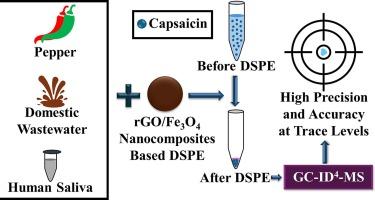
In the presented study, reduced graphene oxide/Fe3O4 (rGO/Fe3O4) nanocomposites based dispersive solid phase extraction (DSPE) – gas chromatography–mass spectrometry (GC–MS) method was developed for the determination of capsaicin in domestic wastewater (DW), pepper (PP) and human saliva (HS) samples. All important parameters of the DSPE method affected the preconcentration factor were carefully optimized to achieve high signal to noise ratio for the analyte. After the optimization studies, the system analytical performance of DSPE-GC–MS system was evaluated using the aqueous standard solution of capsaicin. Limit of detection (LOD), limit of quantitation (LOQ) and dynamic range were figured out to be 0.54 µg/kg, 1.80 µg/kg and 2.66 – 487.35 µg/kg, respectively. Under the optimum experimental conditions, recovery studies were conducted with the spiked DW, PP and HS samples, and percent recovery results were recorded between 52.6 % and 183.6 % via matrix matching calibration strategy. After the implementation of ID4 strategy, percent recovery results for the spiked DW, PP and HS samples were calculated as 98.2 %–99.3 %, 99.7 %–100.7 % and 99.4 %–99.8 %, respectively. In addition, capsaicin content in Sivri (S)-PP, Kıl (K)-PP and Samandağ (SA)-PP samples were found to be 309.5 ± 11.8 mg/kg, 873.7 ± 26.7 mg/kg and 165.3 ± 5.1 mg/kg via DSPE-GC-ID4-MS method, respectively. As a result, the combination of quadruple isotope dilution (ID4) strategy and the DSPE-GC–MS method were successfully performed to boost the accuracy and precision of developed DSPE-GC–MS method.
期刊介绍:
The Microchemical Journal is a peer reviewed journal devoted to all aspects and phases of analytical chemistry and chemical analysis. The Microchemical Journal publishes articles which are at the forefront of modern analytical chemistry and cover innovations in the techniques to the finest possible limits. This includes fundamental aspects, instrumentation, new developments, innovative and novel methods and applications including environmental and clinical field.
Traditional classical analytical methods such as spectrophotometry and titrimetry as well as established instrumentation methods such as flame and graphite furnace atomic absorption spectrometry, gas chromatography, and modified glassy or carbon electrode electrochemical methods will be considered, provided they show significant improvements and novelty compared to the established methods.



 京公网安备 11010802042870号
京ICP备2023020795号-1
京公网安备 11010802042870号
京ICP备2023020795号-1

 分享
分享
 求助内容:
求助内容: 应助结果提醒方式:
 扫码关注我们
