Hoai Van T. Nguyen , Hee Jin Han , Euna Choi , Yong Ho Lee , Kyung-Koo Lee
{"title":"Implementation of phosphonium salt for high-performance supercapacitors from room to ultra-low temperature conditions","authors":"Hoai Van T. Nguyen , Hee Jin Han , Euna Choi , Yong Ho Lee , Kyung-Koo Lee","doi":"10.1016/j.est.2024.114750","DOIUrl":null,"url":null,"abstract":"<div><div>Conventional supercapacitors encounter limitations in operating voltage and performance at low temperatures due to poor ionic conductivity and diminished interfacial dynamics in electrolytes. In this study, we synthesized the phosphonium salt 5-phosphinaspiro[4.4] nonane tetrafluoroborate (PSNBF<sub>4</sub>) for the first time. We extensively characterized the physical and electrochemical properties of PSNBF<sub>4</sub> in acetonitrile (AN) and propionitrile (PN) as electrolytes, assessing their performance in supercapacitors at room temperature and − 40 °C. The results demonstrate PSNBF<sub>4</sub> electrolytes exhibit high solubility, outstanding ionic conductivity (1 M PSNBF<sub>4</sub>/AN: 49.8 mS cm<sup>−1</sup>; 1 M PSNBF<sub>4</sub>/PN: 27.5 mS cm<sup>−1</sup>), and high electrochemical stability, contributing to good capacitance retention after 500 h of floating tests at 25 °C. Supercapacitors using PSNBF<sub>4</sub>/AN retained 78 % of their capacitance at 3.1 V, whereas those with PSNBF<sub>4</sub>/PN maintained 68 % at 3.2 V. Impressively, these supercapacitors performed exceptionally well at −40 °C, displaying excellent cycle stability and high capacitance retention at elevated voltages. Supercapacitors with PSNBF<sub>4</sub>/AN retain 96.6 % of their capacitance at 3.2 V, while PSNBF<sub>4</sub>/PN retained 93.4 % of their capacitance at 3.4 V after floating for 500 h. These results demonstrate PSNBF<sub>4</sub>-based supercapacitors can operate effectively at high voltages in both room and extremely low temperatures, addressing a significant challenge in commercial supercapacitor applications.</div></div>","PeriodicalId":15942,"journal":{"name":"Journal of energy storage","volume":"106 ","pages":"Article 114750"},"PeriodicalIF":8.9000,"publicationDate":"2025-01-15","publicationTypes":"Journal Article","fieldsOfStudy":null,"isOpenAccess":false,"openAccessPdf":"","citationCount":"0","resultStr":null,"platform":"Semanticscholar","paperid":null,"PeriodicalName":"Journal of energy storage","FirstCategoryId":"5","ListUrlMain":"https://www.sciencedirect.com/science/article/pii/S2352152X24043366","RegionNum":2,"RegionCategory":"工程技术","ArticlePicture":[],"TitleCN":null,"AbstractTextCN":null,"PMCID":null,"EPubDate":"2024/11/29 0:00:00","PubModel":"Epub","JCR":"Q1","JCRName":"ENERGY & FUELS","Score":null,"Total":0}
引用次数: 0
Abstract
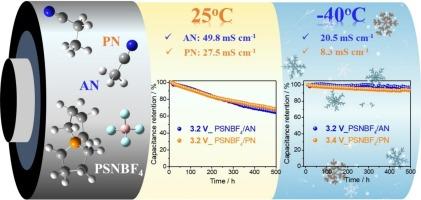
Conventional supercapacitors encounter limitations in operating voltage and performance at low temperatures due to poor ionic conductivity and diminished interfacial dynamics in electrolytes. In this study, we synthesized the phosphonium salt 5-phosphinaspiro[4.4] nonane tetrafluoroborate (PSNBF4) for the first time. We extensively characterized the physical and electrochemical properties of PSNBF4 in acetonitrile (AN) and propionitrile (PN) as electrolytes, assessing their performance in supercapacitors at room temperature and − 40 °C. The results demonstrate PSNBF4 electrolytes exhibit high solubility, outstanding ionic conductivity (1 M PSNBF4/AN: 49.8 mS cm−1; 1 M PSNBF4/PN: 27.5 mS cm−1), and high electrochemical stability, contributing to good capacitance retention after 500 h of floating tests at 25 °C. Supercapacitors using PSNBF4/AN retained 78 % of their capacitance at 3.1 V, whereas those with PSNBF4/PN maintained 68 % at 3.2 V. Impressively, these supercapacitors performed exceptionally well at −40 °C, displaying excellent cycle stability and high capacitance retention at elevated voltages. Supercapacitors with PSNBF4/AN retain 96.6 % of their capacitance at 3.2 V, while PSNBF4/PN retained 93.4 % of their capacitance at 3.4 V after floating for 500 h. These results demonstrate PSNBF4-based supercapacitors can operate effectively at high voltages in both room and extremely low temperatures, addressing a significant challenge in commercial supercapacitor applications.
由于离子电导率差和电解质界面动力学减弱,传统的超级电容器在低温下的工作电压和性能受到限制。本研究首次合成了5-膦[4.4]壬烷四氟硼酸磷盐(PSNBF4)。我们广泛表征了PSNBF4在乙腈(AN)和丙腈(PN)中作为电解质的物理和电化学性能,评估了它们在室温和- 40℃下在超级电容器中的性能。结果表明,PSNBF4电解质具有高溶解度和优异的离子电导率(1 M PSNBF4/AN: 49.8 mS cm−1;1 M PSNBF4/PN: 27.5 mS cm−1),电化学稳定性高,在25°C下漂浮测试500 h后保持良好的电容。使用PSNBF4/AN的超级电容器在3.1 V时保持了78%的电容,而使用PSNBF4/PN的超级电容器在3.2 V时保持了68%的电容。令人印象深刻的是,这些超级电容器在- 40°C下表现出色,在高压下表现出出色的循环稳定性和高电容保持性。使用PSNBF4/AN的超级电容器在3.2 V电压下仍能保持96.6%的电容,而PSNBF4/PN在悬浮500小时后仍能保持3.4 V电压下93.4%的电容。这些结果表明,基于PSNBF4的超级电容器可以在室温和极低温的高压下有效工作,解决了商业超级电容器应用中的重大挑战。
期刊介绍:
Journal of energy storage focusses on all aspects of energy storage, in particular systems integration, electric grid integration, modelling and analysis, novel energy storage technologies, sizing and management strategies, business models for operation of storage systems and energy storage developments worldwide.



 京公网安备 11010802042870号
京ICP备2023020795号-1
京公网安备 11010802042870号
京ICP备2023020795号-1

 分享
分享
 求助内容:
求助内容: 应助结果提醒方式:
 扫码关注我们
