{"title":"The neurotoxicity of acrylamide in ultra-processed foods: interventions of polysaccharides through the microbiota–gut–brain axis","authors":"Chen Cai, Zheyi Song, Xinrui Xu, Xin Yang, Siyu Wei, Fang Chen, Xu Dong, Xin Zhang and Yuchen Zhu","doi":"10.1039/D4FO03002H","DOIUrl":null,"url":null,"abstract":"<p >Ultra-processed foods (UPFs) have become popular in recent years, however, the detrimental effects of their excessive consumption have also become evident. Acrylamide (AA), a processing hazard present in UPFs, can further aggravate the harmful effects of UPFs. AA can cause significant damage to both the intestinal barrier and gut microbiota, thereby affecting the nervous system through the microbiota–gut–brain (MGB) axis. Natural polysaccharides have demonstrated the capacity to significantly alleviate the oxidative stress and inflammatory response associated with AA exposure. In addition, they exhibit neuroprotective properties that may be mediated through the MGB axis. This paper reviews literature on the presence of AA in certain UPFs and its potential to inflict serious harm on the human gut microbiota and brain. Moreover, the possibility of utilizing polysaccharides as a preventative measure against AA-induced neurotoxicity was also proposed. These findings provide new insights into the safety risks associated with the overconsumption of UPFs and highlight the potential of polysaccharides to counteract the neurodegeneration induced by AA.</p>","PeriodicalId":77,"journal":{"name":"Food & Function","volume":" 1","pages":" 10-23"},"PeriodicalIF":5.4000,"publicationDate":"2024-11-18","publicationTypes":"Journal Article","fieldsOfStudy":null,"isOpenAccess":false,"openAccessPdf":"","citationCount":"0","resultStr":null,"platform":"Semanticscholar","paperid":null,"PeriodicalName":"Food & Function","FirstCategoryId":"97","ListUrlMain":"https://pubs.rsc.org/en/content/articlelanding/2025/fo/d4fo03002h","RegionNum":1,"RegionCategory":"农林科学","ArticlePicture":[],"TitleCN":null,"AbstractTextCN":null,"PMCID":null,"EPubDate":"","PubModel":"","JCR":"Q1","JCRName":"BIOCHEMISTRY & MOLECULAR BIOLOGY","Score":null,"Total":0}
引用次数: 0
Abstract
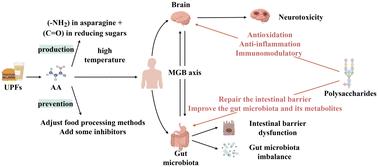
Ultra-processed foods (UPFs) have become popular in recent years, however, the detrimental effects of their excessive consumption have also become evident. Acrylamide (AA), a processing hazard present in UPFs, can further aggravate the harmful effects of UPFs. AA can cause significant damage to both the intestinal barrier and gut microbiota, thereby affecting the nervous system through the microbiota–gut–brain (MGB) axis. Natural polysaccharides have demonstrated the capacity to significantly alleviate the oxidative stress and inflammatory response associated with AA exposure. In addition, they exhibit neuroprotective properties that may be mediated through the MGB axis. This paper reviews literature on the presence of AA in certain UPFs and its potential to inflict serious harm on the human gut microbiota and brain. Moreover, the possibility of utilizing polysaccharides as a preventative measure against AA-induced neurotoxicity was also proposed. These findings provide new insights into the safety risks associated with the overconsumption of UPFs and highlight the potential of polysaccharides to counteract the neurodegeneration induced by AA.
期刊介绍:
Food & Function provides a unique venue for physicists, chemists, biochemists, nutritionists and other food scientists to publish work at the interface of the chemistry, physics and biology of food. The journal focuses on food and the functions of food in relation to health.




 京公网安备 11010802042870号
京ICP备2023020795号-1
京公网安备 11010802042870号
京ICP备2023020795号-1

 分享
分享
 求助内容:
求助内容: 应助结果提醒方式:
 扫码关注我们
