Associations Between Polyphenol Intake, Cardiometabolic Risk Factors and Metabolic Syndrome in the Brazilian Longitudinal Study of Adult Health (ELSA-Brasil)
Renata A Carnauba , Flavia M Sarti , Camille P Coutinho , Neuza MA Hassimotto , Dirce M Marchioni , Paulo A Lotufo , Isabela M Bensenor , Franco M Lajolo
{"title":"Associations Between Polyphenol Intake, Cardiometabolic Risk Factors and Metabolic Syndrome in the Brazilian Longitudinal Study of Adult Health (ELSA-Brasil)","authors":"Renata A Carnauba , Flavia M Sarti , Camille P Coutinho , Neuza MA Hassimotto , Dirce M Marchioni , Paulo A Lotufo , Isabela M Bensenor , Franco M Lajolo","doi":"10.1016/j.tjnut.2024.11.016","DOIUrl":null,"url":null,"abstract":"<div><h3>Background</h3><div>Fruit- and vegetable-rich diets may protect against metabolic syndrome (MetS), partly due to their high polyphenol content.</div></div><div><h3>Objectives</h3><div>This study examined the association between dietary polyphenol intake, MetS risk, and cardiometabolic factors in the Brazilian Longitudinal Study of Adult Health (ELSA-Brasil).</div></div><div><h3>Methods</h3><div>A total of 6387 participants (mean age 49.8 y, 65% female) were included. Food intake was assessed via a semiquantitative Food Frequency Questionnaire with polyphenol content from the Phenol-Explorer database. MetS was defined using the Joint Interim Statement. Logistic regressions assessed associations between polyphenol intake tertiles and cardiometabolic risk factors, as well as the odds of MetS during the follow-up period.</div></div><div><h3>Results</h3><div>During a median of 8.19 y follow-up, 2031 cases of MetS occurred. The second and third tertiles of total polyphenol intake were associated with 22% and 23% lower odds of MetS, respectively, after adjusting for sociodemographic, lifestyle, and dietary factors (T2 vs. T1, odds ratio [OR] 0.78 [95% confidence interval {CI}: 0.68, 0.90]; T3 vs. T1, OR 0.77 [0.66, 0.90]). Inverse associations were also found between phenolic acids, lignans, stilbenes, other polyphenols, and the odds of MetS. Although no significant link was observed for total flavonoids, flavan-3-ols showed inverse associations with MetS (monomers: T3 vs. T1, OR 0.92 [0.80, 0.94]; dimers to polymers: T3 vs. T1, OR 0.82 [0.70, 0.96]). Total polyphenol intake was also inversely associated with waist-hip ratio, diastolic blood pressure, systolic blood pressure, HOMA-IR, triglycerides, and C-reactive protein, and positively associated with total cholesterol, LDL cholesterol, and HDL cholesterol.</div></div><div><h3>Conclusions</h3><div>Higher intakes of dietary polyphenols, particularly phenolic acids, lignans, stilbenes, other polyphenols, and flavan-3-ols, were inversely associated with the odds of MetS and its components. These findings suggest that promoting polyphenol-rich diets could be a valuable strategy in reducing cardiometabolic risk and preventing MetS in the population, potentially informing dietary guidelines and public health interventions.</div></div>","PeriodicalId":16620,"journal":{"name":"Journal of Nutrition","volume":"155 2","pages":"Pages 570-579"},"PeriodicalIF":4.2000,"publicationDate":"2025-02-01","publicationTypes":"Journal Article","fieldsOfStudy":null,"isOpenAccess":false,"openAccessPdf":"","citationCount":"0","resultStr":null,"platform":"Semanticscholar","paperid":null,"PeriodicalName":"Journal of Nutrition","FirstCategoryId":"3","ListUrlMain":"https://www.sciencedirect.com/science/article/pii/S0022316624011854","RegionNum":3,"RegionCategory":"医学","ArticlePicture":[],"TitleCN":null,"AbstractTextCN":null,"PMCID":null,"EPubDate":"2024/11/26 0:00:00","PubModel":"Epub","JCR":"Q2","JCRName":"NUTRITION & DIETETICS","Score":null,"Total":0}
引用次数: 0
Abstract
Background
Fruit- and vegetable-rich diets may protect against metabolic syndrome (MetS), partly due to their high polyphenol content.
Objectives
This study examined the association between dietary polyphenol intake, MetS risk, and cardiometabolic factors in the Brazilian Longitudinal Study of Adult Health (ELSA-Brasil).
Methods
A total of 6387 participants (mean age 49.8 y, 65% female) were included. Food intake was assessed via a semiquantitative Food Frequency Questionnaire with polyphenol content from the Phenol-Explorer database. MetS was defined using the Joint Interim Statement. Logistic regressions assessed associations between polyphenol intake tertiles and cardiometabolic risk factors, as well as the odds of MetS during the follow-up period.
Results
During a median of 8.19 y follow-up, 2031 cases of MetS occurred. The second and third tertiles of total polyphenol intake were associated with 22% and 23% lower odds of MetS, respectively, after adjusting for sociodemographic, lifestyle, and dietary factors (T2 vs. T1, odds ratio [OR] 0.78 [95% confidence interval {CI}: 0.68, 0.90]; T3 vs. T1, OR 0.77 [0.66, 0.90]). Inverse associations were also found between phenolic acids, lignans, stilbenes, other polyphenols, and the odds of MetS. Although no significant link was observed for total flavonoids, flavan-3-ols showed inverse associations with MetS (monomers: T3 vs. T1, OR 0.92 [0.80, 0.94]; dimers to polymers: T3 vs. T1, OR 0.82 [0.70, 0.96]). Total polyphenol intake was also inversely associated with waist-hip ratio, diastolic blood pressure, systolic blood pressure, HOMA-IR, triglycerides, and C-reactive protein, and positively associated with total cholesterol, LDL cholesterol, and HDL cholesterol.
Conclusions
Higher intakes of dietary polyphenols, particularly phenolic acids, lignans, stilbenes, other polyphenols, and flavan-3-ols, were inversely associated with the odds of MetS and its components. These findings suggest that promoting polyphenol-rich diets could be a valuable strategy in reducing cardiometabolic risk and preventing MetS in the population, potentially informing dietary guidelines and public health interventions.
背景:富含水果和蔬菜的饮食可以预防代谢综合征(MetS),部分原因是它们的高多酚含量。目的:本研究在巴西成人健康纵向研究(ELSA-Brasil)中研究了饮食多酚摄入量、MetS风险和心脏代谢因素之间的关系。方法:共纳入6,387名参与者(平均年龄49.8岁,65%为女性)。通过半定量食物频率问卷评估食物摄入量,多酚含量来自酚-探索者数据库。代谢综合征的定义采用联合临时声明。Logistic回归评估了多酚摄入量与心脏代谢危险因素之间的关系,以及随访期间MetS的几率。结果:在中位8.19年的随访期间,发生了2031例代谢综合征。在调整了社会人口统计学、生活方式和饮食因素后,总多酚摄入量的第二和第三十分位数分别与22%和23%的MetS风险降低相关(T2 vs. T1, OR 0.78 [95% CI: 0.68, 0.90];T3 vs. T1, OR 0.77[0.66, 0.90])。在酚酸、木脂素、二苯乙烯和其他多酚类物质与MetS的几率之间也发现了负相关。虽然总黄酮与黄烷-3-醇之间没有显著的联系,但黄烷-3-醇与MetS呈负相关(单体:T3 vs. T1, OR 0.92 [0.80, 0.94];二聚体对聚合物:T3 vs. T1, OR 0.82[0.70, 0.96])。总多酚摄入量也与腰臀比、舒张压、收缩压、HOMA-IR、甘油三酯和c反应蛋白呈负相关,与总胆固醇、低密度脂蛋白胆固醇和高密度脂蛋白胆固醇呈正相关。结论:较高的膳食多酚摄入量,特别是酚酸、木脂素、苯乙烯、其他多酚和黄烷-3-醇,与MetS及其成分的几率呈负相关。这些发现表明,促进富含多酚的饮食可能是降低人群心血管代谢风险和预防MetS的一种有价值的策略,可能为饮食指南和公共卫生干预提供信息。
期刊介绍:
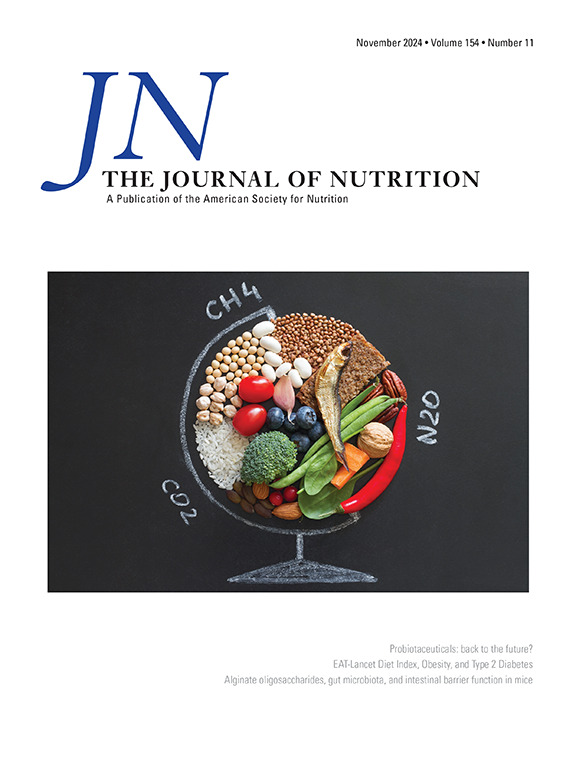
The Journal of Nutrition (JN/J Nutr) publishes peer-reviewed original research papers covering all aspects of experimental nutrition in humans and other animal species; special articles such as reviews and biographies of prominent nutrition scientists; and issues, opinions, and commentaries on controversial issues in nutrition. Supplements are frequently published to provide extended discussion of topics of special interest.




 京公网安备 11010802042870号
京ICP备2023020795号-1
京公网安备 11010802042870号
京ICP备2023020795号-1

 分享
分享
 求助内容:
求助内容: 应助结果提醒方式:
 扫码关注我们
