{"title":"Sex allocation: the effect of population size and structure, fertilisation success, and propagule dimorphism","authors":"Jussi Lehtonen","doi":"10.1111/nph.20239","DOIUrl":null,"url":null,"abstract":"<p>There is a long-debated question in pollination biology regarding the effect of selection on pollen production. Intuitively, one would expect selection for increased pollen production if pollen is a limiting resource (i.e. only a fraction of ovules is successfully fertilised). Yet, classical sex allocation theory suggests that under panmixia, mortality of offspring (or analogously, loss of pollen) does not influence the evolutionarily stable level of sex allocation (Fisher, <span>1930</span>; Leigh, <span>1970</span>; West, <span>2009</span>).</p><p>Bochynek & Burd (<span>2024</span>) address this question quantitatively with a new mathematical model of sex allocation in a simultaneous hermaphrodite. The model is presented in the context of plant reproduction, although it could apply equally well to, for example,broadcast spawning animals. An interesting aspect of their model is that it begins with a set of dynamical equations describing the production of pollen and ovules and their fertilisation and mortality, similar to equations used to model broadcast spawner fertilisation dynamics in the evolution of anisogamy (e.g. the dynamical equations describing the resident population in Lehtonen & Kokko (<span>2011</span>) are essentially identical, but the evolving trait is gamete size instead of sex allocation). The authors then build an evolutionary model of allocation into pollen and ovules around this underlying set of equations. Surprisingly, their panmictic model predicts an effect of population size, pollen mortality and fertilisation success on sex allocation, in contrast with the classical results mentioned above. Bochynek & Burd argue that the classical Fisherian sex allocation of exactly equal male and female allocation under panmixia is a consequence of the ‘atemporal simplification’ of classical models, whereas their model explicitly accounts for the dynamics of fertilisation over time. However, no further justification is given for why atemporal simplification should yield a different result than the dynamic model of Bochynek & Burd.</p><p>Here, I re-analyse the model of Bochynek & Burd and show that it confirms the classical result of an exact 50 : 50 sex allocation rather than challenges it. I then discuss a different set of biological assumptions the mathematical model of Bochynek & Burd does match, relate their model to earlier theory and then generalise it. The reinterpreted model matches previous models in the relevant parts of parameter space but also has something new to say.</p><p>This expression simply means that fitness of individual <i>i</i> is a function of its own trait value and the mean trait value of the remaining population (i.e. frequency-dependent selection), without yet specifying the mathematical form of this functional relationship. Note that it is not always possible to express fitness in this way: more generally, the fitness of each individual could be influenced by the entire distribution of phenotypes in the population (Rousset, <span>2004</span>; Lehtonen, <span>2018</span>; Avila & Mullon, <span>2023</span>). However, in the sex allocation models analysed here, fitness is determined by the mean rather than the entire trait distribution (individuals ‘play the field’: see e.g. Maynard Smith, <span>1982</span>; Avila & Mullon, <span>2023</span>). Furthermore, in other models where this does not hold, under an assumption of weak selection it is usually possible to approximate fitness as a function of the mean value (Rousset, <span>2004</span>; Avila & Mullon, <span>2023</span>). Note also that this is a slightly different formulation than the one in Lehtonen (<span>2018</span>) where fitness was modelled as a function of the focal value and the mean value of the entire population. Either approach could be used here in principle, but the formulation of Eqn 2 engages more directly with the model of Bochynek & Burd, provides more insight into the core issue and shows what is missing in the original model.</p><p>A necessary condition for an evolutionarily stable strategy (ESS) is <span></span><math>\n <mrow>\n <mo>Δ</mo>\n <mi>z</mi>\n <mo>=</mo>\n <mn>0</mn>\n </mrow></math>. The analysis of Bochynek & Burd is missing the second term in the brackets, and the denominator (<i>N</i> − 1) explains why their error diminishes with <i>N</i>.</p><p>The second term in Eqn 5 may not be obvious or intuitive, but it has made appearances in earlier research in various forms. For example, Schaffer's (<span>1988</span>) work on evolutionary game theory in finite populations contains a second term with factor <span></span><math>\n <mrow>\n <mo>−</mo>\n <mfrac>\n <mn>1</mn>\n <mrow>\n <mi>N</mi>\n <mo>−</mo>\n <mn>1</mn>\n </mrow>\n </mfrac>\n </mrow></math> (eqn 12 in Schaffer, <span>1988</span>), which was given an interpretation of ‘spitefulness’. Similarly, Hamilton (<span>1971</span>) alluded to a spiteful effect modulated by a factor <i>N</i> − 1 in a finite, panmictic population, a consequence of a kin selection relatedness coefficient <span></span><math>\n <mrow>\n <mo>−</mo>\n <mfrac>\n <mn>1</mn>\n <mrow>\n <mi>N</mi>\n <mo>−</mo>\n <mn>1</mn>\n </mrow>\n </mfrac>\n </mrow></math> of a focal individual to a random nonfocal individual. In fact, the covariance–variance ratio in Eqn 4 is a relatedness coefficient (see table 3 in Pepper, <span>2000</span>; and table 2 in Lehtonen, <span>2020</span>). One could alternatively use, for example, the method of Taylor & Frank (<span>1996</span>) and arrive at a similar result, where the two partial derivatives in Eqn 5 would be interpreted as the ‘cost’ and ‘benefit’ terms of Hamilton's rule (Hamilton, <span>1964</span>). Whichever method one chooses to follow, care must be taken to account for the effects of finite population size. As is clear from the generic nature of the derivation above, the issues discussed here and in the next section are not specific to the model of Bochynek & Burd – similar arguments would apply to many other models of natural selection.</p><p>Eqn 9 is the sex ratio in Hamilton's local mate competition model for dioecious species (Hamilton, <span>1967</span>) or sex allocation in simultaneous hermaphrodites when self-fertilisation is allowed (West, <span>2009</span>, p. 83; see Charnov, <span>1980</span> for an outcrossing model with a slightly different result). These models are not panmictic models with the total population size <i>N</i>. Instead, they are models of infinite populations structured into finite patches of size <i>N</i>, where reproduction takes place within patches and offspring thereafter disperse to a new patch. Under this interpretation of the model, small values of <i>N</i> can be very relevant. Eqn 9 is hidden in some of the results presented by Bochynek & Burd. For example, in fig. 1(a) in the article of Bochynek & Burd pollen loss is minimal at the left-hand side, and there the curves approach the values (100–1)/200 = 0.495, (200–1)/400 = 04975, (1000–1)/2000 = 0.4995 and (10000–1)/20 000 = 0.49995 reading from the lowest curve to the top curve and substituting their <i>N</i>-values into Eqn 9.</p><p>This is where the mismatch between the model of Bochynek & Burd and its verbal characterisation lies. While their text describes a finite, unstructured population, their mathematics instead match an infinite, patch-structured population where, after reproduction, all offspring disperse to a random patch in the population. Informally, in relation to Eqn 4 <span></span><math>\n <mrow>\n <msub>\n <mi>y</mi>\n <mi>i</mi>\n </msub>\n </mrow></math> must now be taken as the mean trait value of the patch mates of individual <i>i</i>. Because those patch mates are a random sample from an infinite population, <span></span><math>\n <mrow>\n <mi>cov</mi>\n <mfenced>\n <msub>\n <mi>x</mi>\n <mi>i</mi>\n </msub>\n <msub>\n <mi>y</mi>\n <mi>i</mi>\n </msub>\n </mfenced>\n </mrow></math> in Eqn 4 becomes zero on average and only the first derivative remains, matching the mathematical analysis of Bochynek & Burd. To elaborate, if there are <i>k</i> groups of <i>N</i> individuals, the expected value of <span></span><math>\n <mrow>\n <mi>cov</mi>\n <mfenced>\n <msub>\n <mi>x</mi>\n <mi>i</mi>\n </msub>\n <msub>\n <mi>y</mi>\n <mi>i</mi>\n </msub>\n </mfenced>\n </mrow></math> is <span></span><math>\n <mrow>\n <mo>−</mo>\n <mfrac>\n <mrow>\n <mi>var</mi>\n <mfenced>\n <mi>x</mi>\n </mfenced>\n </mrow>\n <mrow>\n <mi>kN</mi>\n <mo>−</mo>\n <mn>1</mn>\n </mrow>\n </mfrac>\n </mrow></math> (see Supporting Information). If <i>k</i> = 1 (panmixia), we have the same result as in the ‘Re-analysing the Bochynek & Burd model under panmixia recovers the classical Fisherian equal investment result’ section. If <i>k</i> approaches infinity, the covariance approaches 0 on average and we recover the result of Bochynek & Burd. The model that to my knowledge comes closest to this reinterpretation of Bochynek & Burd is that of Myllymaa & Lehtonen (<span>2023</span>) where sex allocation is modelled in an infinite patch-structured hermaphrodite population under sperm limitation, analogous to Bochynek & Burd's mathematical model of sex allocation in a patch-structured hermaphrodite population under pollen limitation.</p><p>The interpretation of Bochynek & Burd in the ‘The mathematics of Bochynek & Burd match an infinite, patch-structured population with complete dispersal of offspring’ section assumes 100% dispersal rate of offspring after fertilisation, and without further analysis we cannot generalise it to lower rates of dispersal. Limited dispersal inflates relatedness between patch mates, which initially one might expect to alter selection on sex allocation. However, numerous models have shown that under the simplest assumptions, the ESS sex ratio is independent of dispersal rate and dispersal cost because the effect of increased relatedness is cancelled by increased competition between relatives who do not disperse (Bulmer, <span>1986</span>; Frank, <span>1986</span>; Taylor, <span>1988</span>; see also Taylor, <span>1992</span> for an explanation in a simple, general setting, and e.g. Lehmann, <span>2008</span>; West, <span>2009</span> p. 136; Chokechaipaisarn & Gardner, <span>2022</span> for situations where the cancellation effect does not hold). The closest analogue appears to again be the hermaphrodite model of Myllymaa & Lehtonen (<span>2023</span>), where even under sperm limitation, the result was shown to be independent of dispersal rate and mortality. The Supporting Information presents a similar analysis of the present model, demonstrating that the result is again independent of the rate and cost of dispersal between patches, and hence of inflated relatedness between patch mates.</p><p>While this extension is not crucial for understanding the model of Bochynek & Burd or its amended versions above, it does have some relevance for understanding the nature of the problem. Note that in the fitness function of Bochynek & Burd and in the sections above, density dependence was not explicitly accounted for, and so far, the results did not depend on it. However, to understand the cancellation effect in this extended result we must consider fitness over the entire life cycle and explicitly account for density dependence (see Supporting Information). Thus, while accounting for density dependence can be essential in some models of adaptive evolution, in the model of Bochynek & Burd this is not the source of the problem. Explicit accounting for density dependence becomes essential if the model is extended to scenarios with partial offspring dispersal.</p><p>We have so far seen that while the model of Bochynek & Burd was analysed erroneously in the sense that it did not match the stated verbal assumption of panmixia in a finite population, there is a concrete biological interpretation it does match: evolution in a subdivided, infinite population with finite patches of size <i>N</i> and dispersal of offspring after reproduction. Interpreted from this perspective, the model replicates earlier results of sex allocation under local mate competition or local sperm competition (Eqn 9). Furthermore, Fig. 1(a) shows that the model qualitatively reproduces the results of the hermaphrodite model of Myllymaa & Lehtonen (<span>2023</span>) when pollen/sperm is limiting, as well as those of Lehtonen & Schwanz (<span>2018</span>) where analogously mate limitation was modelled in a species with separate sexes.</p><p>These are not unimportant details. Had the result of Bochynek & Burd been valid in a panmictic population, we would need to rethink our understanding of sex ratio evolution. The independence of the equal investment result from sex-specific mortality has been repeatedly confirmed (Fisher, <span>1930</span>; Leigh, <span>1970</span>), occasionally disputed (Shyu & Caswell, <span>2016</span>) and subsequently confirmed again (Pirrie & Ashby, <span>2021</span>). The result of Bochynek & Burd, if correct, would require careful analysis to understand the cause of the deviation from classical results. However, as shown above, the mathematical model in the form presented by Bochynek & Burd is in fact an example of a patch-structured population model, already well-known to deviate from equal sex allocation in a patch-size dependent way (Hamilton, <span>1967</span>; Charnov, <span>1980</span>; West, <span>2009</span>), and to be further influenced by sperm limitation or mate limitation (see Lehtonen & Schwanz, <span>2018</span>; Myllymaa & Lehtonen, <span>2023</span> and compare their results to Fig. 1a in this article). Thus, the model of Bochynek & Burd is consistent with earlier theory.</p><p>Yet, the model includes novel aspects too. It is an interesting and useful development to model sex allocation with explicit fertilisation dynamics, and the results presented by Bochynek & Burd are valid if reinterpreted in a patch-structured, infinite population context. Furthermore, the results in Fig. 1(b) (in this paper) are, to my knowledge, new: they show explicitly how the isogamy–anisogamy continuum or its equivalent in a pollination context interacts with the evolution of sex allocation. Why does this matter? It matters because in a typical model of sex allocation under local mate competition or local sperm competition, there is a built-in assumption that one type (males or male propagules) competes for fertilisations of the other type (females or female propagules). In the present model, such sex-specific effects arise organically out of the fertilisation equations, and we do not need to preassign any sex-specific properties. The model is mathematically symmetric such that ovules only become ovules when they are given a higher cost than pollen, and vice versa – they are mathematically exchangeable. This kind of independence from sex-specific assumptions is important and timely: potential gender-biased assumptions in evolutionary biology are widely discussed and sometimes questioned (Ah-King, <span>2013</span>, <span>2022</span>; Gowaty, <span>2018</span>; Ahnesjö <i>et al</i>., <span>2020</span>). We can attempt to pre-empt such biases from theory by deriving results from deeper underlying principles, without resorting to sex-specific assumptions (de Vries & Lehtonen, <span>2023</span>). The model of Bochynek & Burd, reinterpreted in the patch-structured context dictated by its mathematical form, is another step in this direction.</p><p>None declared.</p>","PeriodicalId":214,"journal":{"name":"New Phytologist","volume":"245 3","pages":"934-938"},"PeriodicalIF":8.1000,"publicationDate":"2024-11-28","publicationTypes":"Journal Article","fieldsOfStudy":null,"isOpenAccess":false,"openAccessPdf":"https://onlinelibrary.wiley.com/doi/epdf/10.1111/nph.20239","citationCount":"0","resultStr":null,"platform":"Semanticscholar","paperid":null,"PeriodicalName":"New Phytologist","FirstCategoryId":"99","ListUrlMain":"https://nph.onlinelibrary.wiley.com/doi/10.1111/nph.20239","RegionNum":1,"RegionCategory":"生物学","ArticlePicture":[],"TitleCN":null,"AbstractTextCN":null,"PMCID":null,"EPubDate":"","PubModel":"","JCR":"Q1","JCRName":"PLANT SCIENCES","Score":null,"Total":0}
引用次数: 0
Abstract
There is a long-debated question in pollination biology regarding the effect of selection on pollen production. Intuitively, one would expect selection for increased pollen production if pollen is a limiting resource (i.e. only a fraction of ovules is successfully fertilised). Yet, classical sex allocation theory suggests that under panmixia, mortality of offspring (or analogously, loss of pollen) does not influence the evolutionarily stable level of sex allocation (Fisher, 1930; Leigh, 1970; West, 2009).
Bochynek & Burd (2024) address this question quantitatively with a new mathematical model of sex allocation in a simultaneous hermaphrodite. The model is presented in the context of plant reproduction, although it could apply equally well to, for example,broadcast spawning animals. An interesting aspect of their model is that it begins with a set of dynamical equations describing the production of pollen and ovules and their fertilisation and mortality, similar to equations used to model broadcast spawner fertilisation dynamics in the evolution of anisogamy (e.g. the dynamical equations describing the resident population in Lehtonen & Kokko (2011) are essentially identical, but the evolving trait is gamete size instead of sex allocation). The authors then build an evolutionary model of allocation into pollen and ovules around this underlying set of equations. Surprisingly, their panmictic model predicts an effect of population size, pollen mortality and fertilisation success on sex allocation, in contrast with the classical results mentioned above. Bochynek & Burd argue that the classical Fisherian sex allocation of exactly equal male and female allocation under panmixia is a consequence of the ‘atemporal simplification’ of classical models, whereas their model explicitly accounts for the dynamics of fertilisation over time. However, no further justification is given for why atemporal simplification should yield a different result than the dynamic model of Bochynek & Burd.
Here, I re-analyse the model of Bochynek & Burd and show that it confirms the classical result of an exact 50 : 50 sex allocation rather than challenges it. I then discuss a different set of biological assumptions the mathematical model of Bochynek & Burd does match, relate their model to earlier theory and then generalise it. The reinterpreted model matches previous models in the relevant parts of parameter space but also has something new to say.
This expression simply means that fitness of individual i is a function of its own trait value and the mean trait value of the remaining population (i.e. frequency-dependent selection), without yet specifying the mathematical form of this functional relationship. Note that it is not always possible to express fitness in this way: more generally, the fitness of each individual could be influenced by the entire distribution of phenotypes in the population (Rousset, 2004; Lehtonen, 2018; Avila & Mullon, 2023). However, in the sex allocation models analysed here, fitness is determined by the mean rather than the entire trait distribution (individuals ‘play the field’: see e.g. Maynard Smith, 1982; Avila & Mullon, 2023). Furthermore, in other models where this does not hold, under an assumption of weak selection it is usually possible to approximate fitness as a function of the mean value (Rousset, 2004; Avila & Mullon, 2023). Note also that this is a slightly different formulation than the one in Lehtonen (2018) where fitness was modelled as a function of the focal value and the mean value of the entire population. Either approach could be used here in principle, but the formulation of Eqn 2 engages more directly with the model of Bochynek & Burd, provides more insight into the core issue and shows what is missing in the original model.
A necessary condition for an evolutionarily stable strategy (ESS) is . The analysis of Bochynek & Burd is missing the second term in the brackets, and the denominator (N − 1) explains why their error diminishes with N.
The second term in Eqn 5 may not be obvious or intuitive, but it has made appearances in earlier research in various forms. For example, Schaffer's (1988) work on evolutionary game theory in finite populations contains a second term with factor (eqn 12 in Schaffer, 1988), which was given an interpretation of ‘spitefulness’. Similarly, Hamilton (1971) alluded to a spiteful effect modulated by a factor N − 1 in a finite, panmictic population, a consequence of a kin selection relatedness coefficient of a focal individual to a random nonfocal individual. In fact, the covariance–variance ratio in Eqn 4 is a relatedness coefficient (see table 3 in Pepper, 2000; and table 2 in Lehtonen, 2020). One could alternatively use, for example, the method of Taylor & Frank (1996) and arrive at a similar result, where the two partial derivatives in Eqn 5 would be interpreted as the ‘cost’ and ‘benefit’ terms of Hamilton's rule (Hamilton, 1964). Whichever method one chooses to follow, care must be taken to account for the effects of finite population size. As is clear from the generic nature of the derivation above, the issues discussed here and in the next section are not specific to the model of Bochynek & Burd – similar arguments would apply to many other models of natural selection.
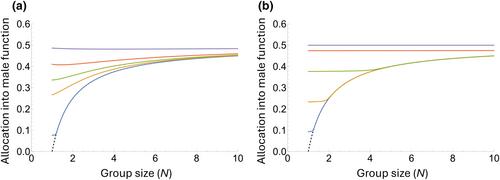
Eqn 9 is the sex ratio in Hamilton's local mate competition model for dioecious species (Hamilton, 1967) or sex allocation in simultaneous hermaphrodites when self-fertilisation is allowed (West, 2009, p. 83; see Charnov, 1980 for an outcrossing model with a slightly different result). These models are not panmictic models with the total population size N. Instead, they are models of infinite populations structured into finite patches of size N, where reproduction takes place within patches and offspring thereafter disperse to a new patch. Under this interpretation of the model, small values of N can be very relevant. Eqn 9 is hidden in some of the results presented by Bochynek & Burd. For example, in fig. 1(a) in the article of Bochynek & Burd pollen loss is minimal at the left-hand side, and there the curves approach the values (100–1)/200 = 0.495, (200–1)/400 = 04975, (1000–1)/2000 = 0.4995 and (10000–1)/20 000 = 0.49995 reading from the lowest curve to the top curve and substituting their N-values into Eqn 9.
This is where the mismatch between the model of Bochynek & Burd and its verbal characterisation lies. While their text describes a finite, unstructured population, their mathematics instead match an infinite, patch-structured population where, after reproduction, all offspring disperse to a random patch in the population. Informally, in relation to Eqn 4 must now be taken as the mean trait value of the patch mates of individual i. Because those patch mates are a random sample from an infinite population, in Eqn 4 becomes zero on average and only the first derivative remains, matching the mathematical analysis of Bochynek & Burd. To elaborate, if there are k groups of N individuals, the expected value of is (see Supporting Information). If k = 1 (panmixia), we have the same result as in the ‘Re-analysing the Bochynek & Burd model under panmixia recovers the classical Fisherian equal investment result’ section. If k approaches infinity, the covariance approaches 0 on average and we recover the result of Bochynek & Burd. The model that to my knowledge comes closest to this reinterpretation of Bochynek & Burd is that of Myllymaa & Lehtonen (2023) where sex allocation is modelled in an infinite patch-structured hermaphrodite population under sperm limitation, analogous to Bochynek & Burd's mathematical model of sex allocation in a patch-structured hermaphrodite population under pollen limitation.
The interpretation of Bochynek & Burd in the ‘The mathematics of Bochynek & Burd match an infinite, patch-structured population with complete dispersal of offspring’ section assumes 100% dispersal rate of offspring after fertilisation, and without further analysis we cannot generalise it to lower rates of dispersal. Limited dispersal inflates relatedness between patch mates, which initially one might expect to alter selection on sex allocation. However, numerous models have shown that under the simplest assumptions, the ESS sex ratio is independent of dispersal rate and dispersal cost because the effect of increased relatedness is cancelled by increased competition between relatives who do not disperse (Bulmer, 1986; Frank, 1986; Taylor, 1988; see also Taylor, 1992 for an explanation in a simple, general setting, and e.g. Lehmann, 2008; West, 2009 p. 136; Chokechaipaisarn & Gardner, 2022 for situations where the cancellation effect does not hold). The closest analogue appears to again be the hermaphrodite model of Myllymaa & Lehtonen (2023), where even under sperm limitation, the result was shown to be independent of dispersal rate and mortality. The Supporting Information presents a similar analysis of the present model, demonstrating that the result is again independent of the rate and cost of dispersal between patches, and hence of inflated relatedness between patch mates.
While this extension is not crucial for understanding the model of Bochynek & Burd or its amended versions above, it does have some relevance for understanding the nature of the problem. Note that in the fitness function of Bochynek & Burd and in the sections above, density dependence was not explicitly accounted for, and so far, the results did not depend on it. However, to understand the cancellation effect in this extended result we must consider fitness over the entire life cycle and explicitly account for density dependence (see Supporting Information). Thus, while accounting for density dependence can be essential in some models of adaptive evolution, in the model of Bochynek & Burd this is not the source of the problem. Explicit accounting for density dependence becomes essential if the model is extended to scenarios with partial offspring dispersal.
We have so far seen that while the model of Bochynek & Burd was analysed erroneously in the sense that it did not match the stated verbal assumption of panmixia in a finite population, there is a concrete biological interpretation it does match: evolution in a subdivided, infinite population with finite patches of size N and dispersal of offspring after reproduction. Interpreted from this perspective, the model replicates earlier results of sex allocation under local mate competition or local sperm competition (Eqn 9). Furthermore, Fig. 1(a) shows that the model qualitatively reproduces the results of the hermaphrodite model of Myllymaa & Lehtonen (2023) when pollen/sperm is limiting, as well as those of Lehtonen & Schwanz (2018) where analogously mate limitation was modelled in a species with separate sexes.
These are not unimportant details. Had the result of Bochynek & Burd been valid in a panmictic population, we would need to rethink our understanding of sex ratio evolution. The independence of the equal investment result from sex-specific mortality has been repeatedly confirmed (Fisher, 1930; Leigh, 1970), occasionally disputed (Shyu & Caswell, 2016) and subsequently confirmed again (Pirrie & Ashby, 2021). The result of Bochynek & Burd, if correct, would require careful analysis to understand the cause of the deviation from classical results. However, as shown above, the mathematical model in the form presented by Bochynek & Burd is in fact an example of a patch-structured population model, already well-known to deviate from equal sex allocation in a patch-size dependent way (Hamilton, 1967; Charnov, 1980; West, 2009), and to be further influenced by sperm limitation or mate limitation (see Lehtonen & Schwanz, 2018; Myllymaa & Lehtonen, 2023 and compare their results to Fig. 1a in this article). Thus, the model of Bochynek & Burd is consistent with earlier theory.
Yet, the model includes novel aspects too. It is an interesting and useful development to model sex allocation with explicit fertilisation dynamics, and the results presented by Bochynek & Burd are valid if reinterpreted in a patch-structured, infinite population context. Furthermore, the results in Fig. 1(b) (in this paper) are, to my knowledge, new: they show explicitly how the isogamy–anisogamy continuum or its equivalent in a pollination context interacts with the evolution of sex allocation. Why does this matter? It matters because in a typical model of sex allocation under local mate competition or local sperm competition, there is a built-in assumption that one type (males or male propagules) competes for fertilisations of the other type (females or female propagules). In the present model, such sex-specific effects arise organically out of the fertilisation equations, and we do not need to preassign any sex-specific properties. The model is mathematically symmetric such that ovules only become ovules when they are given a higher cost than pollen, and vice versa – they are mathematically exchangeable. This kind of independence from sex-specific assumptions is important and timely: potential gender-biased assumptions in evolutionary biology are widely discussed and sometimes questioned (Ah-King, 2013, 2022; Gowaty, 2018; Ahnesjö et al., 2020). We can attempt to pre-empt such biases from theory by deriving results from deeper underlying principles, without resorting to sex-specific assumptions (de Vries & Lehtonen, 2023). The model of Bochynek & Burd, reinterpreted in the patch-structured context dictated by its mathematical form, is another step in this direction.
期刊介绍:
New Phytologist is an international electronic journal published 24 times a year. It is owned by the New Phytologist Foundation, a non-profit-making charitable organization dedicated to promoting plant science. The journal publishes excellent, novel, rigorous, and timely research and scholarship in plant science and its applications. The articles cover topics in five sections: Physiology & Development, Environment, Interaction, Evolution, and Transformative Plant Biotechnology. These sections encompass intracellular processes, global environmental change, and encourage cross-disciplinary approaches. The journal recognizes the use of techniques from molecular and cell biology, functional genomics, modeling, and system-based approaches in plant science. Abstracting and Indexing Information for New Phytologist includes Academic Search, AgBiotech News & Information, Agroforestry Abstracts, Biochemistry & Biophysics Citation Index, Botanical Pesticides, CAB Abstracts®, Environment Index, Global Health, and Plant Breeding Abstracts, and others.






 京公网安备 11010802042870号
京ICP备2023020795号-1
京公网安备 11010802042870号
京ICP备2023020795号-1

 分享
分享
 求助内容:
求助内容: 应助结果提醒方式:
 扫码关注我们
