{"title":"Clearance of Protein-Bound Uremic Toxins Using Anion Nanotraps with Record High Uptake","authors":"Meiyu Zhang, Yujie Miao, Ping Zhang, Chengliang Xiao","doi":"10.1021/acsami.4c16425","DOIUrl":null,"url":null,"abstract":"Traditional hemodialysis often fails to remove protein-bound uremic toxins (PBUTs) like <i>p</i>-cresyl sulfate (<i>p</i>CS) and indoxyl sulfate (IS) due to their strong binding to human serum albumin, which is linked to adverse cardiovascular outcomes. Herein, a class of cationic polymeric networks, denoted as CPN-X6–CPN-X9, are reported for the efficient removal of PBUTs. The abundant imidazole-based nanotraps in these cationic polymeric networks confer a highly positive charge density, resulting in CPN-X7 achieving a maximum sorption capacity of 1000.8 mg/g for <i>p</i>CS and CPN-X6 offering a maximum sorption capacity of 1028.4 mg/g for IS, surpassing all previously reported sorbents. Furthermore, CPN-X9, which is relatively hydrophobic, exhibits remarkable selectivity in competitive experiments involving large amount of chloride ions and serum albumin, attaining removal rates of up to 74% for <i>p</i>CS and 93% for IS in the recycling <i>in vitro</i> dialysis mode. Meanwhile, CPN-X9 demonstrates excellent recyclability over five cycles, and the cationic polymeric network materials exhibit satisfactory hemocompatibility. The sorption mechanism of the anion exchange process is fully elucidated and verified by density functional theory (DFT) calculations. This study provides valuable insights into enhancing the removal efficiency of PBUTs and presents broad prospects in the field of clinical blood purification.","PeriodicalId":5,"journal":{"name":"ACS Applied Materials & Interfaces","volume":"27 1","pages":""},"PeriodicalIF":8.2000,"publicationDate":"2024-11-30","publicationTypes":"Journal Article","fieldsOfStudy":null,"isOpenAccess":false,"openAccessPdf":"","citationCount":"0","resultStr":null,"platform":"Semanticscholar","paperid":null,"PeriodicalName":"ACS Applied Materials & Interfaces","FirstCategoryId":"88","ListUrlMain":"https://doi.org/10.1021/acsami.4c16425","RegionNum":2,"RegionCategory":"材料科学","ArticlePicture":[],"TitleCN":null,"AbstractTextCN":null,"PMCID":null,"EPubDate":"","PubModel":"","JCR":"Q1","JCRName":"MATERIALS SCIENCE, MULTIDISCIPLINARY","Score":null,"Total":0}
引用次数: 0
Abstract
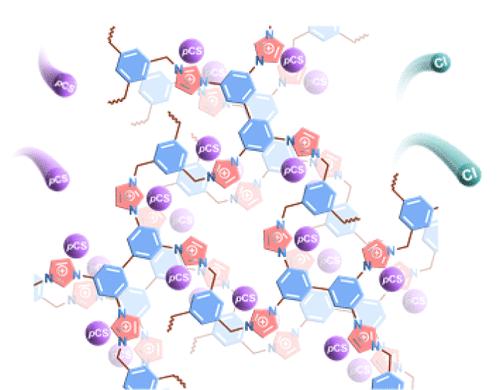
Traditional hemodialysis often fails to remove protein-bound uremic toxins (PBUTs) like p-cresyl sulfate (pCS) and indoxyl sulfate (IS) due to their strong binding to human serum albumin, which is linked to adverse cardiovascular outcomes. Herein, a class of cationic polymeric networks, denoted as CPN-X6–CPN-X9, are reported for the efficient removal of PBUTs. The abundant imidazole-based nanotraps in these cationic polymeric networks confer a highly positive charge density, resulting in CPN-X7 achieving a maximum sorption capacity of 1000.8 mg/g for pCS and CPN-X6 offering a maximum sorption capacity of 1028.4 mg/g for IS, surpassing all previously reported sorbents. Furthermore, CPN-X9, which is relatively hydrophobic, exhibits remarkable selectivity in competitive experiments involving large amount of chloride ions and serum albumin, attaining removal rates of up to 74% for pCS and 93% for IS in the recycling in vitro dialysis mode. Meanwhile, CPN-X9 demonstrates excellent recyclability over five cycles, and the cationic polymeric network materials exhibit satisfactory hemocompatibility. The sorption mechanism of the anion exchange process is fully elucidated and verified by density functional theory (DFT) calculations. This study provides valuable insights into enhancing the removal efficiency of PBUTs and presents broad prospects in the field of clinical blood purification.
期刊介绍:
ACS Applied Materials & Interfaces is a leading interdisciplinary journal that brings together chemists, engineers, physicists, and biologists to explore the development and utilization of newly-discovered materials and interfacial processes for specific applications. Our journal has experienced remarkable growth since its establishment in 2009, both in terms of the number of articles published and the impact of the research showcased. We are proud to foster a truly global community, with the majority of published articles originating from outside the United States, reflecting the rapid growth of applied research worldwide.



 京公网安备 11010802042870号
京ICP备2023020795号-1
京公网安备 11010802042870号
京ICP备2023020795号-1

 分享
分享
 求助内容:
求助内容: 应助结果提醒方式:
 扫码关注我们
