Antibiotic resistance genes and virulence factors in the plastisphere in wastewater treatment plant effluent: Health risk quantification and driving mechanism interpretation
Yaxin Wang , Xiuhong Liu , Chenduo Huang , Weipeng Han , Pengchao Gu , Ruxian Jing , Qing Yang
{"title":"Antibiotic resistance genes and virulence factors in the plastisphere in wastewater treatment plant effluent: Health risk quantification and driving mechanism interpretation","authors":"Yaxin Wang , Xiuhong Liu , Chenduo Huang , Weipeng Han , Pengchao Gu , Ruxian Jing , Qing Yang","doi":"10.1016/j.watres.2024.122896","DOIUrl":null,"url":null,"abstract":"<div><div>Microplastics (MPs) are ubiquitous in wastewater treatment plants (WWTPs) and provide a unique niche for the spread of pollutants. To date, risk assessments and driving mechanisms of pathogens, antibiotic resistance genes (ARGs), and virulence factors (VFs) in the plastisphere are still lacking. Here, the microbiota, ARGs, VFs, their potential health risks, and biologically driving mechanisms on polythene (PE), polyethylene terephthalate (PET), poly (butyleneadipate-co-terephthalate) and polylactic acid blends (PBAT/PLA), PLA MPs, and gravel in WWTP effluent were investigated. The results showed that plastisphere and gravel biofilm harbored more distinctive microorganisms, promoting the uniqueness of pathogens, ARGs, and VFs compared to WWTP effluent. The abundance of major pathogens, ARGs, and VFs in the plastisphere was 1.01–1.35 times higher than that in the effluent. The high health risk of ARGs (HRA) calculated by fully considering the abundance, clinical relevance, pathogenicity, accessibility and mobility, and the high proportion of resistance contigs with mobile genetic elements confirmed that the plastisphere posed the highest potential health risk. <em>Candidatus Microthrix</em> and <em>Candidatus Promineifilum</em> were the essential hosts of ARGs and VFs in the plastisphere and gravel biofilm, respectively. High metabolic activity such as amino acid metabolism and biosynthesis of secondary metabolites, and highly expressed key genes increased the synthesis of ARGs and VFs. The primary mechanisms driving ARG enrichment in the plastisphere were enhanced microbial metabolic activity, increased frequency of horizontal gene transfer, heightened antibiotic inactivation and efflux, and reduced cell permeability. This study provided new insights into the ARGs, VFs, and health risks of the plastisphere and emphasized the importance of strict control of wastewater discharge.</div></div>","PeriodicalId":443,"journal":{"name":"Water Research","volume":"271 ","pages":"Article 122896"},"PeriodicalIF":12.4000,"publicationDate":"2025-03-01","publicationTypes":"Journal Article","fieldsOfStudy":null,"isOpenAccess":false,"openAccessPdf":"","citationCount":"0","resultStr":null,"platform":"Semanticscholar","paperid":null,"PeriodicalName":"Water Research","FirstCategoryId":"93","ListUrlMain":"https://www.sciencedirect.com/science/article/pii/S0043135424017962","RegionNum":1,"RegionCategory":"环境科学与生态学","ArticlePicture":[],"TitleCN":null,"AbstractTextCN":null,"PMCID":null,"EPubDate":"2024/12/1 0:00:00","PubModel":"Epub","JCR":"Q1","JCRName":"ENGINEERING, ENVIRONMENTAL","Score":null,"Total":0}
引用次数: 0
Abstract
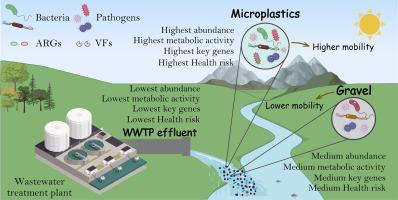
Microplastics (MPs) are ubiquitous in wastewater treatment plants (WWTPs) and provide a unique niche for the spread of pollutants. To date, risk assessments and driving mechanisms of pathogens, antibiotic resistance genes (ARGs), and virulence factors (VFs) in the plastisphere are still lacking. Here, the microbiota, ARGs, VFs, their potential health risks, and biologically driving mechanisms on polythene (PE), polyethylene terephthalate (PET), poly (butyleneadipate-co-terephthalate) and polylactic acid blends (PBAT/PLA), PLA MPs, and gravel in WWTP effluent were investigated. The results showed that plastisphere and gravel biofilm harbored more distinctive microorganisms, promoting the uniqueness of pathogens, ARGs, and VFs compared to WWTP effluent. The abundance of major pathogens, ARGs, and VFs in the plastisphere was 1.01–1.35 times higher than that in the effluent. The high health risk of ARGs (HRA) calculated by fully considering the abundance, clinical relevance, pathogenicity, accessibility and mobility, and the high proportion of resistance contigs with mobile genetic elements confirmed that the plastisphere posed the highest potential health risk. Candidatus Microthrix and Candidatus Promineifilum were the essential hosts of ARGs and VFs in the plastisphere and gravel biofilm, respectively. High metabolic activity such as amino acid metabolism and biosynthesis of secondary metabolites, and highly expressed key genes increased the synthesis of ARGs and VFs. The primary mechanisms driving ARG enrichment in the plastisphere were enhanced microbial metabolic activity, increased frequency of horizontal gene transfer, heightened antibiotic inactivation and efflux, and reduced cell permeability. This study provided new insights into the ARGs, VFs, and health risks of the plastisphere and emphasized the importance of strict control of wastewater discharge.
期刊介绍:
Water Research, along with its open access companion journal Water Research X, serves as a platform for publishing original research papers covering various aspects of the science and technology related to the anthropogenic water cycle, water quality, and its management worldwide. The audience targeted by the journal comprises biologists, chemical engineers, chemists, civil engineers, environmental engineers, limnologists, and microbiologists. The scope of the journal include:
•Treatment processes for water and wastewaters (municipal, agricultural, industrial, and on-site treatment), including resource recovery and residuals management;
•Urban hydrology including sewer systems, stormwater management, and green infrastructure;
•Drinking water treatment and distribution;
•Potable and non-potable water reuse;
•Sanitation, public health, and risk assessment;
•Anaerobic digestion, solid and hazardous waste management, including source characterization and the effects and control of leachates and gaseous emissions;
•Contaminants (chemical, microbial, anthropogenic particles such as nanoparticles or microplastics) and related water quality sensing, monitoring, fate, and assessment;
•Anthropogenic impacts on inland, tidal, coastal and urban waters, focusing on surface and ground waters, and point and non-point sources of pollution;
•Environmental restoration, linked to surface water, groundwater and groundwater remediation;
•Analysis of the interfaces between sediments and water, and between water and atmosphere, focusing specifically on anthropogenic impacts;
•Mathematical modelling, systems analysis, machine learning, and beneficial use of big data related to the anthropogenic water cycle;
•Socio-economic, policy, and regulations studies.



 京公网安备 11010802042870号
京ICP备2023020795号-1
京公网安备 11010802042870号
京ICP备2023020795号-1

 分享
分享
 求助内容:
求助内容: 应助结果提醒方式:
 扫码关注我们
