{"title":"How Plants Survive the Heat—On the Benefit of Engineered Photorespiration","authors":"Hu Sun, Inken Thiemann, Stefan Timm","doi":"10.1111/gcb.17609","DOIUrl":null,"url":null,"abstract":"<p>The world population is projected to continuously grow to approximately 9.5 billion by the year 2050. Combined with advancing climate change, this increase is likely to exacerbate global food insecurity. The problem is further intensified by shifting dietary demands and the rising use of key crops for biofuel production (WHO <span>2023</span>). Although the Green Revolution and advancements in agricultural practices have significantly boosted crop yields over the past decades, these gains have plateaued, and in some cases, even declined, in recent years (Ray et al. <span>2013</span>). Consequently, conventional breeding alone may be insufficient to bridge the anticipated food gap, which is expected to widen steadily in the coming decades. Notably, this challenge must be addressed without expanding agricultural land use and minimizing the emission of greenhouse gases. Together, these factors underscore an urgent need for alternative, sustainable approaches to increase food production. Recent research has shown that genetic engineering of photosynthesis, specifically enhancing photosynthetic CO₂ fixation and carbon utilization, holds promise for sustainably increasing yields in many key global crops. Such advancements may be effective even in the face of future climate challenges, including that of global warming.</p><p>The photosynthetic process in oxygenic phototrophs is responsible for the majority of global carbon fixation, forming the foundation for the biosynthesis of food and numerous natural products. In higher plants, efficient CO₂ fixation is achieved through the coordinated activity of the photosynthetic-photorespiratory super cycle, a complex metabolic and physiological network that mutually integrates at least three primary processes: (i) the photosynthetic light reactions, (ii) the Calvin–Benson (CB) cycle, or “dark reactions,” and (iii) photorespiration, an unavoidable metabolite repair pathway. This key pathway is mandatory because of the biochemical properties of the central CO<sub>2</sub> fixing enzyme, Rubisco, that catalyzes a major side reaction in the presence of high oxygen concentrations. Thus, photorespiration occurs to detoxify the high amounts of autoinhibitory 2-phosphoglycolate (2-PG), inhibiting CO<sub>2</sub> fixation via the CB cycle, formed by Rubisco (Fernie and Bauwe, <span>2020</span>).</p><p>Each of these processes contains biochemical limitations that research has shown can be mitigated through genetic engineering. For instance, the light reactions, responsible for generating energy and reducing power to drive the CB cycle, can be enhanced by modifying plant architecture, optimizing light-harvesting and conversion capacity, or fine-tuning specific enzymatic reactions within the chloroplast electron transport chain (e.g., summarized in Leister <span>2023</span>). Studies on the CB cycle across various phototrophic organisms, including plants, have also yielded promising results. Manipulating enzymatic steps involved in regenerating the primary CO₂ acceptor molecule, ribulose-1,5-bisphosphate (RuBP), has significantly boosted photosynthesis and biomass production in higher plants, with stability across both laboratory and natural field conditions in diverse plant species (e.g., summarized in Raines <span>2022</span>). Similarly, advances in photorespiration research suggest two distinct strategies for optimizing this pathway. One approach involves enhancing endogenous enzyme abundance through overexpression, which improves internal carbon flow through photorespiration, ultimately leading to higher photosynthesis rates and biomass accumulation in various organisms. Strikingly, these enhancements have shown additive effects when combined with CB cycle optimizations (Timm and Hagemann <span>2020</span>; Raines <span>2022</span>). Another approach involves introducing synthetic bypasses into the natural photorespiratory pathway, which has proven effective for increased photosynthesis and growth under various environmental conditions (Smith et al. <span>2023</span>). The success of the strategy is anticipated to function through reducing the energetic costs of photorespiration and by minimizing its endogenous CO<sub>2</sub> release, which typically lead to substantial carbon loss during daily illumination (Fernie and Bauwe, <span>2020</span>).</p><p>The original research by Meacham-Hensold et al. (<span>2024</span>), presented in Global Change Biology, provides a compelling example of how engineered photorespiratory bypasses could enhance plant yield and its acclimation to future climate scenarios, such as generally rising temperatures or heatwaves. Building on their earlier work, the authors genetically modified photorespiration in potato (<i>Solanum tuberosum</i>), the most widely cultivated non-grain crop and the fourth most consumed crop globally, and tested its performance over two growing seasons under natural field conditions in the United States. This genetic modification was previously tested successfully in the non-crop model tobacco (<i>Nicotiana tabacum</i>) (South, Cavanagh, and Liu <span>2019</span>). In detail, the authors introduced the alternative photorespiration pathway 3 (AP3) into the chloroplasts of tobacco, while simultaneously reducing flux through the plants´ native photorespiratory pathway. This reduction was achieved by decreasing the export capacity of glycolate, a central pathway intermediate, from the chloroplast, using RNAi suppression to reduce the expression of the plastidial glycolate transporter (PLGG1) (see Figure 1). Consequently, the natural pathway might release less CO₂ because of reduced mitochondrial decarboxylation reactions. At the same time, CO₂ concentration within the chloroplast is enriched through two synthetically introduced decarboxylation reactions in the close vicinity of Rubisco, the enzyme responsible for CO₂ fixation, coevally suppressing its oxygenation reaction. This relocation of decarboxylation reactions, along with the reduced flux through the native photorespiratory cycle, is also hypothesized to reduce ATP and NADPH consumption, adding another potential benefit of the synthetic pathway. Another advantage of the synthetic pathway discussed is that it creates an additional sink for redox equivalents, serving to protect the light reactions from overreduction (Meacham-Hensold et al. <span>2024</span>).</p><p>In agreement with their previous study on tobacco, the authors found strong evidence for improved tuber yield supporting their hypothesis in potato, particularly during a growing season in which plants encountered two natural heatwaves early in their vegetative stage. Under these conditions, AP3-modified plants demonstrated improved photosynthetic performance, including a 23% increase in the maximum carboxylation efficiency, a 13% increase in maximum rate of photosynthetic electron transport, and lower CO₂ compensation points, compared with control plants following two periods of exposure to temperatures of about 35°C. Additionally, during the tuber bulking phase, the AP3 plants showed increased accumulation of intermediates associated with the synthetic bypass pathway, suggesting an elevated carbon flux through the engineered metabolic route (Meacham-Hensold et al. <span>2024</span>). This shift was accompanied by larger tuber masses, indicating that diverting carbon from the native photorespiratory cycle through enhanced glycolate metabolism in the AP3 pathway may increase carbon allocation from the CB cycle toward storage. This research thus highlights that alternative photorespiratory pathways can reduce photorespiratory losses, enhance carbon fixation, and improve abiotic stress tolerance in major crop species. Importantly, the study also found that the nutritional quality of potato tubers underwent rather inconsistent changes in the analyzed growing seasons, suggesting the transgenic approach largely maintains compatibility with human dietary needs (Meacham-Hensold et al. <span>2024</span>). However, in some experiments the authors found a significant increase in iron alongside with smaller decreases in vitamin C and total dietary fiber. Hence, side effects on the overall nutrient compositions cannot yet be fully excluded. Furthermore, future research is needed to determine whether these gains in biomass and thermal resilience are responses to short-term environmental changes or whether they can be sustained under prolonged exposure to elevated temperatures.</p><p>Somewhat similar to the findings by Meacham-Hensold et al. (<span>2024</span>), further experimental evidence suggests that improving the native photorespiratory cycle by overexpressing, for example, the chloroplast 2-PG degrading enzyme, 2-PG phosphatase (PGLP1), can also contribute to enhancing plant thermostability (Timm et al. <span>2019</span>; Figure 1). In detailed laboratory studies on transgenic Arabidopsis mutants with increased PGLP1 activity and, in turn, improved 2-PG degradation, researchers observed that these modified plants maintained higher rates of photosynthetic CO₂ fixation and related parameters at elevated temperatures of about 30°C, along with higher levels of transient starch storage (Timm et al. <span>2019</span>). Given the specificity of this genetic modification, which solely affects 2-PG turnover, one can hypothesize that the improved detoxification of Rubisco's primary oxygenation byproduct is a key reason why optimized chloroplast photorespiratory reactions have positive impacts on photosynthesis, growth, and abiotic stress tolerance. To fully understand this effect and its underlying mechanistic, future experiments should conduct parallel comparisons on plants engineered using both strategies, allowing for a more comprehensive assessment of how different approaches to photorespiratory modification influence plant performance under stress. Certainly, combining both strategies would also be a welcome avenue of research to take, too.</p><p>As photorespiration is intimately intertwined with metabolic repair mechanisms for oxygenic phototrophs living in a high-oxygen environment, we are only beginning to grasp its further implications for plant physiology. However, an increasing body of evidence supports the hypothesis that optimized photorespiration can serve as a tool for enhancing plant tolerance to abiotic stress under projected climate change scenarios. Both approaches, bypassing parts of the photorespiratory pathway (Meacham-Hensold et al. <span>2024</span>) and optimizing native photorespiration through enzyme overexpression (Timm et al. <span>2019</span>), have shown potential to significantly improve plant resilience to elevated temperatures, including during heatwaves, or global warming in general. Future research is essential to determine whether these strategies can sustainably boost crop yields over the long term and in response to the combined environmental stresses anticipated with ongoing climate change.</p><p><b>Hu Sun:</b> visualization, writing – review and editing. <b>Inken Thiemann:</b> writing – review and editing. <b>Stefan Timm:</b> writing – original draft, writing – review and editing.</p><p>The authors declare no conflicts of interest.</p>","PeriodicalId":175,"journal":{"name":"Global Change Biology","volume":"30 12","pages":""},"PeriodicalIF":12.0000,"publicationDate":"2024-12-03","publicationTypes":"Journal Article","fieldsOfStudy":null,"isOpenAccess":false,"openAccessPdf":"https://onlinelibrary.wiley.com/doi/epdf/10.1111/gcb.17609","citationCount":"0","resultStr":null,"platform":"Semanticscholar","paperid":null,"PeriodicalName":"Global Change Biology","FirstCategoryId":"93","ListUrlMain":"https://onlinelibrary.wiley.com/doi/10.1111/gcb.17609","RegionNum":1,"RegionCategory":"环境科学与生态学","ArticlePicture":[],"TitleCN":null,"AbstractTextCN":null,"PMCID":null,"EPubDate":"","PubModel":"","JCR":"Q1","JCRName":"BIODIVERSITY CONSERVATION","Score":null,"Total":0}
引用次数: 0
Abstract
The world population is projected to continuously grow to approximately 9.5 billion by the year 2050. Combined with advancing climate change, this increase is likely to exacerbate global food insecurity. The problem is further intensified by shifting dietary demands and the rising use of key crops for biofuel production (WHO 2023). Although the Green Revolution and advancements in agricultural practices have significantly boosted crop yields over the past decades, these gains have plateaued, and in some cases, even declined, in recent years (Ray et al. 2013). Consequently, conventional breeding alone may be insufficient to bridge the anticipated food gap, which is expected to widen steadily in the coming decades. Notably, this challenge must be addressed without expanding agricultural land use and minimizing the emission of greenhouse gases. Together, these factors underscore an urgent need for alternative, sustainable approaches to increase food production. Recent research has shown that genetic engineering of photosynthesis, specifically enhancing photosynthetic CO₂ fixation and carbon utilization, holds promise for sustainably increasing yields in many key global crops. Such advancements may be effective even in the face of future climate challenges, including that of global warming.
The photosynthetic process in oxygenic phototrophs is responsible for the majority of global carbon fixation, forming the foundation for the biosynthesis of food and numerous natural products. In higher plants, efficient CO₂ fixation is achieved through the coordinated activity of the photosynthetic-photorespiratory super cycle, a complex metabolic and physiological network that mutually integrates at least three primary processes: (i) the photosynthetic light reactions, (ii) the Calvin–Benson (CB) cycle, or “dark reactions,” and (iii) photorespiration, an unavoidable metabolite repair pathway. This key pathway is mandatory because of the biochemical properties of the central CO2 fixing enzyme, Rubisco, that catalyzes a major side reaction in the presence of high oxygen concentrations. Thus, photorespiration occurs to detoxify the high amounts of autoinhibitory 2-phosphoglycolate (2-PG), inhibiting CO2 fixation via the CB cycle, formed by Rubisco (Fernie and Bauwe, 2020).
Each of these processes contains biochemical limitations that research has shown can be mitigated through genetic engineering. For instance, the light reactions, responsible for generating energy and reducing power to drive the CB cycle, can be enhanced by modifying plant architecture, optimizing light-harvesting and conversion capacity, or fine-tuning specific enzymatic reactions within the chloroplast electron transport chain (e.g., summarized in Leister 2023). Studies on the CB cycle across various phototrophic organisms, including plants, have also yielded promising results. Manipulating enzymatic steps involved in regenerating the primary CO₂ acceptor molecule, ribulose-1,5-bisphosphate (RuBP), has significantly boosted photosynthesis and biomass production in higher plants, with stability across both laboratory and natural field conditions in diverse plant species (e.g., summarized in Raines 2022). Similarly, advances in photorespiration research suggest two distinct strategies for optimizing this pathway. One approach involves enhancing endogenous enzyme abundance through overexpression, which improves internal carbon flow through photorespiration, ultimately leading to higher photosynthesis rates and biomass accumulation in various organisms. Strikingly, these enhancements have shown additive effects when combined with CB cycle optimizations (Timm and Hagemann 2020; Raines 2022). Another approach involves introducing synthetic bypasses into the natural photorespiratory pathway, which has proven effective for increased photosynthesis and growth under various environmental conditions (Smith et al. 2023). The success of the strategy is anticipated to function through reducing the energetic costs of photorespiration and by minimizing its endogenous CO2 release, which typically lead to substantial carbon loss during daily illumination (Fernie and Bauwe, 2020).
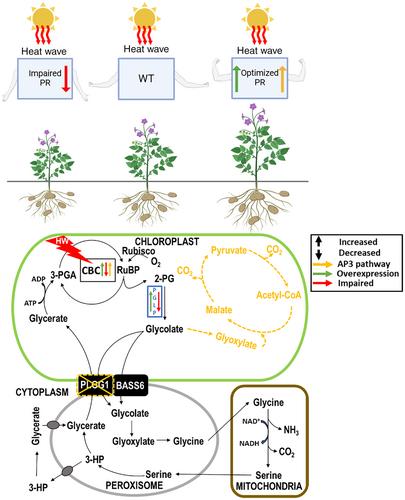
The original research by Meacham-Hensold et al. (2024), presented in Global Change Biology, provides a compelling example of how engineered photorespiratory bypasses could enhance plant yield and its acclimation to future climate scenarios, such as generally rising temperatures or heatwaves. Building on their earlier work, the authors genetically modified photorespiration in potato (Solanum tuberosum), the most widely cultivated non-grain crop and the fourth most consumed crop globally, and tested its performance over two growing seasons under natural field conditions in the United States. This genetic modification was previously tested successfully in the non-crop model tobacco (Nicotiana tabacum) (South, Cavanagh, and Liu 2019). In detail, the authors introduced the alternative photorespiration pathway 3 (AP3) into the chloroplasts of tobacco, while simultaneously reducing flux through the plants´ native photorespiratory pathway. This reduction was achieved by decreasing the export capacity of glycolate, a central pathway intermediate, from the chloroplast, using RNAi suppression to reduce the expression of the plastidial glycolate transporter (PLGG1) (see Figure 1). Consequently, the natural pathway might release less CO₂ because of reduced mitochondrial decarboxylation reactions. At the same time, CO₂ concentration within the chloroplast is enriched through two synthetically introduced decarboxylation reactions in the close vicinity of Rubisco, the enzyme responsible for CO₂ fixation, coevally suppressing its oxygenation reaction. This relocation of decarboxylation reactions, along with the reduced flux through the native photorespiratory cycle, is also hypothesized to reduce ATP and NADPH consumption, adding another potential benefit of the synthetic pathway. Another advantage of the synthetic pathway discussed is that it creates an additional sink for redox equivalents, serving to protect the light reactions from overreduction (Meacham-Hensold et al. 2024).
In agreement with their previous study on tobacco, the authors found strong evidence for improved tuber yield supporting their hypothesis in potato, particularly during a growing season in which plants encountered two natural heatwaves early in their vegetative stage. Under these conditions, AP3-modified plants demonstrated improved photosynthetic performance, including a 23% increase in the maximum carboxylation efficiency, a 13% increase in maximum rate of photosynthetic electron transport, and lower CO₂ compensation points, compared with control plants following two periods of exposure to temperatures of about 35°C. Additionally, during the tuber bulking phase, the AP3 plants showed increased accumulation of intermediates associated with the synthetic bypass pathway, suggesting an elevated carbon flux through the engineered metabolic route (Meacham-Hensold et al. 2024). This shift was accompanied by larger tuber masses, indicating that diverting carbon from the native photorespiratory cycle through enhanced glycolate metabolism in the AP3 pathway may increase carbon allocation from the CB cycle toward storage. This research thus highlights that alternative photorespiratory pathways can reduce photorespiratory losses, enhance carbon fixation, and improve abiotic stress tolerance in major crop species. Importantly, the study also found that the nutritional quality of potato tubers underwent rather inconsistent changes in the analyzed growing seasons, suggesting the transgenic approach largely maintains compatibility with human dietary needs (Meacham-Hensold et al. 2024). However, in some experiments the authors found a significant increase in iron alongside with smaller decreases in vitamin C and total dietary fiber. Hence, side effects on the overall nutrient compositions cannot yet be fully excluded. Furthermore, future research is needed to determine whether these gains in biomass and thermal resilience are responses to short-term environmental changes or whether they can be sustained under prolonged exposure to elevated temperatures.
Somewhat similar to the findings by Meacham-Hensold et al. (2024), further experimental evidence suggests that improving the native photorespiratory cycle by overexpressing, for example, the chloroplast 2-PG degrading enzyme, 2-PG phosphatase (PGLP1), can also contribute to enhancing plant thermostability (Timm et al. 2019; Figure 1). In detailed laboratory studies on transgenic Arabidopsis mutants with increased PGLP1 activity and, in turn, improved 2-PG degradation, researchers observed that these modified plants maintained higher rates of photosynthetic CO₂ fixation and related parameters at elevated temperatures of about 30°C, along with higher levels of transient starch storage (Timm et al. 2019). Given the specificity of this genetic modification, which solely affects 2-PG turnover, one can hypothesize that the improved detoxification of Rubisco's primary oxygenation byproduct is a key reason why optimized chloroplast photorespiratory reactions have positive impacts on photosynthesis, growth, and abiotic stress tolerance. To fully understand this effect and its underlying mechanistic, future experiments should conduct parallel comparisons on plants engineered using both strategies, allowing for a more comprehensive assessment of how different approaches to photorespiratory modification influence plant performance under stress. Certainly, combining both strategies would also be a welcome avenue of research to take, too.
As photorespiration is intimately intertwined with metabolic repair mechanisms for oxygenic phototrophs living in a high-oxygen environment, we are only beginning to grasp its further implications for plant physiology. However, an increasing body of evidence supports the hypothesis that optimized photorespiration can serve as a tool for enhancing plant tolerance to abiotic stress under projected climate change scenarios. Both approaches, bypassing parts of the photorespiratory pathway (Meacham-Hensold et al. 2024) and optimizing native photorespiration through enzyme overexpression (Timm et al. 2019), have shown potential to significantly improve plant resilience to elevated temperatures, including during heatwaves, or global warming in general. Future research is essential to determine whether these strategies can sustainably boost crop yields over the long term and in response to the combined environmental stresses anticipated with ongoing climate change.
Hu Sun: visualization, writing – review and editing. Inken Thiemann: writing – review and editing. Stefan Timm: writing – original draft, writing – review and editing.
期刊介绍:
Global Change Biology is an environmental change journal committed to shaping the future and addressing the world's most pressing challenges, including sustainability, climate change, environmental protection, food and water safety, and global health.
Dedicated to fostering a profound understanding of the impacts of global change on biological systems and offering innovative solutions, the journal publishes a diverse range of content, including primary research articles, technical advances, research reviews, reports, opinions, perspectives, commentaries, and letters. Starting with the 2024 volume, Global Change Biology will transition to an online-only format, enhancing accessibility and contributing to the evolution of scholarly communication.





 京公网安备 11010802042870号
京ICP备2023020795号-1
京公网安备 11010802042870号
京ICP备2023020795号-1

 分享
分享
 求助内容:
求助内容: 应助结果提醒方式:
 扫码关注我们
