Sanaa Hobeichi, Gab Abramowitz, Alex Sen Gupta, Andréa S. Taschetto, Doug Richardson, Neelesh Rampal, Hooman Ayat, Lisa V. Alexander, Andrew J. Pitman
{"title":"How well do climate modes explain precipitation variability?","authors":"Sanaa Hobeichi, Gab Abramowitz, Alex Sen Gupta, Andréa S. Taschetto, Doug Richardson, Neelesh Rampal, Hooman Ayat, Lisa V. Alexander, Andrew J. Pitman","doi":"10.1038/s41612-024-00853-5","DOIUrl":null,"url":null,"abstract":"Large-scale modes of climate variability, such as the El Niño-Southern Oscillation, North Atlantic Oscillation, and Indian Ocean Dipole, show significant regional correlations with seasonal weather conditions, and are routinely forecast by meteorological agencies attempting to anticipate seasonal precipitation patterns. Here, we use machine learning together with more traditional approaches to quantify how much precipitation variability can be explained by large-scale modes of variability, and to understand the degree to which these modes interact non-linearly. We find that the relationship between climate modes and precipitation is predominantly non-linear. In some regions and seasons climate modes can explain up to 80% of precipitation variability. However, variability explained is below 10% for more than half of the land surface, and only 1% of the land shows values above 50%. This outcome provides a clear rationale to limit expectations of predictability from modes of variability in all but a few select regions and seasons.","PeriodicalId":19438,"journal":{"name":"npj Climate and Atmospheric Science","volume":" ","pages":"1-9"},"PeriodicalIF":8.4000,"publicationDate":"2024-12-04","publicationTypes":"Journal Article","fieldsOfStudy":null,"isOpenAccess":false,"openAccessPdf":"https://www.nature.com/articles/s41612-024-00853-5.pdf","citationCount":"0","resultStr":null,"platform":"Semanticscholar","paperid":null,"PeriodicalName":"npj Climate and Atmospheric Science","FirstCategoryId":"89","ListUrlMain":"https://www.nature.com/articles/s41612-024-00853-5","RegionNum":1,"RegionCategory":"地球科学","ArticlePicture":[],"TitleCN":null,"AbstractTextCN":null,"PMCID":null,"EPubDate":"","PubModel":"","JCR":"Q1","JCRName":"METEOROLOGY & ATMOSPHERIC SCIENCES","Score":null,"Total":0}
引用次数: 0
Abstract
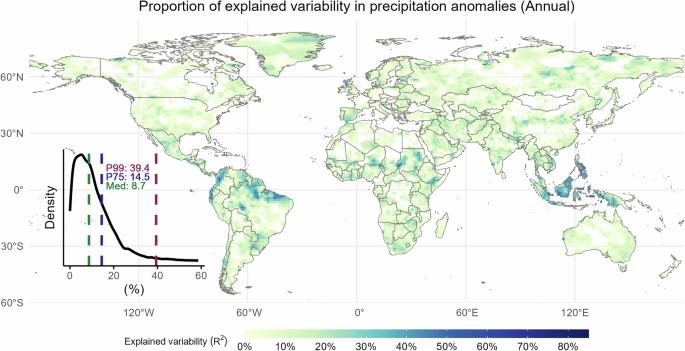
Large-scale modes of climate variability, such as the El Niño-Southern Oscillation, North Atlantic Oscillation, and Indian Ocean Dipole, show significant regional correlations with seasonal weather conditions, and are routinely forecast by meteorological agencies attempting to anticipate seasonal precipitation patterns. Here, we use machine learning together with more traditional approaches to quantify how much precipitation variability can be explained by large-scale modes of variability, and to understand the degree to which these modes interact non-linearly. We find that the relationship between climate modes and precipitation is predominantly non-linear. In some regions and seasons climate modes can explain up to 80% of precipitation variability. However, variability explained is below 10% for more than half of the land surface, and only 1% of the land shows values above 50%. This outcome provides a clear rationale to limit expectations of predictability from modes of variability in all but a few select regions and seasons.
期刊介绍:
npj Climate and Atmospheric Science is an open-access journal encompassing the relevant physical, chemical, and biological aspects of atmospheric and climate science. The journal places particular emphasis on regional studies that unveil new insights into specific localities, including examinations of local atmospheric composition, such as aerosols.
The range of topics covered by the journal includes climate dynamics, climate variability, weather and climate prediction, climate change, ocean dynamics, weather extremes, air pollution, atmospheric chemistry (including aerosols), the hydrological cycle, and atmosphere–ocean and atmosphere–land interactions. The journal welcomes studies employing a diverse array of methods, including numerical and statistical modeling, the development and application of in situ observational techniques, remote sensing, and the development or evaluation of new reanalyses.




 京公网安备 11010802042870号
京ICP备2023020795号-1
京公网安备 11010802042870号
京ICP备2023020795号-1

 分享
分享
 求助内容:
求助内容: 应助结果提醒方式:
 扫码关注我们
