Ekaterina Bellan, Martin Jakoobi, Vincent Collière, Yannick Coppel, Julien Trébosc, Olivier Lafon, Pierre Lecante, Paul Fleurat-Lessard, Céline Dupont, Jean-Cyrille Hierso, Pierre Fau, Katia Fajerwerg, Lauriane Pautrot-d’Alençon, Thierry Le Mercier, Myrtil L. Kahn
{"title":"Understanding Ion-Exchange Processes in the Synthesis of ZnSx@ZnO1–x Heterostructures from Controlled Sulfidation of ZnO Nanocrystals","authors":"Ekaterina Bellan, Martin Jakoobi, Vincent Collière, Yannick Coppel, Julien Trébosc, Olivier Lafon, Pierre Lecante, Paul Fleurat-Lessard, Céline Dupont, Jean-Cyrille Hierso, Pierre Fau, Katia Fajerwerg, Lauriane Pautrot-d’Alençon, Thierry Le Mercier, Myrtil L. Kahn","doi":"10.1021/acs.chemmater.4c01892","DOIUrl":null,"url":null,"abstract":"Semiconducting heterostructures are considered promising candidates for meeting specific environmental challenges, such as greener or decarbonated production of energy. However, optimizing the performance of these hybrid systems largely depends on the fine understanding of the mechanisms by which they are formed in relation to their mode of preparation. We report herein the synthesis of nanosized semiconducting heterostructures of ZnS@ZnO shell-core nature; this is from well-controlled preformed ZnO nanoparticles (NPs) modified via anion exchange process using (TMS)<sub>2</sub>S. The formation of these ZnS@ZnO heterostructures has been investigated in depth, shedding light specifically on the sulfidation mechanism and its dynamics. Our study reveals the dynamic evolution of the nanomaterial in the sulfidation process, evidencing that it is both driven by the initial presence of oxygen vacancies─acting as gateways for sulfur atoms─and also by the action in the medium of (TMS)<sub>2</sub>S, which as a sulfurizing agent behaves also as an oxygen atom extractor. The structural modification of the preformed monocrystalline ZnO nanomaterial into a polycrystalline ZnS hollow nanostructure occurs via amorphization–crystallization steps, which clearly depends on the amount of (TMS)<sub>2</sub>S in the reaction. This morphological transition to a hollow structure has been followed by multinuclear NMR spectroscopy (<sup>1</sup>H, <sup>13</sup>C, <sup>17</sup>O), and notably oxygen atoms at the interfaces of ZnS@ZnO heterostructures have been identified and quantified. Consistently, our study clearly establishes the link between the preparation mode of the ZnS@ZnO heterostructures and the modification of their optical band gaps as a function of their composition. The variation in optical properties, and the bowing of the band gap, depends on the sulfidation level, and this mode of sulfidation is clarified step-by-step by a DFT computational approach of surface and interface processes that is fully supported by the experimental characterization (XRD, WAXS, EDX line-analysis, HRTEM, STEM-HAADF) of these materials.","PeriodicalId":33,"journal":{"name":"Chemistry of Materials","volume":"117 1","pages":""},"PeriodicalIF":7.0000,"publicationDate":"2024-12-03","publicationTypes":"Journal Article","fieldsOfStudy":null,"isOpenAccess":false,"openAccessPdf":"","citationCount":"0","resultStr":null,"platform":"Semanticscholar","paperid":null,"PeriodicalName":"Chemistry of Materials","FirstCategoryId":"88","ListUrlMain":"https://doi.org/10.1021/acs.chemmater.4c01892","RegionNum":2,"RegionCategory":"材料科学","ArticlePicture":[],"TitleCN":null,"AbstractTextCN":null,"PMCID":null,"EPubDate":"","PubModel":"","JCR":"Q2","JCRName":"CHEMISTRY, PHYSICAL","Score":null,"Total":0}
引用次数: 0
Abstract
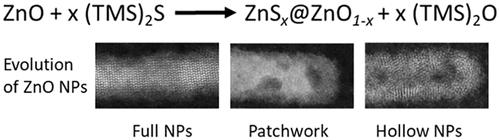
Semiconducting heterostructures are considered promising candidates for meeting specific environmental challenges, such as greener or decarbonated production of energy. However, optimizing the performance of these hybrid systems largely depends on the fine understanding of the mechanisms by which they are formed in relation to their mode of preparation. We report herein the synthesis of nanosized semiconducting heterostructures of ZnS@ZnO shell-core nature; this is from well-controlled preformed ZnO nanoparticles (NPs) modified via anion exchange process using (TMS)2S. The formation of these ZnS@ZnO heterostructures has been investigated in depth, shedding light specifically on the sulfidation mechanism and its dynamics. Our study reveals the dynamic evolution of the nanomaterial in the sulfidation process, evidencing that it is both driven by the initial presence of oxygen vacancies─acting as gateways for sulfur atoms─and also by the action in the medium of (TMS)2S, which as a sulfurizing agent behaves also as an oxygen atom extractor. The structural modification of the preformed monocrystalline ZnO nanomaterial into a polycrystalline ZnS hollow nanostructure occurs via amorphization–crystallization steps, which clearly depends on the amount of (TMS)2S in the reaction. This morphological transition to a hollow structure has been followed by multinuclear NMR spectroscopy (1H, 13C, 17O), and notably oxygen atoms at the interfaces of ZnS@ZnO heterostructures have been identified and quantified. Consistently, our study clearly establishes the link between the preparation mode of the ZnS@ZnO heterostructures and the modification of their optical band gaps as a function of their composition. The variation in optical properties, and the bowing of the band gap, depends on the sulfidation level, and this mode of sulfidation is clarified step-by-step by a DFT computational approach of surface and interface processes that is fully supported by the experimental characterization (XRD, WAXS, EDX line-analysis, HRTEM, STEM-HAADF) of these materials.
期刊介绍:
The journal Chemistry of Materials focuses on publishing original research at the intersection of materials science and chemistry. The studies published in the journal involve chemistry as a prominent component and explore topics such as the design, synthesis, characterization, processing, understanding, and application of functional or potentially functional materials. The journal covers various areas of interest, including inorganic and organic solid-state chemistry, nanomaterials, biomaterials, thin films and polymers, and composite/hybrid materials. The journal particularly seeks papers that highlight the creation or development of innovative materials with novel optical, electrical, magnetic, catalytic, or mechanical properties. It is essential that manuscripts on these topics have a primary focus on the chemistry of materials and represent a significant advancement compared to prior research. Before external reviews are sought, submitted manuscripts undergo a review process by a minimum of two editors to ensure their appropriateness for the journal and the presence of sufficient evidence of a significant advance that will be of broad interest to the materials chemistry community.



 京公网安备 11010802042870号
京ICP备2023020795号-1
京公网安备 11010802042870号
京ICP备2023020795号-1

 分享
分享
 求助内容:
求助内容: 应助结果提醒方式:
 扫码关注我们
