Joseph D. Dixon MD, Aruna V. Josyula MD, MPH, Noelle Marie Javier MD, Yael Zweig MSN, Mriganka Singh MD, AGSF, Luke Kim MD, MEd, Niranjan Thothala MD, MBA, Timothy W. Farrell MD, AGSF
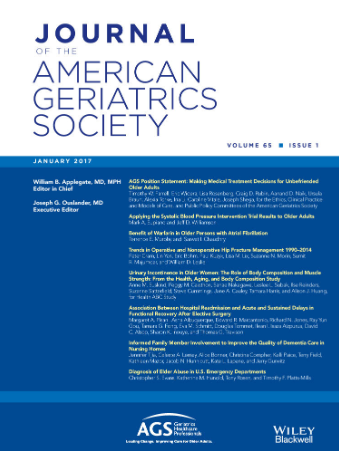
{"title":"American Geriatrics Society position statement: Making medical treatment decisions for unrepresented older adults","authors":"Joseph D. Dixon MD, Aruna V. Josyula MD, MPH, Noelle Marie Javier MD, Yael Zweig MSN, Mriganka Singh MD, AGSF, Luke Kim MD, MEd, Niranjan Thothala MD, MBA, Timothy W. Farrell MD, AGSF","doi":"10.1111/jgs.19288","DOIUrl":null,"url":null,"abstract":"<p>This paper is an official position statement of the American Geriatrics Society (AGS) and updates the 2017 AGS position statement, Making Medical Treatment Decisions for Unbefriended Older Adults. In this updated position statement, the term “unbefriended” is replaced by “unrepresented” as a term that is more value-neutral, more accurately describes the circumstance in which a person without medical decision-making capacity does not have recognized surrogate representation, and better aligns with increasingly preferred terminology as reflected in recent medical literature. We define unrepresented older adults as those who (1) lack decisional capacity to provide informed consent for a particular medical treatment, (2) have not executed an advance directive that addresses the medical treatment at hand and lack capacity to do so, and (3) lack representation from a surrogate decision-maker (i.e., family, friend, or legally authorized surrogate). Making medical decisions on behalf of unrepresented older adults is exceptionally challenging and, given demographic trends, is likely to become increasingly common in the years ahead. The process of arriving at treatment decisions for this population should follow standards of procedural fairness and include capacity assessment, search for potential surrogates, team-based efforts to determine the patient's values and preferences, and steps to guard against bias. Proactive measures are needed to identify older adults at risk for becoming unrepresented. This position statement also calls for national efforts to reduce state-to-state variability in legal approaches for unrepresented patients.</p>","PeriodicalId":17240,"journal":{"name":"Journal of the American Geriatrics Society","volume":"73 5","pages":"1353-1364"},"PeriodicalIF":4.6000,"publicationDate":"2024-11-30","publicationTypes":"Journal Article","fieldsOfStudy":null,"isOpenAccess":false,"openAccessPdf":"https://onlinelibrary.wiley.com/doi/epdf/10.1111/jgs.19288","citationCount":"0","resultStr":null,"platform":"Semanticscholar","paperid":null,"PeriodicalName":"Journal of the American Geriatrics Society","FirstCategoryId":"3","ListUrlMain":"https://agsjournals.onlinelibrary.wiley.com/doi/10.1111/jgs.19288","RegionNum":2,"RegionCategory":"医学","ArticlePicture":[],"TitleCN":null,"AbstractTextCN":null,"PMCID":null,"EPubDate":"","PubModel":"","JCR":"Q1","JCRName":"GERIATRICS & GERONTOLOGY","Score":null,"Total":0}
引用次数: 0
Abstract
This paper is an official position statement of the American Geriatrics Society (AGS) and updates the 2017 AGS position statement, Making Medical Treatment Decisions for Unbefriended Older Adults. In this updated position statement, the term “unbefriended” is replaced by “unrepresented” as a term that is more value-neutral, more accurately describes the circumstance in which a person without medical decision-making capacity does not have recognized surrogate representation, and better aligns with increasingly preferred terminology as reflected in recent medical literature. We define unrepresented older adults as those who (1) lack decisional capacity to provide informed consent for a particular medical treatment, (2) have not executed an advance directive that addresses the medical treatment at hand and lack capacity to do so, and (3) lack representation from a surrogate decision-maker (i.e., family, friend, or legally authorized surrogate). Making medical decisions on behalf of unrepresented older adults is exceptionally challenging and, given demographic trends, is likely to become increasingly common in the years ahead. The process of arriving at treatment decisions for this population should follow standards of procedural fairness and include capacity assessment, search for potential surrogates, team-based efforts to determine the patient's values and preferences, and steps to guard against bias. Proactive measures are needed to identify older adults at risk for becoming unrepresented. This position statement also calls for national efforts to reduce state-to-state variability in legal approaches for unrepresented patients.
期刊介绍:
Journal of the American Geriatrics Society (JAGS) is the go-to journal for clinical aging research. We provide a diverse, interprofessional community of healthcare professionals with the latest insights on geriatrics education, clinical practice, and public policy—all supporting the high-quality, person-centered care essential to our well-being as we age. Since the publication of our first edition in 1953, JAGS has remained one of the oldest and most impactful journals dedicated exclusively to gerontology and geriatrics.




 京公网安备 11010802042870号
京ICP备2023020795号-1
京公网安备 11010802042870号
京ICP备2023020795号-1

 分享
分享
 求助内容:
求助内容: 应助结果提醒方式:
 扫码关注我们
