W. Verla , N. Lumen , M. Waterloos , J. Adamowicz , F. Campos-Juanatey , A. Cocci , M. Frankiewicz , G. Mantica , C. Rosenbaum , F.X. Madec , E. Redmond , Ł. Białek , F. Chierigo , M. Oszczudłowski , M. Vetterlein , en representación del Grupo de Trabajo de Urología Reconstructiva y Trauma Urológico de la Sección de Jóvenes Urólogos Académicos - Asociación Europea de Urología
{"title":"Treatment of anastomotic strictures after phalloplasty: An up-to-date review of the literature","authors":"W. Verla , N. Lumen , M. Waterloos , J. Adamowicz , F. Campos-Juanatey , A. Cocci , M. Frankiewicz , G. Mantica , C. Rosenbaum , F.X. Madec , E. Redmond , Ł. Białek , F. Chierigo , M. Oszczudłowski , M. Vetterlein , en representación del Grupo de Trabajo de Urología Reconstructiva y Trauma Urológico de la Sección de Jóvenes Urólogos Académicos - Asociación Europea de Urología","doi":"10.1016/j.acuroe.2024.11.001","DOIUrl":null,"url":null,"abstract":"<div><h3>Introduction</h3><div>Neo-urethral stricture formation frequently occurs after phalloplasty and most commonly affects the anastomosis between the fixed and phallic part of the neo-urethra. This narrative review gives an overview of the existing literature on how to treat these particular strictures.</div></div><div><h3>Methods</h3><div>This narrative review is based on a literature search conducted in June 2024. No restrictions in terms of publication date, language or sample size were applied.</div></div><div><h3>Results</h3><div>Treatment options include direct vision internal urethrotomy, anastomotic repair urethroplasty, augmentation urethroplasty with grafts or flaps, multi-stage urethroplasty and urethrostomy. Overall, outcomes of these treatments are worse in transmen than in cismen, mainly due to the specific challenges posed by the neophallus environment. Generally, limited data are available on the treatment options for patients with anastomotic strictures after phalloplasty and, consequently, no clear recommendations can be made.</div></div><div><h3>Conclusion</h3><div>This narrative review provides a comprehensive and up-to-date overview of the available literature, which may guide future research and help optimize the outcomes for patients with this complex problem after phalloplasty.</div></div>","PeriodicalId":94291,"journal":{"name":"Actas urologicas espanolas","volume":"49 1","pages":"Pages 35-41"},"PeriodicalIF":0.0000,"publicationDate":"2025-01-01","publicationTypes":"Journal Article","fieldsOfStudy":null,"isOpenAccess":false,"openAccessPdf":"","citationCount":"0","resultStr":null,"platform":"Semanticscholar","paperid":null,"PeriodicalName":"Actas urologicas espanolas","FirstCategoryId":"1085","ListUrlMain":"https://www.sciencedirect.com/science/article/pii/S2173578624001203","RegionNum":0,"RegionCategory":null,"ArticlePicture":[],"TitleCN":null,"AbstractTextCN":null,"PMCID":null,"EPubDate":"2024/11/28 0:00:00","PubModel":"Epub","JCR":"","JCRName":"","Score":null,"Total":0}
引用次数: 0
Abstract
Introduction
Neo-urethral stricture formation frequently occurs after phalloplasty and most commonly affects the anastomosis between the fixed and phallic part of the neo-urethra. This narrative review gives an overview of the existing literature on how to treat these particular strictures.
Methods
This narrative review is based on a literature search conducted in June 2024. No restrictions in terms of publication date, language or sample size were applied.
Results
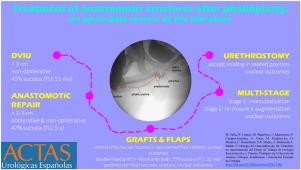
Treatment options include direct vision internal urethrotomy, anastomotic repair urethroplasty, augmentation urethroplasty with grafts or flaps, multi-stage urethroplasty and urethrostomy. Overall, outcomes of these treatments are worse in transmen than in cismen, mainly due to the specific challenges posed by the neophallus environment. Generally, limited data are available on the treatment options for patients with anastomotic strictures after phalloplasty and, consequently, no clear recommendations can be made.
Conclusion
This narrative review provides a comprehensive and up-to-date overview of the available literature, which may guide future research and help optimize the outcomes for patients with this complex problem after phalloplasty.



 京公网安备 11010802042870号
京ICP备2023020795号-1
京公网安备 11010802042870号
京ICP备2023020795号-1

 分享
分享

 求助内容:
求助内容: 应助结果提醒方式:
 扫码关注我们
