Xueling Tan , Juanqi Zhong , Yongfen Tong , Lin Guo , Yu Xie , Jinsheng Zhao
{"title":"Ionic covalent organic framework based quasi-solid-state electrolyte for high-performance lithium metal battery","authors":"Xueling Tan , Juanqi Zhong , Yongfen Tong , Lin Guo , Yu Xie , Jinsheng Zhao","doi":"10.1016/j.polymer.2024.127911","DOIUrl":null,"url":null,"abstract":"<div><div>Lithium metal solid-state batteries are promising as rechargeable energy storage devices due to their non-combustible nature, resistance to high temperatures, and non-corrosive properties. However, their widespread application is hindered by low lithium-ion conductivity and poor compatibility at the electrode/electrolyte interface. To address these challenges, two covalent organic frameworks (COFs), one with functional imidazolium groups (Dha-COF<sub>im</sub>) and one without (Dha-COF), were synthesized. Ionic liquids (ILs) were then incorporated into these COFs to create quasi-solid-state electrolytes (Dha-COF<sub>im</sub>-IL and Dha–COF–IL). The Dha-COF<sub>im</sub>, with its ordered porous structure, forms interconnected ion channels that enable fast lithium-ion transport and enhance lithium salt dissociation, achieving excellent thermal stability, high ionic conductivity (1.74 × 10⁻³ S cm⁻<sup>1</sup>), and a wide electrochemical window at room temperature. Density functional theory (DFT) calculations showed that the fixed imidazolium groups in Dha-COF<sub>im</sub> enhance interactions with TFSI⁻ anions, improving lithium salt dissociation. This allows free lithium ions to move quickly through the channels with minimal energy loss. Additionally, the formation of a stable SEI layer rich in LiF and Li<sub>3</sub>N at the lithium metal/electrolyte interface accelerates Li⁺transport, ensuring uniform lithium deposition and superior battery performance. When combined with a LiFePO<sub>4</sub> cathode, the LiFePO<sub>4</sub>‖Dha-COFim-IL‖Li cell delivers high discharge capacity and excellent cycling stability, providing a new strategy for designing quasi-solid-state electrolytes for high-energy-density lithium batteries.</div></div>","PeriodicalId":405,"journal":{"name":"Polymer","volume":"317 ","pages":"Article 127911"},"PeriodicalIF":4.5000,"publicationDate":"2025-01-15","publicationTypes":"Journal Article","fieldsOfStudy":null,"isOpenAccess":false,"openAccessPdf":"","citationCount":"0","resultStr":null,"platform":"Semanticscholar","paperid":null,"PeriodicalName":"Polymer","FirstCategoryId":"92","ListUrlMain":"https://www.sciencedirect.com/science/article/pii/S0032386124012473","RegionNum":2,"RegionCategory":"化学","ArticlePicture":[],"TitleCN":null,"AbstractTextCN":null,"PMCID":null,"EPubDate":"","PubModel":"","JCR":"Q2","JCRName":"POLYMER SCIENCE","Score":null,"Total":0}
引用次数: 0
Abstract
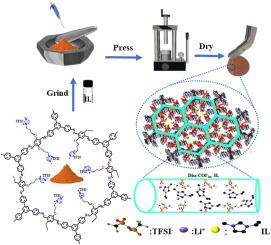
Lithium metal solid-state batteries are promising as rechargeable energy storage devices due to their non-combustible nature, resistance to high temperatures, and non-corrosive properties. However, their widespread application is hindered by low lithium-ion conductivity and poor compatibility at the electrode/electrolyte interface. To address these challenges, two covalent organic frameworks (COFs), one with functional imidazolium groups (Dha-COFim) and one without (Dha-COF), were synthesized. Ionic liquids (ILs) were then incorporated into these COFs to create quasi-solid-state electrolytes (Dha-COFim-IL and Dha–COF–IL). The Dha-COFim, with its ordered porous structure, forms interconnected ion channels that enable fast lithium-ion transport and enhance lithium salt dissociation, achieving excellent thermal stability, high ionic conductivity (1.74 × 10⁻³ S cm⁻1), and a wide electrochemical window at room temperature. Density functional theory (DFT) calculations showed that the fixed imidazolium groups in Dha-COFim enhance interactions with TFSI⁻ anions, improving lithium salt dissociation. This allows free lithium ions to move quickly through the channels with minimal energy loss. Additionally, the formation of a stable SEI layer rich in LiF and Li3N at the lithium metal/electrolyte interface accelerates Li⁺transport, ensuring uniform lithium deposition and superior battery performance. When combined with a LiFePO4 cathode, the LiFePO4‖Dha-COFim-IL‖Li cell delivers high discharge capacity and excellent cycling stability, providing a new strategy for designing quasi-solid-state electrolytes for high-energy-density lithium batteries.
期刊介绍:
Polymer is an interdisciplinary journal dedicated to publishing innovative and significant advances in Polymer Physics, Chemistry and Technology. We welcome submissions on polymer hybrids, nanocomposites, characterisation and self-assembly. Polymer also publishes work on the technological application of polymers in energy and optoelectronics.
The main scope is covered but not limited to the following core areas:
Polymer Materials
Nanocomposites and hybrid nanomaterials
Polymer blends, films, fibres, networks and porous materials
Physical Characterization
Characterisation, modelling and simulation* of molecular and materials properties in bulk, solution, and thin films
Polymer Engineering
Advanced multiscale processing methods
Polymer Synthesis, Modification and Self-assembly
Including designer polymer architectures, mechanisms and kinetics, and supramolecular polymerization
Technological Applications
Polymers for energy generation and storage
Polymer membranes for separation technology
Polymers for opto- and microelectronics.





 京公网安备 11010802042870号
京ICP备2023020795号-1
京公网安备 11010802042870号
京ICP备2023020795号-1

 分享
分享
 求助内容:
求助内容: 应助结果提醒方式:
 扫码关注我们
