First Results of Migoprotafib, a Potent and Highly Selective Src Homology-2 Domain-Containing Phosphatase 2 Inhibitor in Patients with Advanced Solid Tumors.
Melissa L Johnson, Beni B Wolf, Judy S Wang, Alexander Philipovskiy, Geoffrey I Shapiro, Bruno Bockorny, Wei Guo, Jinshan Shen, Kai Yu Jen, MaryBeth LeRose, Tamieka Lauz Hunter, Mahesh Padval, Oleg Schmidt-Kittler, Namrata Bhatia, Sarita Dubey, Julia Suchomel, Johanna C Bendell, Shekeab Jauhari, Jennifer Eng-Wong, Jessica J Lin
{"title":"First Results of Migoprotafib, a Potent and Highly Selective Src Homology-2 Domain-Containing Phosphatase 2 Inhibitor in Patients with Advanced Solid Tumors.","authors":"Melissa L Johnson, Beni B Wolf, Judy S Wang, Alexander Philipovskiy, Geoffrey I Shapiro, Bruno Bockorny, Wei Guo, Jinshan Shen, Kai Yu Jen, MaryBeth LeRose, Tamieka Lauz Hunter, Mahesh Padval, Oleg Schmidt-Kittler, Namrata Bhatia, Sarita Dubey, Julia Suchomel, Johanna C Bendell, Shekeab Jauhari, Jennifer Eng-Wong, Jessica J Lin","doi":"10.1158/1535-7163.MCT-24-0466","DOIUrl":null,"url":null,"abstract":"<p><p>Src homology-2 domain-containing phosphatase 2 promotes rat sarcoma viral oncogene homolog-MAPK signaling and tumorigenesis and is a promising therapeutic target for multiple solid tumors. Migoprotafib is a potent and highly selective Src homology-2 domain-containing phosphatase 2 inhibitor designed for the treatment of rat sarcoma viral oncogene homolog-MAPK-driven cancers, particularly in combination with other targeted agents. Here, we report first-in-human study results of single-agent migoprotafib in patients with advanced solid tumor. We conducted a phase Ia, open-label, multi-center, dose-escalation and expansion study in adult patients with locally advanced or metastatic solid tumors. The key objectives were to evaluate safety, pharmacokinetics (PK), pharmacodynamics (peripheral blood phosphorylated ERK), and preliminary antitumor activity. Fifty-six heavily pretreated patients were treated with migoprotafib (10-150 mg once daily). Migoprotafib had a rapid absorption rate (∼0.5-2 hours) with dose-dependent increases in exposure and pathway modulation (phosphorylated ERK changes). The maximum tolerated dose was 100 mg, and the recommended phase II dose was 60 mg daily (once daily) based on safety, PK, pharmacodynamics, and antitumor activity. Migoprotafib was generally well tolerated with the most frequent adverse events of diarrhea, peripheral edema, dyspnea, anemia, constipation, fatigue, aspartate aminotransferase increase, and platelet count decrease. Stable disease was observed in 10 patients (18%). Migoprotafib had predictable, dose-dependent PK with an effective half-life that supports once-daily dosing and demonstrated promising safety, tolerability, and clinical activity at the recommended phase II dose. Further clinical testing of migoprotafib in combination with other targeted agents is warranted.</p>","PeriodicalId":18791,"journal":{"name":"Molecular Cancer Therapeutics","volume":" ","pages":"384-391"},"PeriodicalIF":5.5000,"publicationDate":"2025-03-04","publicationTypes":"Journal Article","fieldsOfStudy":null,"isOpenAccess":false,"openAccessPdf":"https://www.ncbi.nlm.nih.gov/pmc/articles/PMC11876956/pdf/","citationCount":"0","resultStr":null,"platform":"Semanticscholar","paperid":null,"PeriodicalName":"Molecular Cancer Therapeutics","FirstCategoryId":"3","ListUrlMain":"https://doi.org/10.1158/1535-7163.MCT-24-0466","RegionNum":2,"RegionCategory":"医学","ArticlePicture":[],"TitleCN":null,"AbstractTextCN":null,"PMCID":null,"EPubDate":"","PubModel":"","JCR":"Q1","JCRName":"ONCOLOGY","Score":null,"Total":0}
引用次数: 0
Abstract
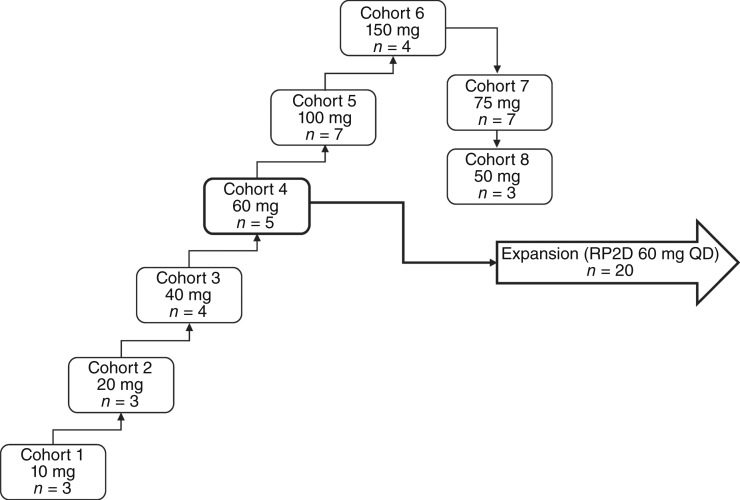
Src homology-2 domain-containing phosphatase 2 promotes rat sarcoma viral oncogene homolog-MAPK signaling and tumorigenesis and is a promising therapeutic target for multiple solid tumors. Migoprotafib is a potent and highly selective Src homology-2 domain-containing phosphatase 2 inhibitor designed for the treatment of rat sarcoma viral oncogene homolog-MAPK-driven cancers, particularly in combination with other targeted agents. Here, we report first-in-human study results of single-agent migoprotafib in patients with advanced solid tumor. We conducted a phase Ia, open-label, multi-center, dose-escalation and expansion study in adult patients with locally advanced or metastatic solid tumors. The key objectives were to evaluate safety, pharmacokinetics (PK), pharmacodynamics (peripheral blood phosphorylated ERK), and preliminary antitumor activity. Fifty-six heavily pretreated patients were treated with migoprotafib (10-150 mg once daily). Migoprotafib had a rapid absorption rate (∼0.5-2 hours) with dose-dependent increases in exposure and pathway modulation (phosphorylated ERK changes). The maximum tolerated dose was 100 mg, and the recommended phase II dose was 60 mg daily (once daily) based on safety, PK, pharmacodynamics, and antitumor activity. Migoprotafib was generally well tolerated with the most frequent adverse events of diarrhea, peripheral edema, dyspnea, anemia, constipation, fatigue, aspartate aminotransferase increase, and platelet count decrease. Stable disease was observed in 10 patients (18%). Migoprotafib had predictable, dose-dependent PK with an effective half-life that supports once-daily dosing and demonstrated promising safety, tolerability, and clinical activity at the recommended phase II dose. Further clinical testing of migoprotafib in combination with other targeted agents is warranted.
期刊介绍:
Molecular Cancer Therapeutics will focus on basic research that has implications for cancer therapeutics in the following areas: Experimental Cancer Therapeutics, Identification of Molecular Targets, Targets for Chemoprevention, New Models, Cancer Chemistry and Drug Discovery, Molecular and Cellular Pharmacology, Molecular Classification of Tumors, and Bioinformatics and Computational Molecular Biology. The journal provides a publication forum for these emerging disciplines that is focused specifically on cancer research. Papers are stringently reviewed and only those that report results of novel, timely, and significant research and meet high standards of scientific merit will be accepted for publication.





 京公网安备 11010802042870号
京ICP备2023020795号-1
京公网安备 11010802042870号
京ICP备2023020795号-1

 分享
分享
 求助内容:
求助内容: 应助结果提醒方式:
 扫码关注我们
