p38 MAPK determines the sensitivity of the aquatic keystone species Moina macrocopa to toxic Microcystis: Insights into potential biomarker applications
Kai Lyu, Yuchen Fan, Xinyu Zhou, Yuzhou Hou, Zhou Yang
{"title":"p38 MAPK determines the sensitivity of the aquatic keystone species Moina macrocopa to toxic Microcystis: Insights into potential biomarker applications","authors":"Kai Lyu, Yuchen Fan, Xinyu Zhou, Yuzhou Hou, Zhou Yang","doi":"10.1016/j.envpol.2024.125458","DOIUrl":null,"url":null,"abstract":"<div><div>Harmful cyanobacterial blooms, particularly those caused by <em>Microcystis</em> species, pose significant ecological threats to freshwater environments by negatively impacting zooplankton populations, essential components of aquatic food webs. Understanding the molecular mechanisms underlying zooplankton responses to these toxic blooms is crucial for assessing and mitigating these impacts. The mitogen-activated protein kinase (MAPK) pathway, known for its critical role in stress response signaling, offers a promising area of study to elucidate these mechanisms. However, the specific involvement of MAPK in zooplankton responses to cyanobacterial stress remains unclear. In this study, we identify and characterize the p38 MAPK gene (MmMAPK) from the zooplankton <em>Moina macrocopa</em>. The gene contains conserved structural elements typical of MAPKs, including a Thr-Gly-Tyr (TGY) motif and a substrate-binding site, Ala-Thr-Arg-Trp (ATRW), indicating its potential functional relevance in stress signaling pathways. Expression analysis reveals a significant upregulation of MmMAPK in <em>M. macrocopa</em> upon exposure to toxic <em>Microcystis</em>, suggesting its role in mediating the organism's stress response. Furthermore, RNA interference (RNAi) experiments demonstrate that knockdown of MmMAPK results in reduced survival and decreased body size, particularly under cyanobacterial stress, underscoring its importance in maintaining stress sensitivity. These findings provide new insights into the molecular mechanisms by which <em>M. macrocopa</em> responds to harmful algal blooms and highlight the potential of MmMAPK as a biomarker for ecological risk assessment and management of cyanobacterial pollution in freshwater ecosystems.</div></div>","PeriodicalId":311,"journal":{"name":"Environmental Pollution","volume":"366 ","pages":"Article 125458"},"PeriodicalIF":7.3000,"publicationDate":"2025-02-01","publicationTypes":"Journal Article","fieldsOfStudy":null,"isOpenAccess":false,"openAccessPdf":"","citationCount":"0","resultStr":null,"platform":"Semanticscholar","paperid":null,"PeriodicalName":"Environmental Pollution","FirstCategoryId":"93","ListUrlMain":"https://www.sciencedirect.com/science/article/pii/S0269749124021754","RegionNum":2,"RegionCategory":"环境科学与生态学","ArticlePicture":[],"TitleCN":null,"AbstractTextCN":null,"PMCID":null,"EPubDate":"2024/12/6 0:00:00","PubModel":"Epub","JCR":"Q1","JCRName":"ENVIRONMENTAL SCIENCES","Score":null,"Total":0}
引用次数: 0
Abstract
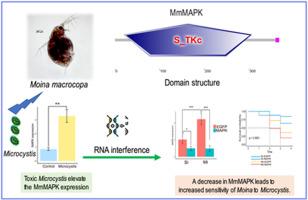
Harmful cyanobacterial blooms, particularly those caused by Microcystis species, pose significant ecological threats to freshwater environments by negatively impacting zooplankton populations, essential components of aquatic food webs. Understanding the molecular mechanisms underlying zooplankton responses to these toxic blooms is crucial for assessing and mitigating these impacts. The mitogen-activated protein kinase (MAPK) pathway, known for its critical role in stress response signaling, offers a promising area of study to elucidate these mechanisms. However, the specific involvement of MAPK in zooplankton responses to cyanobacterial stress remains unclear. In this study, we identify and characterize the p38 MAPK gene (MmMAPK) from the zooplankton Moina macrocopa. The gene contains conserved structural elements typical of MAPKs, including a Thr-Gly-Tyr (TGY) motif and a substrate-binding site, Ala-Thr-Arg-Trp (ATRW), indicating its potential functional relevance in stress signaling pathways. Expression analysis reveals a significant upregulation of MmMAPK in M. macrocopa upon exposure to toxic Microcystis, suggesting its role in mediating the organism's stress response. Furthermore, RNA interference (RNAi) experiments demonstrate that knockdown of MmMAPK results in reduced survival and decreased body size, particularly under cyanobacterial stress, underscoring its importance in maintaining stress sensitivity. These findings provide new insights into the molecular mechanisms by which M. macrocopa responds to harmful algal blooms and highlight the potential of MmMAPK as a biomarker for ecological risk assessment and management of cyanobacterial pollution in freshwater ecosystems.
期刊介绍:
Environmental Pollution is an international peer-reviewed journal that publishes high-quality research papers and review articles covering all aspects of environmental pollution and its impacts on ecosystems and human health.
Subject areas include, but are not limited to:
• Sources and occurrences of pollutants that are clearly defined and measured in environmental compartments, food and food-related items, and human bodies;
• Interlinks between contaminant exposure and biological, ecological, and human health effects, including those of climate change;
• Contaminants of emerging concerns (including but not limited to antibiotic resistant microorganisms or genes, microplastics/nanoplastics, electronic wastes, light, and noise) and/or their biological, ecological, or human health effects;
• Laboratory and field studies on the remediation/mitigation of environmental pollution via new techniques and with clear links to biological, ecological, or human health effects;
• Modeling of pollution processes, patterns, or trends that is of clear environmental and/or human health interest;
• New techniques that measure and examine environmental occurrences, transport, behavior, and effects of pollutants within the environment or the laboratory, provided that they can be clearly used to address problems within regional or global environmental compartments.




 京公网安备 11010802042870号
京ICP备2023020795号-1
京公网安备 11010802042870号
京ICP备2023020795号-1

 分享
分享
 求助内容:
求助内容: 应助结果提醒方式:
 扫码关注我们
