Shuanglin Jia, Wanyu Qian, Penglu Yu, Ke Li, Wenxin Tang, Mingxuan Li, Jinle Lan, Yuan-Hua Lin, Xiaoping Yang
{"title":"Realization of Hydrogel Electrolytes with High Thermoelectric Properties: Utilization of the Hofmeister Effect.","authors":"Shuanglin Jia, Wanyu Qian, Penglu Yu, Ke Li, Wenxin Tang, Mingxuan Li, Jinle Lan, Yuan-Hua Lin, Xiaoping Yang","doi":"10.1021/acsami.4c18790","DOIUrl":null,"url":null,"abstract":"<p><p>Ionic thermoelectric materials, renowned for their high Seebeck coefficients, are gaining prominence for their potential in harvesting low-grade waste heat. However, the theoretical underpinnings for enhancing the performance of these materials remain underexplored. In this study, the Hoffmeister effect was leveraged to augment the thermoelectric properties of hydrogel-based ionic thermoelectric materials. A series of PAAm-<i>x</i> Zn(CF<sub>3</sub>SO<sub>3</sub>)<sub>2</sub>, PAAm-<i>x</i> ZnSO<sub>4</sub>, and PAAm-<i>x</i> Zn(ClO<sub>4</sub>)<sub>2</sub> hydrogels were synthesized, using polyacrylamide (PAAm) as the matrix and three distinct zinc salts with varying anion volumes to impart the Hoffmeister effect. Exceptionally, the most cost-effective ZnSO<sub>4</sub> yielded the highest ionic Seebeck coefficient among the hydrogels, with PAAm-1 ZnSO<sub>4</sub> achieving a remarkable value of -3.72 mV K<sup>-1</sup>. To elucidate the underlying mechanism, we conducted an innovative analysis correlating the Seebeck coefficient with the zinc ion transfer number. Additionally, the hydrogel materials demonstrated outstanding mechanical properties, including high elongation at break (>1400% at its peak), exceptional resilience (virtually no hysteresis loops), and robust fatigue resistance (overlapping cyclic tensile curves). This work not only advances the understanding of ionic thermoelectric materials but also showcases the potential of hydrogels for practical waste heat recovery applications.</p>","PeriodicalId":5,"journal":{"name":"ACS Applied Materials & Interfaces","volume":" ","pages":"69519-69528"},"PeriodicalIF":8.2000,"publicationDate":"2024-12-18","publicationTypes":"Journal Article","fieldsOfStudy":null,"isOpenAccess":false,"openAccessPdf":"","citationCount":"0","resultStr":null,"platform":"Semanticscholar","paperid":null,"PeriodicalName":"ACS Applied Materials & Interfaces","FirstCategoryId":"88","ListUrlMain":"https://doi.org/10.1021/acsami.4c18790","RegionNum":2,"RegionCategory":"材料科学","ArticlePicture":[],"TitleCN":null,"AbstractTextCN":null,"PMCID":null,"EPubDate":"2024/12/5 0:00:00","PubModel":"Epub","JCR":"Q1","JCRName":"MATERIALS SCIENCE, MULTIDISCIPLINARY","Score":null,"Total":0}
引用次数: 0
Abstract
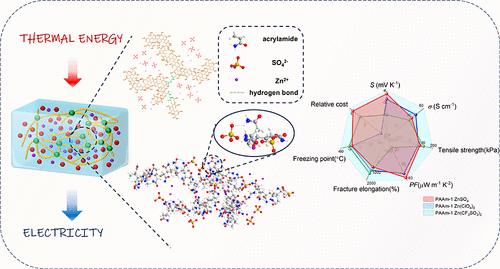
Ionic thermoelectric materials, renowned for their high Seebeck coefficients, are gaining prominence for their potential in harvesting low-grade waste heat. However, the theoretical underpinnings for enhancing the performance of these materials remain underexplored. In this study, the Hoffmeister effect was leveraged to augment the thermoelectric properties of hydrogel-based ionic thermoelectric materials. A series of PAAm-x Zn(CF3SO3)2, PAAm-x ZnSO4, and PAAm-x Zn(ClO4)2 hydrogels were synthesized, using polyacrylamide (PAAm) as the matrix and three distinct zinc salts with varying anion volumes to impart the Hoffmeister effect. Exceptionally, the most cost-effective ZnSO4 yielded the highest ionic Seebeck coefficient among the hydrogels, with PAAm-1 ZnSO4 achieving a remarkable value of -3.72 mV K-1. To elucidate the underlying mechanism, we conducted an innovative analysis correlating the Seebeck coefficient with the zinc ion transfer number. Additionally, the hydrogel materials demonstrated outstanding mechanical properties, including high elongation at break (>1400% at its peak), exceptional resilience (virtually no hysteresis loops), and robust fatigue resistance (overlapping cyclic tensile curves). This work not only advances the understanding of ionic thermoelectric materials but also showcases the potential of hydrogels for practical waste heat recovery applications.
期刊介绍:
ACS Applied Materials & Interfaces is a leading interdisciplinary journal that brings together chemists, engineers, physicists, and biologists to explore the development and utilization of newly-discovered materials and interfacial processes for specific applications. Our journal has experienced remarkable growth since its establishment in 2009, both in terms of the number of articles published and the impact of the research showcased. We are proud to foster a truly global community, with the majority of published articles originating from outside the United States, reflecting the rapid growth of applied research worldwide.




 京公网安备 11010802042870号
京ICP备2023020795号-1
京公网安备 11010802042870号
京ICP备2023020795号-1

 分享
分享
 求助内容:
求助内容: 应助结果提醒方式:
 扫码关注我们
