{"title":"Modelling analysis confirms the role of NPQ saturation for the divergence of the GPP–SIF relationship during heatwave","authors":"David Martini, Mirco Migliavacca, Georg Wohlfahrt","doi":"10.1111/nph.20313","DOIUrl":null,"url":null,"abstract":"<p>We appreciate Antala <i>et al</i>. (<span>2025</span>) for their critical assessment of our article titled ‘Heatwave breaks down the linearity between sun-induced fluorescence and gross primary production’ (Martini <i>et al</i>., <span>2022</span>), and support their emphasis on the importance of understanding how nonphotochemical quenching (NPQ) modulates the relationship between sun-induced fluorescence (SIF) and gross primary production (GPP). However, we believe that their Correspondence may have overlooked several crucial aspects of our work and their conclusions are, at least partially, based on some misunderstandings. We address what we believe represents their major points of criticism and reinforce the results presented in Martini <i>et al</i>. (<span>2022</span>) by means of a new modelling analysis.</p><p>In their opening paragraph titled ‘Heatwave did not break the linearity between SIF and GPP’, Antala <i>et al</i>. (<span>2025</span>) claim that a diverging, nonlinear SIF–GPP relationship is evident already in the preheatwave (pre-HW) and was not caused by the heatwave (HW) conditions, as reported by Martini <i>et al</i>. (<span>2022</span>). They arrive at this conclusion by focussing, day by day, on the subdiurnal dynamics of SIF and GPP (figs 1 and 2 of Antala <i>et al</i>., <span>2025</span>). However, interpreting the data in this way is inherently challenging, which is why Martini <i>et al</i>. (<span>2022</span>) have refrained from doing so, for two main reasons. First and foremost, environmental conditions change dramatically during the course of any one day with ensuing effects on plant physiology. For example, during the morning hours, photochemical and fluorescence yields often exhibit a negative relationship driven by changes in photochemical quenching. Conversely, during midday hours, the relationship between photochemical and fluorescence yield is typically positive and driven by changes in NPQ (Porcar-Castell <i>et al</i>., <span>2014</span>; Magney <i>et al</i>., <span>2020</span>). In fact, Antala <i>et al</i>. (<span>2025</span>) confirm substantial subdiurnal changes in plant physiology themselves by invoking a dominant role of changes in stomatal conductance in shaping the subdiurnal SIF–GPP relationship during pre-HW conditions, which we do not dispute. Second, the SIF–GPP relationship on a subdiurnal basis is highly sensitive to angular effects, which have the potential to obscure the true physiological signal. While these effects were minimized by correcting SIF measurements for the escape probability, the simple correction method used may introduce additional uncertainty. Consequently, Martini <i>et al</i>. (<span>2022</span>) averaged data over certain hours of the day, and thus a given range of solar zenith angles, to obtain robust results.</p><p>In the paragraph titled ‘NPQ did not saturate’, Antala <i>et al</i>. (<span>2025</span>) put forth that ‘NPQ does not saturate with decreasing GPP’. This is indeed the case, as demonstrated in fig. 4(b) of the original manuscript where a single linear relationship is evident for both pre-HW and HW conditions, and Martini <i>et al</i>. (<span>2022</span>) never claimed the opposite.</p><p>What Martini <i>et al</i>. (<span>2022</span>) did in fact suggest is that NPQ saturates at high levels of relative light saturation of photosynthesis (x; figs 5, 6a,b in the original manuscript), leading to increased energy allocation to SIF (fig. S4b in the original manuscript), thereby altering the direction of the SIF–GPP relationship observed both at leaf and canopy scale (fig. 3 in the original manuscript).</p><p>To verify the reasoning by Martini <i>et al</i>. (<span>2022</span>), we conducted simulations using the leaf-scale physiological module of the SCOPE model (Van der <i>et al</i>., <span>2009</span>, <span>2014</span>), replacing its parameterization of the NPQ-relative light saturation of photosynthesis (x) with two separate linear relationships; one for pre-HW, where NPQ increases with x, and one for HW conditions, where NPQ is saturating/decreasing with x, based on leaf-level observations at high x values shown in Fig. 1(a). We then conducted a series of simulations by varying leaf temperature from 25 to 40°C at high radiation conditions (to ensure high x values). As shown in Fig. 1(b), these simulations reproduce the divergent relationship of the leaf-scale yields of photochemistry and fluorescence between pre-HW (positive relationship) and HW (negative relationship) conditions shown in fig. 3(b) of the original manuscript, corroborating the reasoning by Martini <i>et al</i>. (<span>2022</span>).</p><p>Additionally, the statement ‘NPQ also contains information about the fluorescence emission’ by Antala <i>et al</i>. (<span>2025</span>) is inaccurate in our view and not supported by the references cited. The confusion likely arises from the fact that NPQ is derived from active fluorescence data, but this does not imply that NPQ contains information about fluorescence emission. NPQ reflects the first-order rate constant of NPQ (Kn) (Porcar-Castell, <span>2011</span>), as well as the first-order rate constants of fluorescence emission (Kf) and constitutive heat dissipation (Kd). While Kn is strongly physiologically regulated, Kf is assumed to remain constant (Clegg, <span>2004</span>), and Kd is only weakly dependent on temperature (Van der <i>et al</i>., <span>2014</span>). Therefore, NPQ primarily provides insight into the rate of the NPQ process.</p><p>Antala <i>et al</i>. (<span>2025</span>) emphasize φNPQ, noting its different patterns compared with NPQ, and claim that ‘Correlating φNPQ with a quantum yield of photochemistry further supports no saturation of φNPQ in measured data’. Again, we did not claim that photochemical vs nonphotochemical yields saturate. In fact, we do show (fig. S12 of the original manuscript) that the behaviour of the yield of NPQ differs somewhat from NPQ (fig. 6 of the original manuscript).</p><p>Finally, in the paragraph titled ‘Fluorescence dramatically decreased with severe heat’, Antala <i>et al</i>. (<span>2025</span>) mention the presence of negative SIF values in their fig. 1 and question the accuracy of retrievals when SIF is low, that is, during the heatwave. Here, we agree on the need to scrutinize fluorescence retrievals when the signal-to-noise ratio is low; however, would like to clarify that while some values approached zero, negative SIF values were not observed. Even though some retrieval methods, such as the spectral fitting method, may produce physically not meaningful negative SIF values, we suggest not omitting these, as these reflect the overall uncertainty of retrievals. In addition, the active leaf-scale and passive canopy-scale data show similar behaviours (fig. 3b,c in the original manuscript), providing an independent confirmation of the retrieved canopy-level SIF data.</p><p>Taken together, we unequivocally demonstrate using an independent process-based modelling approach that the diverging relationships between SIF and GPP during pre-HW and HW conditions are driven by the saturation of NPQ during the HW period, confirming the core message of Martini <i>et al</i>. (<span>2022</span>). We agree with Antala <i>et al</i>. (<span>2025</span>) in that further work is necessary to elucidate the processes underlying observed changes in excitation energy distribution caused by extreme environmental conditions, which is a prerequisite for correctly interpreting the SIF–GPP relationship during such periods. However, their Correspondence seems to contribute little to that end. Synthesis studies using combined active and passive fluorescence data and canopy scale fluxes collected at multiple structurally and functionally differing sites are, in our opinion, the way forward for process understanding and for improving a generalizable parameterization of models, such as SCOPE, to simulate carbon fluxes and radiative transfer under extreme environmental conditions.</p><p>None declared.</p><p>DM, MM and GW contributed to the writing of the article. GW carried out the SCOPE simulations and DM crafted the figure.</p><p>The New Phytologist Foundation remains neutral with regard to jurisdictional claims in maps and in any institutional affiliations.</p>","PeriodicalId":214,"journal":{"name":"New Phytologist","volume":"245 3","pages":"931-933"},"PeriodicalIF":8.1000,"publicationDate":"2024-12-07","publicationTypes":"Journal Article","fieldsOfStudy":null,"isOpenAccess":false,"openAccessPdf":"https://onlinelibrary.wiley.com/doi/epdf/10.1111/nph.20313","citationCount":"0","resultStr":null,"platform":"Semanticscholar","paperid":null,"PeriodicalName":"New Phytologist","FirstCategoryId":"99","ListUrlMain":"https://nph.onlinelibrary.wiley.com/doi/10.1111/nph.20313","RegionNum":1,"RegionCategory":"生物学","ArticlePicture":[],"TitleCN":null,"AbstractTextCN":null,"PMCID":null,"EPubDate":"","PubModel":"","JCR":"Q1","JCRName":"PLANT SCIENCES","Score":null,"Total":0}
引用次数: 0
Abstract
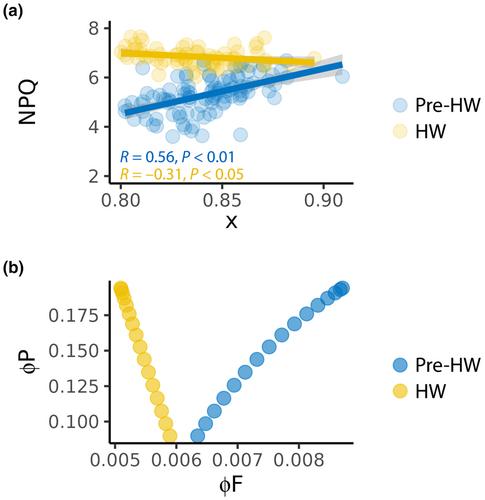
We appreciate Antala et al. (2025) for their critical assessment of our article titled ‘Heatwave breaks down the linearity between sun-induced fluorescence and gross primary production’ (Martini et al., 2022), and support their emphasis on the importance of understanding how nonphotochemical quenching (NPQ) modulates the relationship between sun-induced fluorescence (SIF) and gross primary production (GPP). However, we believe that their Correspondence may have overlooked several crucial aspects of our work and their conclusions are, at least partially, based on some misunderstandings. We address what we believe represents their major points of criticism and reinforce the results presented in Martini et al. (2022) by means of a new modelling analysis.
In their opening paragraph titled ‘Heatwave did not break the linearity between SIF and GPP’, Antala et al. (2025) claim that a diverging, nonlinear SIF–GPP relationship is evident already in the preheatwave (pre-HW) and was not caused by the heatwave (HW) conditions, as reported by Martini et al. (2022). They arrive at this conclusion by focussing, day by day, on the subdiurnal dynamics of SIF and GPP (figs 1 and 2 of Antala et al., 2025). However, interpreting the data in this way is inherently challenging, which is why Martini et al. (2022) have refrained from doing so, for two main reasons. First and foremost, environmental conditions change dramatically during the course of any one day with ensuing effects on plant physiology. For example, during the morning hours, photochemical and fluorescence yields often exhibit a negative relationship driven by changes in photochemical quenching. Conversely, during midday hours, the relationship between photochemical and fluorescence yield is typically positive and driven by changes in NPQ (Porcar-Castell et al., 2014; Magney et al., 2020). In fact, Antala et al. (2025) confirm substantial subdiurnal changes in plant physiology themselves by invoking a dominant role of changes in stomatal conductance in shaping the subdiurnal SIF–GPP relationship during pre-HW conditions, which we do not dispute. Second, the SIF–GPP relationship on a subdiurnal basis is highly sensitive to angular effects, which have the potential to obscure the true physiological signal. While these effects were minimized by correcting SIF measurements for the escape probability, the simple correction method used may introduce additional uncertainty. Consequently, Martini et al. (2022) averaged data over certain hours of the day, and thus a given range of solar zenith angles, to obtain robust results.
In the paragraph titled ‘NPQ did not saturate’, Antala et al. (2025) put forth that ‘NPQ does not saturate with decreasing GPP’. This is indeed the case, as demonstrated in fig. 4(b) of the original manuscript where a single linear relationship is evident for both pre-HW and HW conditions, and Martini et al. (2022) never claimed the opposite.
What Martini et al. (2022) did in fact suggest is that NPQ saturates at high levels of relative light saturation of photosynthesis (x; figs 5, 6a,b in the original manuscript), leading to increased energy allocation to SIF (fig. S4b in the original manuscript), thereby altering the direction of the SIF–GPP relationship observed both at leaf and canopy scale (fig. 3 in the original manuscript).
To verify the reasoning by Martini et al. (2022), we conducted simulations using the leaf-scale physiological module of the SCOPE model (Van der et al., 2009, 2014), replacing its parameterization of the NPQ-relative light saturation of photosynthesis (x) with two separate linear relationships; one for pre-HW, where NPQ increases with x, and one for HW conditions, where NPQ is saturating/decreasing with x, based on leaf-level observations at high x values shown in Fig. 1(a). We then conducted a series of simulations by varying leaf temperature from 25 to 40°C at high radiation conditions (to ensure high x values). As shown in Fig. 1(b), these simulations reproduce the divergent relationship of the leaf-scale yields of photochemistry and fluorescence between pre-HW (positive relationship) and HW (negative relationship) conditions shown in fig. 3(b) of the original manuscript, corroborating the reasoning by Martini et al. (2022).
Additionally, the statement ‘NPQ also contains information about the fluorescence emission’ by Antala et al. (2025) is inaccurate in our view and not supported by the references cited. The confusion likely arises from the fact that NPQ is derived from active fluorescence data, but this does not imply that NPQ contains information about fluorescence emission. NPQ reflects the first-order rate constant of NPQ (Kn) (Porcar-Castell, 2011), as well as the first-order rate constants of fluorescence emission (Kf) and constitutive heat dissipation (Kd). While Kn is strongly physiologically regulated, Kf is assumed to remain constant (Clegg, 2004), and Kd is only weakly dependent on temperature (Van der et al., 2014). Therefore, NPQ primarily provides insight into the rate of the NPQ process.
Antala et al. (2025) emphasize φNPQ, noting its different patterns compared with NPQ, and claim that ‘Correlating φNPQ with a quantum yield of photochemistry further supports no saturation of φNPQ in measured data’. Again, we did not claim that photochemical vs nonphotochemical yields saturate. In fact, we do show (fig. S12 of the original manuscript) that the behaviour of the yield of NPQ differs somewhat from NPQ (fig. 6 of the original manuscript).
Finally, in the paragraph titled ‘Fluorescence dramatically decreased with severe heat’, Antala et al. (2025) mention the presence of negative SIF values in their fig. 1 and question the accuracy of retrievals when SIF is low, that is, during the heatwave. Here, we agree on the need to scrutinize fluorescence retrievals when the signal-to-noise ratio is low; however, would like to clarify that while some values approached zero, negative SIF values were not observed. Even though some retrieval methods, such as the spectral fitting method, may produce physically not meaningful negative SIF values, we suggest not omitting these, as these reflect the overall uncertainty of retrievals. In addition, the active leaf-scale and passive canopy-scale data show similar behaviours (fig. 3b,c in the original manuscript), providing an independent confirmation of the retrieved canopy-level SIF data.
Taken together, we unequivocally demonstrate using an independent process-based modelling approach that the diverging relationships between SIF and GPP during pre-HW and HW conditions are driven by the saturation of NPQ during the HW period, confirming the core message of Martini et al. (2022). We agree with Antala et al. (2025) in that further work is necessary to elucidate the processes underlying observed changes in excitation energy distribution caused by extreme environmental conditions, which is a prerequisite for correctly interpreting the SIF–GPP relationship during such periods. However, their Correspondence seems to contribute little to that end. Synthesis studies using combined active and passive fluorescence data and canopy scale fluxes collected at multiple structurally and functionally differing sites are, in our opinion, the way forward for process understanding and for improving a generalizable parameterization of models, such as SCOPE, to simulate carbon fluxes and radiative transfer under extreme environmental conditions.
None declared.
DM, MM and GW contributed to the writing of the article. GW carried out the SCOPE simulations and DM crafted the figure.
The New Phytologist Foundation remains neutral with regard to jurisdictional claims in maps and in any institutional affiliations.
我们感谢Antala等人(2025)对我们题为“热浪破坏了太阳诱导荧光和初级生产总值之间的线性关系”的文章(Martini等人,2022)的批判性评估,并支持他们强调理解非光化学猝灭(NPQ)如何调节太阳诱导荧光(SIF)和初级生产总值(GPP)之间关系的重要性。然而,我们认为,他们的通信可能忽略了我们工作的几个关键方面,他们的结论至少部分是基于一些误解。我们解决了我们认为代表他们主要批评点的问题,并通过新的建模分析加强了Martini等人(2022)提出的结果。在题为“热浪没有打破SIF和GPP之间的线性关系”的开头段落中,Antala等人(2025)声称,正如Martini等人(2022)所报道的那样,在预热浪(pre-HW)中已经明显存在发散的非线性SIF - GPP关系,并且不是由热浪(HW)条件引起的。他们通过日复一日地关注SIF和GPP的次日动态得出了这一结论(Antala等人,2025年的图1和2)。然而,以这种方式解释数据本质上是具有挑战性的,这就是为什么Martini等人(2022)没有这样做的原因,主要有两个原因。首先,环境条件在任何一天的过程中都发生了巨大的变化,随之而来的是对植物生理的影响。例如,在早晨,光化学和荧光产率往往表现出由光化学猝灭变化驱动的负相关关系。相反,在正午时段,光化学和荧光产率之间的关系通常是正的,并受到NPQ变化的驱动(Porcar-Castell et al., 2014;Magney et al., 2020)。事实上,Antala等人(2025)通过引用气孔导度变化在hw前条件下形成SIF-GPP亚日变化关系中的主导作用,证实了植物生理本身的实质性亚日变化,我们对此没有异议。其次,在亚日基础上的SIF-GPP关系对角度效应高度敏感,这可能会掩盖真实的生理信号。虽然这些影响可以通过校正SIF测量的逃逸概率来最小化,但使用的简单校正方法可能会引入额外的不确定性。因此,Martini等人(2022)对一天中特定小时的数据进行了平均,从而对给定的太阳天顶角范围进行了平均,从而获得了可靠的结果。在题为“NPQ没有饱和”的段落中,Antala等人(2025)提出“NPQ不会随着GPP的降低而饱和”。事实确实如此,如原始手稿的图4(b)所示,在HW前和HW条件下,单一线性关系都很明显,而Martini等人(2022)从未声称相反。Martini等人(2022)实际上表明,NPQ在光合作用的相对光饱和度较高时达到饱和(x;图5、图6a、图b),导致SIF的能量分配增加(图S4b),从而改变了叶片和冠层尺度上SIF - gpp关系的方向(图3)。为了验证Martini et al.(2022)的推理,我们使用SCOPE模型的叶片尺度生理模块(Van der et al., 2009, 2014)进行了模拟,用两个独立的线性关系替换了其对光合作用npq相对光饱和度(x)的参数化;根据图1(a)所示高x值时叶片水平的观测,一个用于预高w条件,其中NPQ随x增加,另一个用于高w条件,其中NPQ随x饱和/减少。然后,我们通过在高辐射条件下将叶片温度从25°C变化到40°C进行了一系列模拟(以确保高x值)。如图1(b)所示,这些模拟重现了原稿图3(b)所示的前HW(正相关)和HW(负相关)条件下叶级光化学和荧光产率的发散关系,证实了Martini et al.(2022)的推理。此外,我们认为Antala等人(2025)的“NPQ还包含有关荧光发射的信息”的说法是不准确的,并且没有引用的参考文献支持。这种混淆可能是由于NPQ是从主动荧光数据中得出的,但这并不意味着NPQ包含有关荧光发射的信息。NPQ反映了NPQ的一级速率常数(Kn) (Porcar-Castell, 2011),以及荧光发射(Kf)和本态散热(Kd)的一级速率常数。虽然Kn受到强烈的生理调节,但Kf被认为是保持不变的(Clegg, 2004), Kd仅对温度有微弱的依赖性(Van der等)。 , 2014)。因此,NPQ主要提供对NPQ过程速率的洞察。Antala等人(2025)强调φNPQ,指出其与NPQ的模式不同,并声称“将φNPQ与光化学的量子产率相关联进一步支持测量数据中φNPQ不饱和”。同样,我们没有声称光化学与非光化学的产率饱和。事实上,我们确实表明(原始手稿的图S12), NPQ的产量行为与NPQ有所不同(原始手稿的图6)。最后,在题为“荧光在高温下急剧下降”的段落中,Antala等人(2025)在他们的图1中提到了负SIF值的存在,并质疑SIF低时(即热浪期间)检索的准确性。在这里,我们同意需要仔细审查荧光检索时,信噪比低;然而,我想澄清的是,虽然有些值接近于零,但没有观察到负SIF值。尽管一些检索方法,如光谱拟合方法,可能会产生物理上没有意义的负SIF值,但我们建议不要省略这些,因为它们反映了检索的总体不确定性。此外,主动叶尺度和被动冠层尺度数据表现出相似的行为(原文图3b,c),为检索到的冠层级SIF数据提供了独立的确认。综上所述,我们使用独立的基于过程的建模方法明确地证明,在HW前和HW条件下SIF和GPP之间的差异关系是由HW期间NPQ的饱和驱动的,证实了Martini等人(2022)的核心信息。我们同意Antala等人(2025)的观点,即需要进一步的工作来阐明由极端环境条件引起的观测到的激发能分布变化的过程,这是正确解释此类时期SIF-GPP关系的先决条件。然而,他们的通信似乎对这一目的贡献不大。在我们看来,利用在多个结构和功能不同的地点收集的主动和被动荧光数据和冠层尺度通量的综合研究是理解过程和改进模型(如SCOPE)的可推广参数化的前进方向,以模拟极端环境条件下的碳通量和辐射转移。没有宣布。DM, MM和GW对文章的撰写做出了贡献。GW进行了SCOPE模拟,DM制作了图形。新植物学家基金会对地图和任何机构的管辖权要求保持中立。
期刊介绍:
New Phytologist is an international electronic journal published 24 times a year. It is owned by the New Phytologist Foundation, a non-profit-making charitable organization dedicated to promoting plant science. The journal publishes excellent, novel, rigorous, and timely research and scholarship in plant science and its applications. The articles cover topics in five sections: Physiology & Development, Environment, Interaction, Evolution, and Transformative Plant Biotechnology. These sections encompass intracellular processes, global environmental change, and encourage cross-disciplinary approaches. The journal recognizes the use of techniques from molecular and cell biology, functional genomics, modeling, and system-based approaches in plant science. Abstracting and Indexing Information for New Phytologist includes Academic Search, AgBiotech News & Information, Agroforestry Abstracts, Biochemistry & Biophysics Citation Index, Botanical Pesticides, CAB Abstracts®, Environment Index, Global Health, and Plant Breeding Abstracts, and others.






 京公网安备 11010802042870号
京ICP备2023020795号-1
京公网安备 11010802042870号
京ICP备2023020795号-1

 分享
分享
 求助内容:
求助内容: 应助结果提醒方式:
 扫码关注我们
