Weijin Cai , Qiang Long , Shenghan Lu , Kang Wang , Junyang He , Shiteng Zhao , Zhiping Xiong , Jun Hu , Wenzhen Xia , Ian Baker , Kefu Gan , Min Song , Zhangwei Wang
{"title":"Enhanced strength-ductility synergy in medium entropy alloy via phase selective precipitation","authors":"Weijin Cai , Qiang Long , Shenghan Lu , Kang Wang , Junyang He , Shiteng Zhao , Zhiping Xiong , Jun Hu , Wenzhen Xia , Ian Baker , Kefu Gan , Min Song , Zhangwei Wang","doi":"10.1016/j.ijplas.2024.104204","DOIUrl":null,"url":null,"abstract":"<div><div>Precipitation strengthening is paramount in the development of high-performance medium/high entropy alloys (M/HEAs). In this work, we showcase a phase-selective precipitation design applied to a (Ni<sub>67.2</sub>V<sub>32.8</sub>)<sub>90</sub>Ti<sub>5</sub>Al<sub>5</sub> MEA to enable enhanced strength-ductility synergy. Upon annealing at 950 °C, multiple precipitates form in this MEA, including L2<sub>1</sub>, σ and hexagonal close packed (HCP) phases. However, an increase of 50 °C in annealing temperature removes most of the aforementioned precipitates except for the L2<sub>1</sub> phase. Density functional theory calculations are conducted to elucidate the formation mechanisms of phase-selective precipitation. Such selective approach to precipitation induces a brittle to ductile transition, increasing tensile elongation from 4 % to 43 % in our MEAs. Remarkably, the ultimate tensile strength of 1000 °C annealing MEA is maintained at ∼1.4 GPa, surpassing that of the precipitation-free Ni<sub>67.2</sub>V<sub>32.8</sub> base alloy (∼1.1 GPa), but with a comparable tensile elongation. Analytical models suggest that the increase in strength is attributed to both precipitation strengthening and grain refinement strengthening due to the pinning effect of precipitates. In particular, we investigate the complex deformation response of the L2<sub>1</sub> phase, which includes the formation of slip steps and a phase transformation from body-centered cubic (BCC) to body-centered tetragonal (BCT) structures, with the underlying mechanisms revealed through experimental characterization and molecular dynamics simulations. This co-deformation of matrix and L2<sub>1</sub> precipitates alleviates stress concentration at phase boundaries during straining and further maintains the microband-induced plasticity in the matrix till later deformation stage. All these result in the excellent strain hardening and thus, markedly enhancing ductility. Our findings pave new ways to craft strong and ductile M/HEAs by selecting hard-yet-deformable intermetallic precipitates.</div></div>","PeriodicalId":340,"journal":{"name":"International Journal of Plasticity","volume":"184 ","pages":"Article 104204"},"PeriodicalIF":12.8000,"publicationDate":"2025-01-01","publicationTypes":"Journal Article","fieldsOfStudy":null,"isOpenAccess":false,"openAccessPdf":"","citationCount":"0","resultStr":null,"platform":"Semanticscholar","paperid":null,"PeriodicalName":"International Journal of Plasticity","FirstCategoryId":"88","ListUrlMain":"https://www.sciencedirect.com/science/article/pii/S0749641924003310","RegionNum":1,"RegionCategory":"材料科学","ArticlePicture":[],"TitleCN":null,"AbstractTextCN":null,"PMCID":null,"EPubDate":"2024/12/9 0:00:00","PubModel":"Epub","JCR":"Q1","JCRName":"ENGINEERING, MECHANICAL","Score":null,"Total":0}
引用次数: 0
Abstract
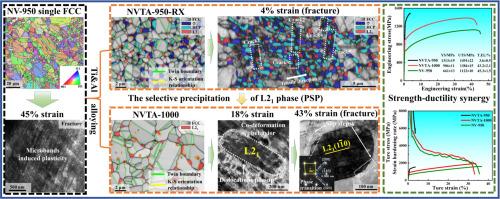
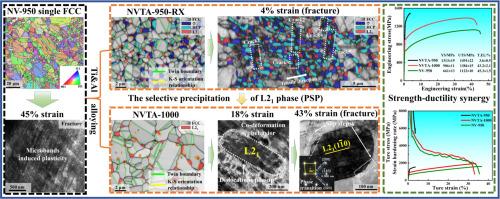
Precipitation strengthening is paramount in the development of high-performance medium/high entropy alloys (M/HEAs). In this work, we showcase a phase-selective precipitation design applied to a (Ni67.2V32.8)90Ti5Al5 MEA to enable enhanced strength-ductility synergy. Upon annealing at 950 °C, multiple precipitates form in this MEA, including L21, σ and hexagonal close packed (HCP) phases. However, an increase of 50 °C in annealing temperature removes most of the aforementioned precipitates except for the L21 phase. Density functional theory calculations are conducted to elucidate the formation mechanisms of phase-selective precipitation. Such selective approach to precipitation induces a brittle to ductile transition, increasing tensile elongation from 4 % to 43 % in our MEAs. Remarkably, the ultimate tensile strength of 1000 °C annealing MEA is maintained at ∼1.4 GPa, surpassing that of the precipitation-free Ni67.2V32.8 base alloy (∼1.1 GPa), but with a comparable tensile elongation. Analytical models suggest that the increase in strength is attributed to both precipitation strengthening and grain refinement strengthening due to the pinning effect of precipitates. In particular, we investigate the complex deformation response of the L21 phase, which includes the formation of slip steps and a phase transformation from body-centered cubic (BCC) to body-centered tetragonal (BCT) structures, with the underlying mechanisms revealed through experimental characterization and molecular dynamics simulations. This co-deformation of matrix and L21 precipitates alleviates stress concentration at phase boundaries during straining and further maintains the microband-induced plasticity in the matrix till later deformation stage. All these result in the excellent strain hardening and thus, markedly enhancing ductility. Our findings pave new ways to craft strong and ductile M/HEAs by selecting hard-yet-deformable intermetallic precipitates.
期刊介绍:
International Journal of Plasticity aims to present original research encompassing all facets of plastic deformation, damage, and fracture behavior in both isotropic and anisotropic solids. This includes exploring the thermodynamics of plasticity and fracture, continuum theory, and macroscopic as well as microscopic phenomena.
Topics of interest span the plastic behavior of single crystals and polycrystalline metals, ceramics, rocks, soils, composites, nanocrystalline and microelectronics materials, shape memory alloys, ferroelectric ceramics, thin films, and polymers. Additionally, the journal covers plasticity aspects of failure and fracture mechanics. Contributions involving significant experimental, numerical, or theoretical advancements that enhance the understanding of the plastic behavior of solids are particularly valued. Papers addressing the modeling of finite nonlinear elastic deformation, bearing similarities to the modeling of plastic deformation, are also welcomed.



 京公网安备 11010802042870号
京ICP备2023020795号-1
京公网安备 11010802042870号
京ICP备2023020795号-1

 分享
分享
 求助内容:
求助内容: 应助结果提醒方式:
 扫码关注我们
