David G. Gelikman, William S. Azar, Enis C. Yilmaz, Yue Lin, Luke A. Shumaker, Andrew M. Fang, Stephanie A. Harmon, Erich P. Huang, Sahil H. Parikh, Jason A. Hyman, Kyle Schuppe, Jeffrey W. Nix, Samuel J. Galgano, Maria J. Merino, Peter L. Choyke, Sandeep Gurram, Bradford J. Wood, Soroush Rais-Bahrami, Peter A. Pinto, Baris Turkbey
{"title":"A Prostate Imaging-Reporting and Data System version 2.1-based predictive model for clinically significant prostate cancer diagnosis","authors":"David G. Gelikman, William S. Azar, Enis C. Yilmaz, Yue Lin, Luke A. Shumaker, Andrew M. Fang, Stephanie A. Harmon, Erich P. Huang, Sahil H. Parikh, Jason A. Hyman, Kyle Schuppe, Jeffrey W. Nix, Samuel J. Galgano, Maria J. Merino, Peter L. Choyke, Sandeep Gurram, Bradford J. Wood, Soroush Rais-Bahrami, Peter A. Pinto, Baris Turkbey","doi":"10.1111/bju.16616","DOIUrl":null,"url":null,"abstract":"<div>\n \n <section>\n \n <h3> Objectives</h3>\n \n <p>To develop and validate a Prostate Imaging-Reporting and Data System (PI-RADS) version 2.1 (v2.1)-based predictive model for diagnosis of clinically significant prostate cancer (csPCa), integrating clinical and multiparametric magnetic resonance imaging (mpMRI) data, and compare its performance with existing models.</p>\n </section>\n \n <section>\n \n <h3> Patients and Methods</h3>\n \n <p>We retrospectively analysed data from patients who underwent prospective mpMRI assessment using the PI-RADS v2.1 scoring system and biopsy at our institution between April 2019 and December 2023. A ‘Clinical Baseline’ model using patient demographics and laboratory results and an ‘MRI Added’ model additionally incorporating PI-RADS v2.1 scores and prostate volumes were created and validated on internal and external patients. Both models were compared against two previously published MRI-based algorithms for csPCa using area under the receiver operating characteristic curve (AUC) and decision curve analysis.</p>\n </section>\n \n <section>\n \n <h3> Results</h3>\n \n <p>A total of 1319 patients across internal and external cohorts were included. Our ‘MRI Added’ model demonstrated significantly improved discriminative ability (AUC<sub>internal</sub> 0.88, AUC<sub>external</sub> 0.79) compared to our ‘Clinical Baseline’ model (AUC<sub>internal</sub> 0.75, AUC<sub>external</sub> 0.68) (<i>P</i> < 0.001). The ‘MRI Added’ model also showed higher net benefits across various clinical threshold probabilities and compared to a ‘biopsy all’ approach, it reduced unnecessary biopsies (defined as biopsies without Gleason Grade Group ≥2 csPCa) by 27% in the internal cohort and 10% in the external cohort at a risk threshold of 25%. However, there was no significant difference in predictive ability and reduction in unnecessary biopsies between our model and comparative ones developed for PI-RADS v2 and v1.</p>\n </section>\n \n <section>\n \n <h3> Conclusion</h3>\n \n <p>Our PI-RADS v2.1-based mpMRI model significantly enhances csPCa prediction, outperforming the traditional clinical model in accuracy and reduction of unnecessary biopsies. It proves promising across diverse patient populations, establishing an updated, integrated approach for detection and management of prostate cancer.</p>\n </section>\n </div>","PeriodicalId":8985,"journal":{"name":"BJU International","volume":"135 5","pages":"751-759"},"PeriodicalIF":4.4000,"publicationDate":"2024-12-09","publicationTypes":"Journal Article","fieldsOfStudy":null,"isOpenAccess":false,"openAccessPdf":"https://onlinelibrary.wiley.com/doi/epdf/10.1111/bju.16616","citationCount":"0","resultStr":null,"platform":"Semanticscholar","paperid":null,"PeriodicalName":"BJU International","FirstCategoryId":"3","ListUrlMain":"https://bjui-journals.onlinelibrary.wiley.com/doi/10.1111/bju.16616","RegionNum":2,"RegionCategory":"医学","ArticlePicture":[],"TitleCN":null,"AbstractTextCN":null,"PMCID":null,"EPubDate":"","PubModel":"","JCR":"Q1","JCRName":"UROLOGY & NEPHROLOGY","Score":null,"Total":0}
引用次数: 0
Abstract
Objectives
To develop and validate a Prostate Imaging-Reporting and Data System (PI-RADS) version 2.1 (v2.1)-based predictive model for diagnosis of clinically significant prostate cancer (csPCa), integrating clinical and multiparametric magnetic resonance imaging (mpMRI) data, and compare its performance with existing models.
Patients and Methods
We retrospectively analysed data from patients who underwent prospective mpMRI assessment using the PI-RADS v2.1 scoring system and biopsy at our institution between April 2019 and December 2023. A ‘Clinical Baseline’ model using patient demographics and laboratory results and an ‘MRI Added’ model additionally incorporating PI-RADS v2.1 scores and prostate volumes were created and validated on internal and external patients. Both models were compared against two previously published MRI-based algorithms for csPCa using area under the receiver operating characteristic curve (AUC) and decision curve analysis.
Results
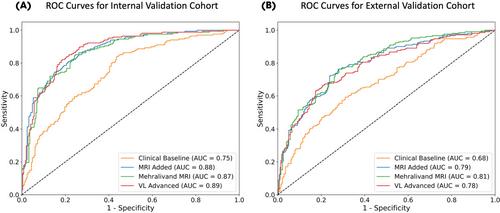
A total of 1319 patients across internal and external cohorts were included. Our ‘MRI Added’ model demonstrated significantly improved discriminative ability (AUCinternal 0.88, AUCexternal 0.79) compared to our ‘Clinical Baseline’ model (AUCinternal 0.75, AUCexternal 0.68) (P < 0.001). The ‘MRI Added’ model also showed higher net benefits across various clinical threshold probabilities and compared to a ‘biopsy all’ approach, it reduced unnecessary biopsies (defined as biopsies without Gleason Grade Group ≥2 csPCa) by 27% in the internal cohort and 10% in the external cohort at a risk threshold of 25%. However, there was no significant difference in predictive ability and reduction in unnecessary biopsies between our model and comparative ones developed for PI-RADS v2 and v1.
Conclusion
Our PI-RADS v2.1-based mpMRI model significantly enhances csPCa prediction, outperforming the traditional clinical model in accuracy and reduction of unnecessary biopsies. It proves promising across diverse patient populations, establishing an updated, integrated approach for detection and management of prostate cancer.
期刊介绍:
BJUI is one of the most highly respected medical journals in the world, with a truly international range of published papers and appeal. Every issue gives invaluable practical information in the form of original articles, reviews, comments, surgical education articles, and translational science articles in the field of urology. BJUI employs topical sections, and is in full colour, making it easier to browse or search for something specific.