Marta-Ievheniia Vonsul , Renuka Dhandapani , Dean C. Webster
{"title":"Moving towards sustainability: Assessment of vitrimer behavior and reprocessability of plant oil-based material","authors":"Marta-Ievheniia Vonsul , Renuka Dhandapani , Dean C. Webster","doi":"10.1016/j.polymer.2024.127941","DOIUrl":null,"url":null,"abstract":"<div><div>The concept of covalent bond reformation has emerged as an innovative technology that aligns with green chemistry principles offering materials that can be recycled. These materials are referred to as Covalent Adaptable Networks (CANs). Having the valuable properties of crosslinked thermosets, these materials can be also reprocessed and reshaped as conventional thermoplastics. These unique abilities are imparted by the presence of crosslinks that become dynamic and undergo exchange by either associative or dissociative mechanisms under certain stimuli. In this work, we prepared a plant-oil based covalent-adaptable network from functionalized cottonseed oil, namely acrylated-epoxidized cottonseed oil (AECO). The AECO resin was synthesized and then photopolymerized with difunctional reactive diluent: 1,6-hexandiol diacrylate (HDDA) in the presence of 2-hydroxy-2-methyl-1-phenylpropanone photoinitiator. The bond exchange in the AECO-based system was provided through dynamic transesterification, namely by incorporation of triazobicyclodecene catalyst in the UV-curable formulation. The presence of this catalyst enabled the transesterification reaction between ester and hydroxy groups, present in AECO, therefore, imparting the vitrimer properties. The activation energy of dynamic transesterification was determined to be 44.38 kJ/mol<sup>−1</sup>. The thermomechanical properties of the AECO vitrimer were evaluated and its ability to reprocess was shown. By incorporating dynamic bonds into an AECO-based network, we demonstrated the potential of biobased coatings to be reprocessable, thereby minimizing waste and resource consumption. The study paves the way for the development of reprocessable coatings and sets the goals for further innovations in coatings technology, particularly in terms of sustainability.</div></div>","PeriodicalId":405,"journal":{"name":"Polymer","volume":"317 ","pages":"Article 127941"},"PeriodicalIF":4.5000,"publicationDate":"2025-01-15","publicationTypes":"Journal Article","fieldsOfStudy":null,"isOpenAccess":false,"openAccessPdf":"","citationCount":"0","resultStr":null,"platform":"Semanticscholar","paperid":null,"PeriodicalName":"Polymer","FirstCategoryId":"92","ListUrlMain":"https://www.sciencedirect.com/science/article/pii/S0032386124012771","RegionNum":2,"RegionCategory":"化学","ArticlePicture":[],"TitleCN":null,"AbstractTextCN":null,"PMCID":null,"EPubDate":"2024/12/9 0:00:00","PubModel":"Epub","JCR":"Q2","JCRName":"POLYMER SCIENCE","Score":null,"Total":0}
引用次数: 0
Abstract
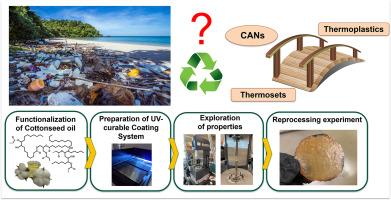
The concept of covalent bond reformation has emerged as an innovative technology that aligns with green chemistry principles offering materials that can be recycled. These materials are referred to as Covalent Adaptable Networks (CANs). Having the valuable properties of crosslinked thermosets, these materials can be also reprocessed and reshaped as conventional thermoplastics. These unique abilities are imparted by the presence of crosslinks that become dynamic and undergo exchange by either associative or dissociative mechanisms under certain stimuli. In this work, we prepared a plant-oil based covalent-adaptable network from functionalized cottonseed oil, namely acrylated-epoxidized cottonseed oil (AECO). The AECO resin was synthesized and then photopolymerized with difunctional reactive diluent: 1,6-hexandiol diacrylate (HDDA) in the presence of 2-hydroxy-2-methyl-1-phenylpropanone photoinitiator. The bond exchange in the AECO-based system was provided through dynamic transesterification, namely by incorporation of triazobicyclodecene catalyst in the UV-curable formulation. The presence of this catalyst enabled the transesterification reaction between ester and hydroxy groups, present in AECO, therefore, imparting the vitrimer properties. The activation energy of dynamic transesterification was determined to be 44.38 kJ/mol−1. The thermomechanical properties of the AECO vitrimer were evaluated and its ability to reprocess was shown. By incorporating dynamic bonds into an AECO-based network, we demonstrated the potential of biobased coatings to be reprocessable, thereby minimizing waste and resource consumption. The study paves the way for the development of reprocessable coatings and sets the goals for further innovations in coatings technology, particularly in terms of sustainability.
期刊介绍:
Polymer is an interdisciplinary journal dedicated to publishing innovative and significant advances in Polymer Physics, Chemistry and Technology. We welcome submissions on polymer hybrids, nanocomposites, characterisation and self-assembly. Polymer also publishes work on the technological application of polymers in energy and optoelectronics.
The main scope is covered but not limited to the following core areas:
Polymer Materials
Nanocomposites and hybrid nanomaterials
Polymer blends, films, fibres, networks and porous materials
Physical Characterization
Characterisation, modelling and simulation* of molecular and materials properties in bulk, solution, and thin films
Polymer Engineering
Advanced multiscale processing methods
Polymer Synthesis, Modification and Self-assembly
Including designer polymer architectures, mechanisms and kinetics, and supramolecular polymerization
Technological Applications
Polymers for energy generation and storage
Polymer membranes for separation technology
Polymers for opto- and microelectronics.




 京公网安备 11010802042870号
京ICP备2023020795号-1
京公网安备 11010802042870号
京ICP备2023020795号-1

 分享
分享
 求助内容:
求助内容: 应助结果提醒方式:
 扫码关注我们
