Cody A Freas, Ajay Narenda, Trevor Murray, Ken Cheng
{"title":"Polarised moonlight guides nocturnal bull ants home.","authors":"Cody A Freas, Ajay Narenda, Trevor Murray, Ken Cheng","doi":"10.7554/eLife.97615","DOIUrl":null,"url":null,"abstract":"<p><p>For the first time in any animal, we show that nocturnal bull ants use the exceedingly dim polarisation pattern produced by the moon for overnight navigation. The sun or moon can provide directional information via their position; however, they can often be obstructed by clouds, canopy, or the horizon. Despite being hidden, these bodies can still provide compass information through the polarised light pattern they produce/reflect. Sunlight produces polarised light patterns across the overhead sky as it enters the atmosphere, and solar polarised light is a well-known compass cue for navigating animals. Moonlight produces an analogous pattern, albeit a million times dimmer than sunlight. Here, we show evidence that polarised moonlight forms part of the celestial compass of navigating nocturnal ants. Nocturnal bull ants leave their nest at twilight and rely heavily on the overhead solar polarisation pattern to navigate. Yet many foragers return home overnight when the sun cannot guide them. We demonstrate that these bull ants use polarised moonlight to navigate home during the night, by rotating the overhead polarisation pattern above homing ants, who alter their headings in response. Furthermore, these ants can detect this cue throughout the lunar month, even under crescent moons, when polarised light levels are at their lowest. Finally, we show the long-term incorporation of this moonlight pattern into the ants' path integration system throughout the night for homing, as polarised sunlight is incorporated throughout the day.</p>","PeriodicalId":11640,"journal":{"name":"eLife","volume":"13 ","pages":""},"PeriodicalIF":6.4000,"publicationDate":"2024-12-09","publicationTypes":"Journal Article","fieldsOfStudy":null,"isOpenAccess":false,"openAccessPdf":"https://www.ncbi.nlm.nih.gov/pmc/articles/PMC11627510/pdf/","citationCount":"0","resultStr":null,"platform":"Semanticscholar","paperid":null,"PeriodicalName":"eLife","FirstCategoryId":"99","ListUrlMain":"https://doi.org/10.7554/eLife.97615","RegionNum":1,"RegionCategory":"生物学","ArticlePicture":[],"TitleCN":null,"AbstractTextCN":null,"PMCID":null,"EPubDate":"","PubModel":"","JCR":"Q1","JCRName":"BIOLOGY","Score":null,"Total":0}
引用次数: 0
Abstract
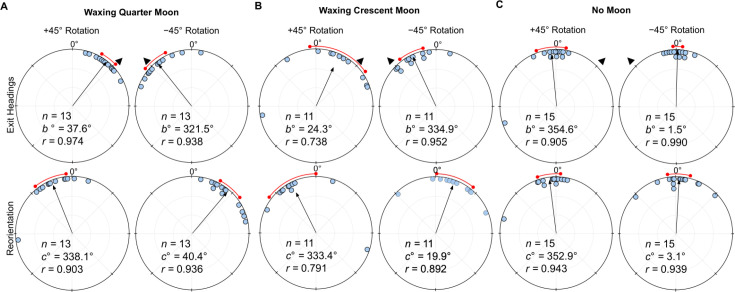
For the first time in any animal, we show that nocturnal bull ants use the exceedingly dim polarisation pattern produced by the moon for overnight navigation. The sun or moon can provide directional information via their position; however, they can often be obstructed by clouds, canopy, or the horizon. Despite being hidden, these bodies can still provide compass information through the polarised light pattern they produce/reflect. Sunlight produces polarised light patterns across the overhead sky as it enters the atmosphere, and solar polarised light is a well-known compass cue for navigating animals. Moonlight produces an analogous pattern, albeit a million times dimmer than sunlight. Here, we show evidence that polarised moonlight forms part of the celestial compass of navigating nocturnal ants. Nocturnal bull ants leave their nest at twilight and rely heavily on the overhead solar polarisation pattern to navigate. Yet many foragers return home overnight when the sun cannot guide them. We demonstrate that these bull ants use polarised moonlight to navigate home during the night, by rotating the overhead polarisation pattern above homing ants, who alter their headings in response. Furthermore, these ants can detect this cue throughout the lunar month, even under crescent moons, when polarised light levels are at their lowest. Finally, we show the long-term incorporation of this moonlight pattern into the ants' path integration system throughout the night for homing, as polarised sunlight is incorporated throughout the day.
期刊介绍:
eLife is a distinguished, not-for-profit, peer-reviewed open access scientific journal that specializes in the fields of biomedical and life sciences. eLife is known for its selective publication process, which includes a variety of article types such as:
Research Articles: Detailed reports of original research findings.
Short Reports: Concise presentations of significant findings that do not warrant a full-length research article.
Tools and Resources: Descriptions of new tools, technologies, or resources that facilitate scientific research.
Research Advances: Brief reports on significant scientific advancements that have immediate implications for the field.
Scientific Correspondence: Short communications that comment on or provide additional information related to published articles.
Review Articles: Comprehensive overviews of a specific topic or field within the life sciences.






 京公网安备 11010802042870号
京ICP备2023020795号-1
京公网安备 11010802042870号
京ICP备2023020795号-1

 分享
分享
 求助内容:
求助内容: 应助结果提醒方式:
 扫码关注我们
