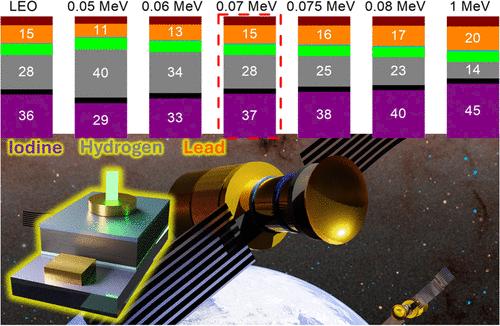
{"title":"Critical Role of Low-Energy Protons in Radiation Testing of Perovskite Space Solar Cells","authors":"Tatchen B. Kum, Ahmad R. Kirmani","doi":"10.1021/acsphotonics.4c01818","DOIUrl":null,"url":null,"abstract":"While perovskite solar cells (PSCs) are attractive for space applications, assessing their radiation tolerance requires adequate testing protocols. The primary criterion is that protons normally incident on a PSC during ground-based testing should create a uniform damage profile, mimicking the effect of the omnidirectional and polyenergetic proton spectrum in space orbit. However, given the low thicknesses of PSCs, proton energies >0.05 MeV can meet this criterion, leading to ambiguity regarding the precise energy needed for testing. Here, we highlight another major criterion: the optimal proton energy should also closely mimic the elemental vacancy distribution created in the perovskite by space protons. Using Monte Carlo ion-solid simulations, we first calculate the elemental vacancies in a PSC due to the low-Earth orbit (LEO) proton spectrum. We then show that only ∼0.07 MeV protons can result in a similar distribution during ground-based testing. Higher energies (∼1 MeV) lead to 25% more iodine, 33% more lead, and 50% fewer hydrogen vacancies, failing to represent the space radiation environment accurately. Our results offer precise guidelines for PSC radiation testing, paving the way for more accurate, reliable, and comparable assessments.","PeriodicalId":23,"journal":{"name":"ACS Photonics","volume":"228 1","pages":""},"PeriodicalIF":6.7000,"publicationDate":"2024-12-11","publicationTypes":"Journal Article","fieldsOfStudy":null,"isOpenAccess":false,"openAccessPdf":"","citationCount":"0","resultStr":null,"platform":"Semanticscholar","paperid":null,"PeriodicalName":"ACS Photonics","FirstCategoryId":"101","ListUrlMain":"https://doi.org/10.1021/acsphotonics.4c01818","RegionNum":1,"RegionCategory":"物理与天体物理","ArticlePicture":[],"TitleCN":null,"AbstractTextCN":null,"PMCID":null,"EPubDate":"","PubModel":"","JCR":"Q1","JCRName":"MATERIALS SCIENCE, MULTIDISCIPLINARY","Score":null,"Total":0}
引用次数: 0
Abstract
While perovskite solar cells (PSCs) are attractive for space applications, assessing their radiation tolerance requires adequate testing protocols. The primary criterion is that protons normally incident on a PSC during ground-based testing should create a uniform damage profile, mimicking the effect of the omnidirectional and polyenergetic proton spectrum in space orbit. However, given the low thicknesses of PSCs, proton energies >0.05 MeV can meet this criterion, leading to ambiguity regarding the precise energy needed for testing. Here, we highlight another major criterion: the optimal proton energy should also closely mimic the elemental vacancy distribution created in the perovskite by space protons. Using Monte Carlo ion-solid simulations, we first calculate the elemental vacancies in a PSC due to the low-Earth orbit (LEO) proton spectrum. We then show that only ∼0.07 MeV protons can result in a similar distribution during ground-based testing. Higher energies (∼1 MeV) lead to 25% more iodine, 33% more lead, and 50% fewer hydrogen vacancies, failing to represent the space radiation environment accurately. Our results offer precise guidelines for PSC radiation testing, paving the way for more accurate, reliable, and comparable assessments.
期刊介绍:
Published as soon as accepted and summarized in monthly issues, ACS Photonics will publish Research Articles, Letters, Perspectives, and Reviews, to encompass the full scope of published research in this field.



 京公网安备 11010802042870号
京ICP备2023020795号-1
京公网安备 11010802042870号
京ICP备2023020795号-1

 分享
分享
 求助内容:
求助内容: 应助结果提醒方式:
 扫码关注我们
