{"title":"Lithium-Rich Layered Oxide Cathode Materials Modified for Lithium-Ion Batteries by CoS of a 3D Rock Salt Structure Assisted by PVP","authors":"Guangchao Jin, Dongmei Liu, Kaihan Hu, Songyuan Sun, Huigui Wu, Na Fu, Jingbo Chen","doi":"10.1021/acsami.4c15367","DOIUrl":null,"url":null,"abstract":"The problem of rapid degradation of the operating voltage and discharge specific capacity of lithium-rich layered oxide (LRMs) cathode materials is a major constraint for their commercial application. In this paper, CoS coating with a 3D layered structure assisted by PVP is used to enhance the cycle life and rate performance of the LRMs material. The introduction of PVP has the following effects: (1) it reduces the solubility of CoS in the electrolyte solution and forms a stable CoS coating, and (2) it acts as a nitrogen-containing carbon matrix material and the heteroatomic dopant, and can provide more active sites to improve the conductivity of CoS. In addition, the CoS coating is capable of efficaciously reducing the direct contact area between electrolyte solution and the LRMs material and alleviating the occurrence of harmful interface reactions. The result of this study manifests that after the modification through CoS modification by PVP, the problem of the capacity decay is obviously solved. When the current density is 0.2 C, the highest specific capacity of 248.87 mAh g<sup>–1</sup> can be provided. The capacity retention ratio of the LRMs@CoS material is 87.21% after 100 cycles, and the capacity decay is 0.3182 mAh g<sup>–1</sup> (1.1534 mAh g<sup>–1</sup> for the LRMs material) per cycle. When the current density is 1 C, the first discharge specific capacity of 220.91 mAh g<sup>–1</sup> is achieved, which demonstrates outstanding electrochemical performance. This study has come up with a simple and practical mentality to realize the modification of cathode materials for high-performance lithium-ion batteries.","PeriodicalId":5,"journal":{"name":"ACS Applied Materials & Interfaces","volume":"98 1","pages":""},"PeriodicalIF":8.2000,"publicationDate":"2024-12-11","publicationTypes":"Journal Article","fieldsOfStudy":null,"isOpenAccess":false,"openAccessPdf":"","citationCount":"0","resultStr":null,"platform":"Semanticscholar","paperid":null,"PeriodicalName":"ACS Applied Materials & Interfaces","FirstCategoryId":"88","ListUrlMain":"https://doi.org/10.1021/acsami.4c15367","RegionNum":2,"RegionCategory":"材料科学","ArticlePicture":[],"TitleCN":null,"AbstractTextCN":null,"PMCID":null,"EPubDate":"","PubModel":"","JCR":"Q1","JCRName":"MATERIALS SCIENCE, MULTIDISCIPLINARY","Score":null,"Total":0}
引用次数: 0
Abstract
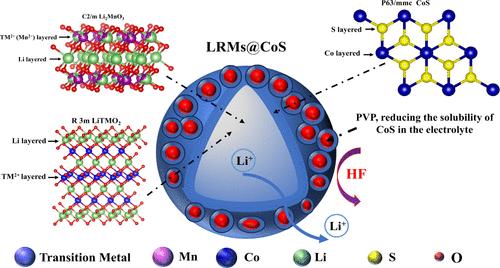
The problem of rapid degradation of the operating voltage and discharge specific capacity of lithium-rich layered oxide (LRMs) cathode materials is a major constraint for their commercial application. In this paper, CoS coating with a 3D layered structure assisted by PVP is used to enhance the cycle life and rate performance of the LRMs material. The introduction of PVP has the following effects: (1) it reduces the solubility of CoS in the electrolyte solution and forms a stable CoS coating, and (2) it acts as a nitrogen-containing carbon matrix material and the heteroatomic dopant, and can provide more active sites to improve the conductivity of CoS. In addition, the CoS coating is capable of efficaciously reducing the direct contact area between electrolyte solution and the LRMs material and alleviating the occurrence of harmful interface reactions. The result of this study manifests that after the modification through CoS modification by PVP, the problem of the capacity decay is obviously solved. When the current density is 0.2 C, the highest specific capacity of 248.87 mAh g–1 can be provided. The capacity retention ratio of the LRMs@CoS material is 87.21% after 100 cycles, and the capacity decay is 0.3182 mAh g–1 (1.1534 mAh g–1 for the LRMs material) per cycle. When the current density is 1 C, the first discharge specific capacity of 220.91 mAh g–1 is achieved, which demonstrates outstanding electrochemical performance. This study has come up with a simple and practical mentality to realize the modification of cathode materials for high-performance lithium-ion batteries.
富锂层状氧化物(LRMs)正极材料的工作电压和放电比容量的快速退化问题是制约其商业化应用的主要问题。本文采用PVP辅助下的三维分层结构CoS涂层来提高LRMs材料的循环寿命和速率性能。PVP的引入有以下作用:(1)降低了CoS在电解质溶液中的溶解度,形成稳定的CoS涂层;(2)作为含氮碳基体材料和杂原子掺杂剂,可以提供更多的活性位点,提高CoS的导电性。此外,CoS涂层能够有效减少电解质溶液与lrm材料之间的直接接触面积,减轻有害界面反应的发生。研究结果表明,通过PVP对CoS进行改性后,明显解决了容量衰减问题。当电流密度为0.2 C时,可提供248.87 mAh g-1的最高比容量。经过100次循环后,LRMs@CoS材料的容量保持率为87.21%,每次循环的容量衰减为0.3182 mAh g-1 (lrm材料为1.1534 mAh g-1)。当电流密度为1℃时,首次放电比容量达到220.91 mAh g-1,电化学性能优异。本研究为实现高性能锂离子电池正极材料的改性提供了一种简单实用的思路。
期刊介绍:
ACS Applied Materials & Interfaces is a leading interdisciplinary journal that brings together chemists, engineers, physicists, and biologists to explore the development and utilization of newly-discovered materials and interfacial processes for specific applications. Our journal has experienced remarkable growth since its establishment in 2009, both in terms of the number of articles published and the impact of the research showcased. We are proud to foster a truly global community, with the majority of published articles originating from outside the United States, reflecting the rapid growth of applied research worldwide.



 京公网安备 11010802042870号
京ICP备2023020795号-1
京公网安备 11010802042870号
京ICP备2023020795号-1

 分享
分享
 求助内容:
求助内容: 应助结果提醒方式:
 扫码关注我们
