Yifei Wang, Conglei Xu, Beibei Li, Meng Tian, Mu Liu, Daming Zhu, Shixue Dou, Qiang Zhang, Jingyu Sun
{"title":"Tailoring a Transition Metal Dual-Atom Catalyst via a Screening Descriptor in Li-S Batteries","authors":"Yifei Wang, Conglei Xu, Beibei Li, Meng Tian, Mu Liu, Daming Zhu, Shixue Dou, Qiang Zhang, Jingyu Sun","doi":"10.1021/acsnano.4c12536","DOIUrl":null,"url":null,"abstract":"The adsorption-conversion paradigm of polysulfides during the sulfur reduction reaction (SRR) is appealing to tackle the shuttle effect in Li-S batteries, especially based upon atomically dispersed electrocatalysts. However, mechanistic insights into such catalytic systems remain ambiguous, limiting the understanding of sulfur electrochemistry and retarding the rational design of available catalysts. Herein, we systematically explore the polysulfide adsorption-conversion essence via a geminal-atom model system to understand the catalyst roles toward an expedited SRR. A descriptor involving an electronic structure index (<i>I</i><sub>ES</sub>) and electron affinity index (<i>I</i><sub>EA</sub>) is proposed, considering the geometric and electronic dictation within a Fe/M (M: 3d-block transition metal) atomic ensemble. With the aid of theoretical computation, we managed to identify the SRR thermodynamic/kinetic trends of Fe/M moieties. Guided by these findings, we in target design a Fe/V-NC dual-atom catalyst, which harvests a minimum <i>I</i><sub>ES</sub> and maximum <i>I</i><sub>EA</sub>, accordingly demonstrating enhanced polysulfide adsorption-conversion and improved full-cell performances. Such a consistency between a computational descriptor and experimental evidence highlights the importance of an atomic catalyst screen and selection for Li-S batteries.","PeriodicalId":21,"journal":{"name":"ACS Nano","volume":"40 1","pages":""},"PeriodicalIF":16.0000,"publicationDate":"2024-12-11","publicationTypes":"Journal Article","fieldsOfStudy":null,"isOpenAccess":false,"openAccessPdf":"","citationCount":"0","resultStr":null,"platform":"Semanticscholar","paperid":null,"PeriodicalName":"ACS Nano","FirstCategoryId":"88","ListUrlMain":"https://doi.org/10.1021/acsnano.4c12536","RegionNum":1,"RegionCategory":"材料科学","ArticlePicture":[],"TitleCN":null,"AbstractTextCN":null,"PMCID":null,"EPubDate":"","PubModel":"","JCR":"Q1","JCRName":"CHEMISTRY, MULTIDISCIPLINARY","Score":null,"Total":0}
引用次数: 0
Abstract
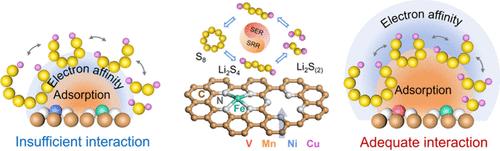
The adsorption-conversion paradigm of polysulfides during the sulfur reduction reaction (SRR) is appealing to tackle the shuttle effect in Li-S batteries, especially based upon atomically dispersed electrocatalysts. However, mechanistic insights into such catalytic systems remain ambiguous, limiting the understanding of sulfur electrochemistry and retarding the rational design of available catalysts. Herein, we systematically explore the polysulfide adsorption-conversion essence via a geminal-atom model system to understand the catalyst roles toward an expedited SRR. A descriptor involving an electronic structure index (IES) and electron affinity index (IEA) is proposed, considering the geometric and electronic dictation within a Fe/M (M: 3d-block transition metal) atomic ensemble. With the aid of theoretical computation, we managed to identify the SRR thermodynamic/kinetic trends of Fe/M moieties. Guided by these findings, we in target design a Fe/V-NC dual-atom catalyst, which harvests a minimum IES and maximum IEA, accordingly demonstrating enhanced polysulfide adsorption-conversion and improved full-cell performances. Such a consistency between a computational descriptor and experimental evidence highlights the importance of an atomic catalyst screen and selection for Li-S batteries.
期刊介绍:
ACS Nano, published monthly, serves as an international forum for comprehensive articles on nanoscience and nanotechnology research at the intersections of chemistry, biology, materials science, physics, and engineering. The journal fosters communication among scientists in these communities, facilitating collaboration, new research opportunities, and advancements through discoveries. ACS Nano covers synthesis, assembly, characterization, theory, and simulation of nanostructures, nanobiotechnology, nanofabrication, methods and tools for nanoscience and nanotechnology, and self- and directed-assembly. Alongside original research articles, it offers thorough reviews, perspectives on cutting-edge research, and discussions envisioning the future of nanoscience and nanotechnology.



 京公网安备 11010802042870号
京ICP备2023020795号-1
京公网安备 11010802042870号
京ICP备2023020795号-1

 分享
分享
 求助内容:
求助内容: 应助结果提醒方式:
 扫码关注我们
