Jing Jin, Feng Chen, Xinyu Hu, Jiashuai Zhang, Li Hou, Wenwei Lei and Faming Gao
{"title":"Self-derived, high-mechanical-strength polymetallic phosphides microsheet heterostructures for industrial-scale high-current-density water-splitting†","authors":"Jing Jin, Feng Chen, Xinyu Hu, Jiashuai Zhang, Li Hou, Wenwei Lei and Faming Gao","doi":"10.1039/D4QI02544J","DOIUrl":null,"url":null,"abstract":"<p >Developing nanoarray microstructure catalysts to amplify catalytic active sites has been a prevalent strategy to achieve effective water electrolysis. However, the stability of electrodes is severely affected by the bubble bombardment at industrial conditions. To address this issue, we synthesized a Fe–CoNiP/NCF (Fe–CNP/NCF) bifunctional catalyst with heterogeneous microsheet arrays on nickel cobalt foam (NCF) using Fe<small><sup>3+</sup></small> as an inducer through cation exchange and low-temperature phosphorization. The optimized Fe–CNP/NCF catalyst exhibited outstanding HER (<em>η</em><small><sub>1000</sub></small> = 195 mV) and OER (<em>η</em><small><sub>1000</sub></small> = 278 mV) activities, benefiting from the integration of abundant active sites on the hierarchical microsheets, where the doping of Fe promoted the formation of active species for the OER. In particular, accelerated mechanical strength tests demonstrated that the self-derived multidimensional catalyst possessed high mechanical robustness, thereby ensuring electrode resistance to withstand bubble impact under high current densities. As a proof of concept, in an industrial environment (6 M KOH, 80 °C), the dual-electrolyzer assembled with Fe–CNP/NCF sustained electrolysis for 200 h at a current density of 0.5 A cm<small><sup>−2</sup></small>, with a minimal rate of voltage loss (1.5 × 10<small><sup>−4</sup></small> V h<small><sup>−1</sup></small>), which demonstrated prolonged catalytic durability and structural integrity. This work provides new insights and approaches for developing nanoscale catalysts with high mechanical strength for large-scale industrial water electrolysis.</p>","PeriodicalId":79,"journal":{"name":"Inorganic Chemistry Frontiers","volume":" 3","pages":" 1049-1058"},"PeriodicalIF":6.4000,"publicationDate":"2024-12-11","publicationTypes":"Journal Article","fieldsOfStudy":null,"isOpenAccess":false,"openAccessPdf":"","citationCount":"0","resultStr":null,"platform":"Semanticscholar","paperid":null,"PeriodicalName":"Inorganic Chemistry Frontiers","FirstCategoryId":"92","ListUrlMain":"https://pubs.rsc.org/en/content/articlelanding/2025/qi/d4qi02544j","RegionNum":1,"RegionCategory":"化学","ArticlePicture":[],"TitleCN":null,"AbstractTextCN":null,"PMCID":null,"EPubDate":"","PubModel":"","JCR":"Q1","JCRName":"CHEMISTRY, INORGANIC & NUCLEAR","Score":null,"Total":0}
引用次数: 0
Abstract
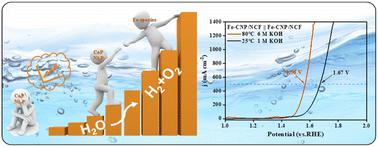
Developing nanoarray microstructure catalysts to amplify catalytic active sites has been a prevalent strategy to achieve effective water electrolysis. However, the stability of electrodes is severely affected by the bubble bombardment at industrial conditions. To address this issue, we synthesized a Fe–CoNiP/NCF (Fe–CNP/NCF) bifunctional catalyst with heterogeneous microsheet arrays on nickel cobalt foam (NCF) using Fe3+ as an inducer through cation exchange and low-temperature phosphorization. The optimized Fe–CNP/NCF catalyst exhibited outstanding HER (η1000 = 195 mV) and OER (η1000 = 278 mV) activities, benefiting from the integration of abundant active sites on the hierarchical microsheets, where the doping of Fe promoted the formation of active species for the OER. In particular, accelerated mechanical strength tests demonstrated that the self-derived multidimensional catalyst possessed high mechanical robustness, thereby ensuring electrode resistance to withstand bubble impact under high current densities. As a proof of concept, in an industrial environment (6 M KOH, 80 °C), the dual-electrolyzer assembled with Fe–CNP/NCF sustained electrolysis for 200 h at a current density of 0.5 A cm−2, with a minimal rate of voltage loss (1.5 × 10⁻⁴ V h−1), which demonstrated prolonged catalytic durability and structural integrity. This work provides new insights and approaches for developing nanoscale catalysts with high mechanical strength for large-scale industrial water electrolysis.
开发纳米阵列微观结构催化剂来放大催化活性位点已成为实现高效水电解的普遍策略。但在工业条件下,气泡轰击严重影响了电极的稳定性。为了解决这一问题,我们以Fe3+为诱导剂,通过阳离子交换和低温磷化方法,在镍钴泡沫(NCF)上合成了Fe-CoNiP/NCF (Fe-CNP/NCF)非均相微片阵列双功能催化剂。优化后的Fe- cnp /NCF催化剂表现出优异的HER (η值1000=195 mV)和OER (η值1000=278 mV)活性,这得益于层叠微片上丰富的活性位点的整合,其中Fe的掺杂促进了OER活性物质的形成。特别是,加速机械强度测试表明,自衍生多维催化剂具有很高的机械稳健性,确保电极抵抗高电流密度下的气泡冲击。作为概念验证,在工业环境(6 M KOH, 80°C)中,由Fe-CNP/NCF组装的双电解槽在0.5 a cm-2的电流密度下持续电解200小时,电压损失率仅为1.5×10⁻⁴ V h-1,显示出长时间的催化耐久性和结构完整性。本研究为开发高机械强度的纳米级大规模工业水电解催化剂提供了新的思路和途径。



 京公网安备 11010802042870号
京ICP备2023020795号-1
京公网安备 11010802042870号
京ICP备2023020795号-1

 分享
分享
 求助内容:
求助内容: 应助结果提醒方式:
 扫码关注我们
