Shuo Zhou, Dengke Zhang, Yi Kong, Qian Zhang, Xinyi Cui
{"title":"In Vivo Bioavailability and In Vitro Bioaccessibility of Iodine in Edible Seaweeds: Method Development and Health Implications","authors":"Shuo Zhou, Dengke Zhang, Yi Kong, Qian Zhang, Xinyi Cui","doi":"10.1021/acs.est.4c08990","DOIUrl":null,"url":null,"abstract":"Both iodine (I) deficiency and I excess can adversely affect human health. Seaweed consumption is one of the most important natural sources for I. This study assessed I relative bioavailability (RBA) in seaweed using an <i>in vivo</i> mouse model and compared it with I bioaccessibility measured by three <i>in vitro</i> methods (Physiologically Based Extraction Test (PBET), the Solubility Bioaccessibility Research Consortium (SBRC), and the Unified Bioaccessibility Research Group of Europe Method (UBM)). Total I concentrations in 26 seaweed samples from four species ranged from 52.4 to 1322 mg/kg of dry weight. The I RBA varied from 18.5% to 89.0%, significantly influenced by inorganic I percentage (<i>r</i> = 0.50, <i>p</i> < 0.01) and total dietary fiber contents (<i>r</i> = −0.28, <i>p</i> < 0.05) in seaweeds. The I bioaccessibility varied among species and methods and were affected by the pH of gastric solution, as well as the structural changes in seaweed during <i>in vitro</i> extraction. Correlation analysis demonstrated that PBET was the best predictor for I RBA (<i>R</i><sup>2</sup> = 0.64). These results developed an appropriate <i>in vitro</i> method for predicting I bioavailability in seaweeds, which is highly beneficial for the accurate assessment for I dietary intake.","PeriodicalId":36,"journal":{"name":"环境科学与技术","volume":"21 1","pages":""},"PeriodicalIF":11.3000,"publicationDate":"2024-12-12","publicationTypes":"Journal Article","fieldsOfStudy":null,"isOpenAccess":false,"openAccessPdf":"","citationCount":"0","resultStr":null,"platform":"Semanticscholar","paperid":null,"PeriodicalName":"环境科学与技术","FirstCategoryId":"1","ListUrlMain":"https://doi.org/10.1021/acs.est.4c08990","RegionNum":1,"RegionCategory":"环境科学与生态学","ArticlePicture":[],"TitleCN":null,"AbstractTextCN":null,"PMCID":null,"EPubDate":"","PubModel":"","JCR":"Q1","JCRName":"ENGINEERING, ENVIRONMENTAL","Score":null,"Total":0}
引用次数: 0
Abstract
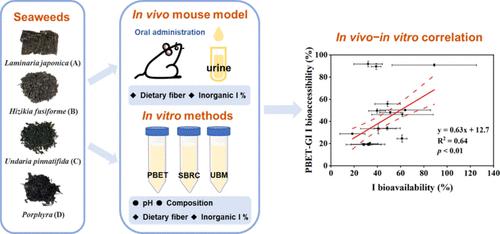
Both iodine (I) deficiency and I excess can adversely affect human health. Seaweed consumption is one of the most important natural sources for I. This study assessed I relative bioavailability (RBA) in seaweed using an in vivo mouse model and compared it with I bioaccessibility measured by three in vitro methods (Physiologically Based Extraction Test (PBET), the Solubility Bioaccessibility Research Consortium (SBRC), and the Unified Bioaccessibility Research Group of Europe Method (UBM)). Total I concentrations in 26 seaweed samples from four species ranged from 52.4 to 1322 mg/kg of dry weight. The I RBA varied from 18.5% to 89.0%, significantly influenced by inorganic I percentage (r = 0.50, p < 0.01) and total dietary fiber contents (r = −0.28, p < 0.05) in seaweeds. The I bioaccessibility varied among species and methods and were affected by the pH of gastric solution, as well as the structural changes in seaweed during in vitro extraction. Correlation analysis demonstrated that PBET was the best predictor for I RBA (R2 = 0.64). These results developed an appropriate in vitro method for predicting I bioavailability in seaweeds, which is highly beneficial for the accurate assessment for I dietary intake.
期刊介绍:
Environmental Science & Technology (ES&T) is a co-sponsored academic and technical magazine by the Hubei Provincial Environmental Protection Bureau and the Hubei Provincial Academy of Environmental Sciences.
Environmental Science & Technology (ES&T) holds the status of Chinese core journals, scientific papers source journals of China, Chinese Science Citation Database source journals, and Chinese Academic Journal Comprehensive Evaluation Database source journals. This publication focuses on the academic field of environmental protection, featuring articles related to environmental protection and technical advancements.



 京公网安备 11010802042870号
京ICP备2023020795号-1
京公网安备 11010802042870号
京ICP备2023020795号-1

 分享
分享
 求助内容:
求助内容: 应助结果提醒方式:
 扫码关注我们
