{"title":"An arbitrary waveform neurostimulator for preclinical studies: design and verification.","authors":"Hipolito Guzman-Miranda, Alejandro Barriga-Rivera","doi":"10.1007/s11517-024-03241-6","DOIUrl":null,"url":null,"abstract":"<p><p>Neural electrostimulation has enabled different therapies to treat a number of health problems. For example, the cochlear implant allows for recovering the hearing function and deep brain electrostimulation has been proved to reduce tremor in Parkinson's disease. Other approaches such as retinal prostheses are progressing rapidly, as researchers continue to investigate new strategies to activate targeted neurons more precisely. The use of arbitrary current waveform electrosimulation is a promising technique that allows exploiting the differences that exist among different neural types to enable preferential activation. This work presents a two-channel arbitrary waveform neurostimulator designed for visual prosthetics research. A field programmable gate array (FPGA) was employed to control and generate voltage waveforms via digital-to-analog converters. Voltage waveforms were then electrically isolated and converted to current waveforms using a modified Howland amplifier. Shorting of the electrodes was provided using multiplexers. The FPGA gateware was verified to a high level of confidence using a transaction-level modeled testbench, achieving a line coverage of 91.4%. The complete system was tested in saline using silver electrodes with diameters from 200 to 1000 µm. The bandwidth obtained was 30 kHz with voltage compliance ± 15 V. The neurostimulator can be easily scaled up using the provided in/out trigger ports and adapted to other applications with minor modifications.</p>","PeriodicalId":49840,"journal":{"name":"Medical & Biological Engineering & Computing","volume":" ","pages":"1143-1159"},"PeriodicalIF":2.6000,"publicationDate":"2025-04-01","publicationTypes":"Journal Article","fieldsOfStudy":null,"isOpenAccess":false,"openAccessPdf":"https://www.ncbi.nlm.nih.gov/pmc/articles/PMC11947015/pdf/","citationCount":"0","resultStr":null,"platform":"Semanticscholar","paperid":null,"PeriodicalName":"Medical & Biological Engineering & Computing","FirstCategoryId":"5","ListUrlMain":"https://doi.org/10.1007/s11517-024-03241-6","RegionNum":4,"RegionCategory":"医学","ArticlePicture":[],"TitleCN":null,"AbstractTextCN":null,"PMCID":null,"EPubDate":"2024/12/12 0:00:00","PubModel":"Epub","JCR":"Q2","JCRName":"COMPUTER SCIENCE, INTERDISCIPLINARY APPLICATIONS","Score":null,"Total":0}
引用次数: 0
Abstract
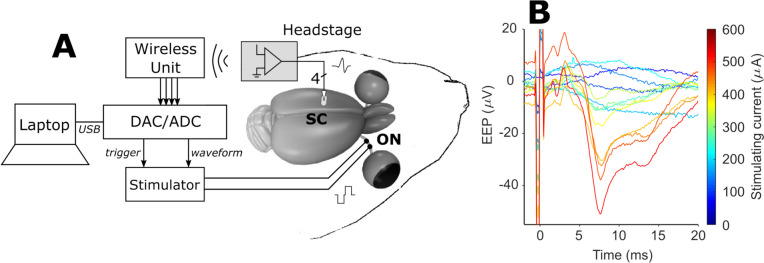
Neural electrostimulation has enabled different therapies to treat a number of health problems. For example, the cochlear implant allows for recovering the hearing function and deep brain electrostimulation has been proved to reduce tremor in Parkinson's disease. Other approaches such as retinal prostheses are progressing rapidly, as researchers continue to investigate new strategies to activate targeted neurons more precisely. The use of arbitrary current waveform electrosimulation is a promising technique that allows exploiting the differences that exist among different neural types to enable preferential activation. This work presents a two-channel arbitrary waveform neurostimulator designed for visual prosthetics research. A field programmable gate array (FPGA) was employed to control and generate voltage waveforms via digital-to-analog converters. Voltage waveforms were then electrically isolated and converted to current waveforms using a modified Howland amplifier. Shorting of the electrodes was provided using multiplexers. The FPGA gateware was verified to a high level of confidence using a transaction-level modeled testbench, achieving a line coverage of 91.4%. The complete system was tested in saline using silver electrodes with diameters from 200 to 1000 µm. The bandwidth obtained was 30 kHz with voltage compliance ± 15 V. The neurostimulator can be easily scaled up using the provided in/out trigger ports and adapted to other applications with minor modifications.
期刊介绍:
Founded in 1963, Medical & Biological Engineering & Computing (MBEC) continues to serve the biomedical engineering community, covering the entire spectrum of biomedical and clinical engineering. The journal presents exciting and vital experimental and theoretical developments in biomedical science and technology, and reports on advances in computer-based methodologies in these multidisciplinary subjects. The journal also incorporates new and evolving technologies including cellular engineering and molecular imaging.
MBEC publishes original research articles as well as reviews and technical notes. Its Rapid Communications category focuses on material of immediate value to the readership, while the Controversies section provides a forum to exchange views on selected issues, stimulating a vigorous and informed debate in this exciting and high profile field.
MBEC is an official journal of the International Federation of Medical and Biological Engineering (IFMBE).






 京公网安备 11010802042870号
京ICP备2023020795号-1
京公网安备 11010802042870号
京ICP备2023020795号-1

 分享
分享
 求助内容:
求助内容: 应助结果提醒方式:
 扫码关注我们
