Yunshuo Wu, Xuanhao Wu, Jie Fan, Haiqiang Wang, Zhongbiao Wu
{"title":"Insights into the Roles of Different Iron Species on Zeolites for N2O Selective Catalytic Reduction by CO","authors":"Yunshuo Wu, Xuanhao Wu, Jie Fan, Haiqiang Wang, Zhongbiao Wu","doi":"10.1021/acs.est.4c06924","DOIUrl":null,"url":null,"abstract":"Iron zeolites are promising candidates for mitigating nitrous oxide (N<sub>2</sub>O), a potent greenhouse gas and contributor to stratospheric ozone destruction. However, the atomic-level mechanisms by which different iron species, including isolated sites, clusters, and particles, participate in N<sub>2</sub>O decomposition in the presence of CO still remain poorly understood, which hinders the application of the reaction in practical technology. Herein, through experiments and density functional theory (DFT) calculations, we identified that isolated iron sites were active for N<sub>2</sub>O activation to generate adsorbed O* species, which readily reacted with CO following the Eley–Rideal (E-R) mechanism. In contrast, Fe<sub>2</sub>O<sub>3</sub> particles exhibited a different reaction pathway, directly reacting with CO to generate oxygen vacancies (O<sub>v</sub>), which could efficiently dissociate N<sub>2</sub>O following the Mars-van Krevelen (MvK) mechanism. Moreover, the transformation of iron oxide clusters into undercoordinated FeO<sub><i>x</i></sub> species by CO was also revealed through various techniques, such as CO-temperature-programmed reduction (TPR), and <i>ab initio</i> molecular dynamics (AIMD) simulations. Our study provides deeper insights into the roles of different iron species in N<sub>2</sub>O-SCR by CO, and is anticipated to facilitate the understanding of multicomponent catalysis and the design of efficient iron-containing catalysts for practical applications.","PeriodicalId":36,"journal":{"name":"环境科学与技术","volume":"7 1","pages":""},"PeriodicalIF":11.3000,"publicationDate":"2024-12-13","publicationTypes":"Journal Article","fieldsOfStudy":null,"isOpenAccess":false,"openAccessPdf":"","citationCount":"0","resultStr":null,"platform":"Semanticscholar","paperid":null,"PeriodicalName":"环境科学与技术","FirstCategoryId":"1","ListUrlMain":"https://doi.org/10.1021/acs.est.4c06924","RegionNum":1,"RegionCategory":"环境科学与生态学","ArticlePicture":[],"TitleCN":null,"AbstractTextCN":null,"PMCID":null,"EPubDate":"","PubModel":"","JCR":"Q1","JCRName":"ENGINEERING, ENVIRONMENTAL","Score":null,"Total":0}
引用次数: 0
Abstract
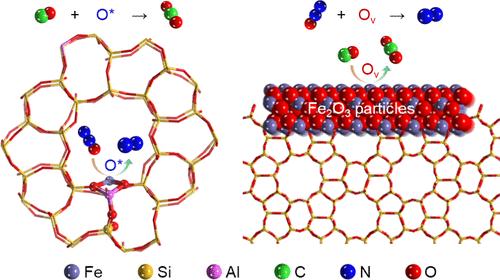
Iron zeolites are promising candidates for mitigating nitrous oxide (N2O), a potent greenhouse gas and contributor to stratospheric ozone destruction. However, the atomic-level mechanisms by which different iron species, including isolated sites, clusters, and particles, participate in N2O decomposition in the presence of CO still remain poorly understood, which hinders the application of the reaction in practical technology. Herein, through experiments and density functional theory (DFT) calculations, we identified that isolated iron sites were active for N2O activation to generate adsorbed O* species, which readily reacted with CO following the Eley–Rideal (E-R) mechanism. In contrast, Fe2O3 particles exhibited a different reaction pathway, directly reacting with CO to generate oxygen vacancies (Ov), which could efficiently dissociate N2O following the Mars-van Krevelen (MvK) mechanism. Moreover, the transformation of iron oxide clusters into undercoordinated FeOx species by CO was also revealed through various techniques, such as CO-temperature-programmed reduction (TPR), and ab initio molecular dynamics (AIMD) simulations. Our study provides deeper insights into the roles of different iron species in N2O-SCR by CO, and is anticipated to facilitate the understanding of multicomponent catalysis and the design of efficient iron-containing catalysts for practical applications.
期刊介绍:
Environmental Science & Technology (ES&T) is a co-sponsored academic and technical magazine by the Hubei Provincial Environmental Protection Bureau and the Hubei Provincial Academy of Environmental Sciences.
Environmental Science & Technology (ES&T) holds the status of Chinese core journals, scientific papers source journals of China, Chinese Science Citation Database source journals, and Chinese Academic Journal Comprehensive Evaluation Database source journals. This publication focuses on the academic field of environmental protection, featuring articles related to environmental protection and technical advancements.



 京公网安备 11010802042870号
京ICP备2023020795号-1
京公网安备 11010802042870号
京ICP备2023020795号-1

 分享
分享
 求助内容:
求助内容: 应助结果提醒方式:
 扫码关注我们
