Savvina Leontakianakou, Carl Grey, Eva Nordberg Karlsson, Roya R R Sardari
{"title":"An improved HPAEC-PAD method for the determination of D-glucuronic acid and 4-O-methyl-D-glucuronic acid from polymeric and oligomeric xylan.","authors":"Savvina Leontakianakou, Carl Grey, Eva Nordberg Karlsson, Roya R R Sardari","doi":"10.1186/s12896-024-00931-9","DOIUrl":null,"url":null,"abstract":"<p><p>Glucuronic acid (GlcA) is an abundant substituent in hardwood xylan, and it is often found in its methylated form as methyl glucuronic acid (MeGlcA). GlcA and MeGlcA are sugar acids, bound to the xylose backbone at position O-2, and their presence can affect the digestibility of the polymer. Currently, detection of released GlcA or MeGlcA from synthetic substrates such as pNP-glucuronic acid can be achieved with colorimetric assays, whereas analysis from natural substrates such as xylan is more complicated. High performance anion exchange chromatography with pulsed amperometric detection (HPAEC-PAD) with an isocratic elution profile has been proposed for quantification of uronic acids in acid-hydrolysed wood samples. However, achieving sufficient separation for comprehensive analysis of hardwood-related xylan components, particularly MeGlcA remains challenging with this methodology. This study offers modified protocols for improved separation by introducing gradient elution profiles to effectively separate hydrolysed hardwood-related compounds, including MeGlcA, and GlcA within a single analytical run. The method showed excellent reproducibility and a standard curve of MeGlcA assured first order linearity in a wide range of concentrations, making the method excellent for quantification.</p>","PeriodicalId":8905,"journal":{"name":"BMC Biotechnology","volume":"24 1","pages":"100"},"PeriodicalIF":3.4000,"publicationDate":"2024-12-12","publicationTypes":"Journal Article","fieldsOfStudy":null,"isOpenAccess":false,"openAccessPdf":"https://www.ncbi.nlm.nih.gov/pmc/articles/PMC11636049/pdf/","citationCount":"0","resultStr":null,"platform":"Semanticscholar","paperid":null,"PeriodicalName":"BMC Biotechnology","FirstCategoryId":"5","ListUrlMain":"https://doi.org/10.1186/s12896-024-00931-9","RegionNum":3,"RegionCategory":"生物学","ArticlePicture":[],"TitleCN":null,"AbstractTextCN":null,"PMCID":null,"EPubDate":"","PubModel":"","JCR":"Q2","JCRName":"BIOTECHNOLOGY & APPLIED MICROBIOLOGY","Score":null,"Total":0}
引用次数: 0
Abstract
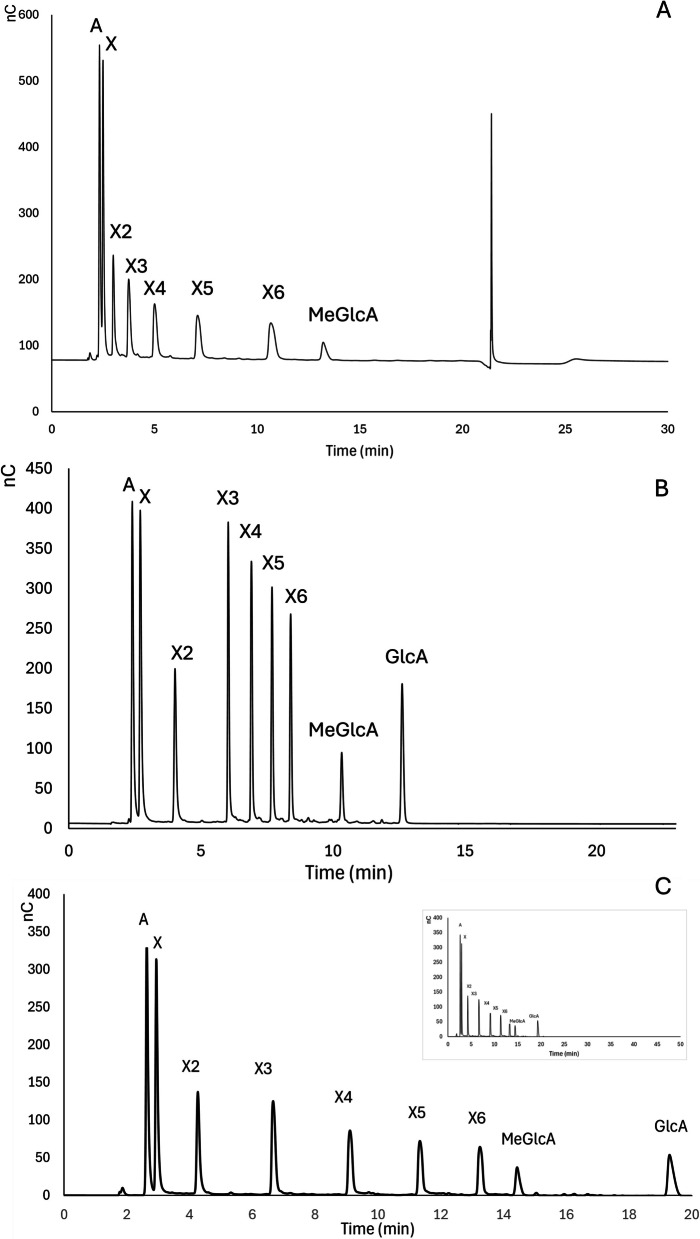
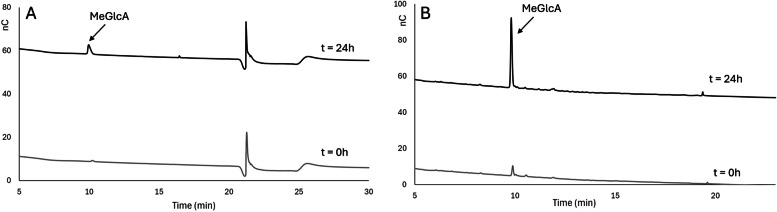
Glucuronic acid (GlcA) is an abundant substituent in hardwood xylan, and it is often found in its methylated form as methyl glucuronic acid (MeGlcA). GlcA and MeGlcA are sugar acids, bound to the xylose backbone at position O-2, and their presence can affect the digestibility of the polymer. Currently, detection of released GlcA or MeGlcA from synthetic substrates such as pNP-glucuronic acid can be achieved with colorimetric assays, whereas analysis from natural substrates such as xylan is more complicated. High performance anion exchange chromatography with pulsed amperometric detection (HPAEC-PAD) with an isocratic elution profile has been proposed for quantification of uronic acids in acid-hydrolysed wood samples. However, achieving sufficient separation for comprehensive analysis of hardwood-related xylan components, particularly MeGlcA remains challenging with this methodology. This study offers modified protocols for improved separation by introducing gradient elution profiles to effectively separate hydrolysed hardwood-related compounds, including MeGlcA, and GlcA within a single analytical run. The method showed excellent reproducibility and a standard curve of MeGlcA assured first order linearity in a wide range of concentrations, making the method excellent for quantification.
期刊介绍:
BMC Biotechnology is an open access, peer-reviewed journal that considers articles on the manipulation of biological macromolecules or organisms for use in experimental procedures, cellular and tissue engineering or in the pharmaceutical, agricultural biotechnology and allied industries.



 京公网安备 11010802042870号
京ICP备2023020795号-1
京公网安备 11010802042870号
京ICP备2023020795号-1

 分享
分享
 求助内容:
求助内容: 应助结果提醒方式:
 扫码关注我们
