{"title":"Health Care Utilization After Immediate Compared With Delayed Postpartum Intrauterine Device Placement.","authors":"Talis M Swisher, Amy Alabaster, Margaret C Howe","doi":"10.1097/AOG.0000000000005807","DOIUrl":null,"url":null,"abstract":"<p><strong>Objective: </strong>To investigate differences in health care utilization between immediate (within 10 minutes of placental delivery) and delayed (after 24 hours) intrauterine device (IUD) placement.</p><p><strong>Methods: </strong>This retrospective cohort study was conducted with data from Kaiser Permanente Northern California from 2017 to 2019 and included patients with an IUD placed between 0 and 63 days postpartum. The primary outcome for health care utilization was the number of obstetrician-gynecologist (ob-gyn) or women's health office visits within 1 year. Secondary outcomes included formal imaging studies, surgical intervention, and hospitalizations related to IUD complications within 1 year. An additional secondary outcome was live births at 120 days and 1 year.</p><p><strong>Results: </strong>Among 1,543 immediate and 10,332 delayed postpartum IUD placements, the number of visits to an ob-gyn or women's health office within 1 year was slightly increased with delayed placement (mean 2.30 vs 2.47, P <.001). Imaging was increased in the immediate compared with the delayed group (10.5% vs 4.1%, P <.001). Laparoscopy was decreased in the immediate compared with the delayed group (0.0% vs 0.4%, P =.005), with no significant difference in hysteroscopy (0.2% vs 0.1%, P =.413). Hospitalizations were rare and increased in the immediate group (0.4% vs 0.02%, P <.001). Lastly, there was no difference in repeat pregnancies between groups at 120 days (both 0.2%) or at 1 year (2.9% vs 2.5%, P =.342).</p><p><strong>Conclusion: </strong>Compared with delayed placement, immediate postpartum IUD placement is not associated with increased office visits. Immediate placement is associated with an increase in imaging but a decrease in laparoscopic surgery to manage IUD-related complications. There was no difference in live birth rates at 6 months or 1 year between groups.</p>","PeriodicalId":19483,"journal":{"name":"Obstetrics and gynecology","volume":" ","pages":"e65-e73"},"PeriodicalIF":4.7000,"publicationDate":"2025-02-01","publicationTypes":"Journal Article","fieldsOfStudy":null,"isOpenAccess":false,"openAccessPdf":"","citationCount":"0","resultStr":null,"platform":"Semanticscholar","paperid":null,"PeriodicalName":"Obstetrics and gynecology","FirstCategoryId":"3","ListUrlMain":"https://doi.org/10.1097/AOG.0000000000005807","RegionNum":2,"RegionCategory":"医学","ArticlePicture":[],"TitleCN":null,"AbstractTextCN":null,"PMCID":null,"EPubDate":"2024/12/12 0:00:00","PubModel":"Epub","JCR":"Q1","JCRName":"OBSTETRICS & GYNECOLOGY","Score":null,"Total":0}
引用次数: 0
Abstract
Objective: To investigate differences in health care utilization between immediate (within 10 minutes of placental delivery) and delayed (after 24 hours) intrauterine device (IUD) placement.
Methods: This retrospective cohort study was conducted with data from Kaiser Permanente Northern California from 2017 to 2019 and included patients with an IUD placed between 0 and 63 days postpartum. The primary outcome for health care utilization was the number of obstetrician-gynecologist (ob-gyn) or women's health office visits within 1 year. Secondary outcomes included formal imaging studies, surgical intervention, and hospitalizations related to IUD complications within 1 year. An additional secondary outcome was live births at 120 days and 1 year.
Results: Among 1,543 immediate and 10,332 delayed postpartum IUD placements, the number of visits to an ob-gyn or women's health office within 1 year was slightly increased with delayed placement (mean 2.30 vs 2.47, P <.001). Imaging was increased in the immediate compared with the delayed group (10.5% vs 4.1%, P <.001). Laparoscopy was decreased in the immediate compared with the delayed group (0.0% vs 0.4%, P =.005), with no significant difference in hysteroscopy (0.2% vs 0.1%, P =.413). Hospitalizations were rare and increased in the immediate group (0.4% vs 0.02%, P <.001). Lastly, there was no difference in repeat pregnancies between groups at 120 days (both 0.2%) or at 1 year (2.9% vs 2.5%, P =.342).
Conclusion: Compared with delayed placement, immediate postpartum IUD placement is not associated with increased office visits. Immediate placement is associated with an increase in imaging but a decrease in laparoscopic surgery to manage IUD-related complications. There was no difference in live birth rates at 6 months or 1 year between groups.
目的:探讨立即(胎盘分娩10分钟内)和延迟(24小时后)放置宫内节育器(IUD)在医疗保健利用方面的差异。方法:本回顾性队列研究采用北加州凯撒医疗机构2017年至2019年的数据,纳入产后0至63天放置宫内节育器的患者。医疗保健利用的主要结局是1年内到妇产科医生或妇女健康办公室就诊的次数。次要结局包括正式影像学检查、手术干预和1年内与宫内节育器并发症相关的住院情况。另一个次要结局是120天和1岁时的活产。结果:在1,543例即刻放置的产后宫内节育器和10,332例延迟放置的产后宫内节育器中,延迟放置的产后1年内到妇产科或妇女健康办公室的次数略有增加(平均2.30 vs 2.47, p)。结论:与延迟放置的产后宫内节育器相比,立即放置的产后宫内节育器与办公室就诊次数的增加无关。立即放置与影像的增加有关,但腹腔镜手术治疗宫内节育器相关并发症的减少有关。组间6个月和1岁的活产率无差异。
期刊介绍:
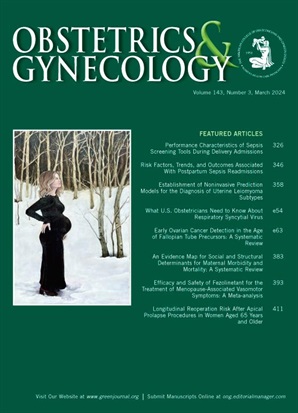
"Obstetrics & Gynecology," affectionately known as "The Green Journal," is the official publication of the American College of Obstetricians and Gynecologists (ACOG). Since its inception in 1953, the journal has been dedicated to advancing the clinical practice of obstetrics and gynecology, as well as related fields. The journal's mission is to promote excellence in these areas by publishing a diverse range of articles that cover translational and clinical topics.
"Obstetrics & Gynecology" provides a platform for the dissemination of evidence-based research, clinical guidelines, and expert opinions that are essential for the continuous improvement of women's health care. The journal's content is designed to inform and educate obstetricians, gynecologists, and other healthcare professionals, ensuring that they stay abreast of the latest developments and best practices in their field.



 京公网安备 11010802042870号
京ICP备2023020795号-1
京公网安备 11010802042870号
京ICP备2023020795号-1

 分享
分享
 求助内容:
求助内容: 应助结果提醒方式:
 扫码关注我们
