Influence of iron-modified biochar on phosphate transport and deposition in saturated porous media under varying pH, ionic strength, and biochar dosage
Rakesh Kumar , Jasmeet Lamba , Sushil Adhikari , Nitesh Kasera , Henry Allen Torbert
{"title":"Influence of iron-modified biochar on phosphate transport and deposition in saturated porous media under varying pH, ionic strength, and biochar dosage","authors":"Rakesh Kumar , Jasmeet Lamba , Sushil Adhikari , Nitesh Kasera , Henry Allen Torbert","doi":"10.1016/j.chemosphere.2024.143932","DOIUrl":null,"url":null,"abstract":"<div><div>Phosphorus (P) is one of the essential nutrients required for plants; however, loss of phosphorus from agricultural areas results in water quality impairment. This research aims to investigate the transport and deposition of phosphate at different solution chemistries and phosphate-biochar dosages under (a) individual phosphate flow, (b) phosphate transport followed by biochar, and (c) co-transport of biochar-phosphate in saturated porous media. Breakthrough curves (BTCs) for phosphate were generated to understand the effect of pine raw biochar (BC) and iron-modified biochar (Fe-BC) on phosphate transport and deposition under varying solutions, pH (5.5 ± 0.1–10.5 ± 0.1), ionic strength (0–10 mM), phosphate (10–20 mg/L), and biochar dosages (100–200 mg/L) in saturated porous media. Results revealed increased deposition of BC and Fe-BC at high ionic strength (IS), i.e., 10 mM compared to 0 mM. The BTCs of phosphate (10–20 mg/L) transport at increasing IS showed delayed elute and long tailing curves compared to BTCs of tracer. Further, phosphate transport using BTCs in biochar-mediated saturated porous media was investigated at 10–20 mg/L phosphate, where maximum retardation (37%) was observed at pH 6.7 ± 0.1 and 0 mM IS due to the availability of active sites for 10 mg/L phosphate using Fe-BC than BC. The BTCs of phosphate transport at pH 6.7 ± 0.1 and 0–10 mM IS showed 37% and 40% phosphate deposition in Fe-BC-mediated columns for 0 mM and 10 mM, respectively, than BC-mediated columns. For BC, maximum phosphate adsorption was observed at pH 5.5 ± 0.1, whereas for Fe-BC, it was observed at pH 6.7 ± 0.1 at 10 mM IS. The least adsorption was observed at pH of 10.5 ± 0.1 for both BC and Fe-BC. Similar phosphate retardation BTCs for BC and Fe-BC at 10 mM were observed with adsorption of 40% phosphate for 100–200 mg/L biochar dosages. Besides, co-transport and deposition of biochar and phosphate, considering with and without ripening effect, reported high phosphate retardation using Fe-BC than BC at pH of 6.7 ± 0.1 and 10 mM IS due to chemical non-equilibrium and mass transfer. Taken together, iron-modified biochar (Fe-BC) showed significant adsorptive potential for phosphate management in saturated porous media. Overall, modeling of transport and deposition of phosphate and biochar are significant to understanding fate, nutrient mobility & management, biochar-phosphate interactions, and remediation designs in saturated porous media.</div></div>","PeriodicalId":276,"journal":{"name":"Chemosphere","volume":"370 ","pages":"Article 143932"},"PeriodicalIF":8.1000,"publicationDate":"2025-02-01","publicationTypes":"Journal Article","fieldsOfStudy":null,"isOpenAccess":false,"openAccessPdf":"","citationCount":"0","resultStr":null,"platform":"Semanticscholar","paperid":null,"PeriodicalName":"Chemosphere","FirstCategoryId":"93","ListUrlMain":"https://www.sciencedirect.com/science/article/pii/S0045653524028406","RegionNum":2,"RegionCategory":"环境科学与生态学","ArticlePicture":[],"TitleCN":null,"AbstractTextCN":null,"PMCID":null,"EPubDate":"2024/12/22 0:00:00","PubModel":"Epub","JCR":"Q1","JCRName":"ENVIRONMENTAL SCIENCES","Score":null,"Total":0}
引用次数: 0
Abstract
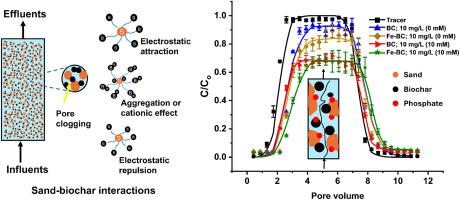
Phosphorus (P) is one of the essential nutrients required for plants; however, loss of phosphorus from agricultural areas results in water quality impairment. This research aims to investigate the transport and deposition of phosphate at different solution chemistries and phosphate-biochar dosages under (a) individual phosphate flow, (b) phosphate transport followed by biochar, and (c) co-transport of biochar-phosphate in saturated porous media. Breakthrough curves (BTCs) for phosphate were generated to understand the effect of pine raw biochar (BC) and iron-modified biochar (Fe-BC) on phosphate transport and deposition under varying solutions, pH (5.5 ± 0.1–10.5 ± 0.1), ionic strength (0–10 mM), phosphate (10–20 mg/L), and biochar dosages (100–200 mg/L) in saturated porous media. Results revealed increased deposition of BC and Fe-BC at high ionic strength (IS), i.e., 10 mM compared to 0 mM. The BTCs of phosphate (10–20 mg/L) transport at increasing IS showed delayed elute and long tailing curves compared to BTCs of tracer. Further, phosphate transport using BTCs in biochar-mediated saturated porous media was investigated at 10–20 mg/L phosphate, where maximum retardation (37%) was observed at pH 6.7 ± 0.1 and 0 mM IS due to the availability of active sites for 10 mg/L phosphate using Fe-BC than BC. The BTCs of phosphate transport at pH 6.7 ± 0.1 and 0–10 mM IS showed 37% and 40% phosphate deposition in Fe-BC-mediated columns for 0 mM and 10 mM, respectively, than BC-mediated columns. For BC, maximum phosphate adsorption was observed at pH 5.5 ± 0.1, whereas for Fe-BC, it was observed at pH 6.7 ± 0.1 at 10 mM IS. The least adsorption was observed at pH of 10.5 ± 0.1 for both BC and Fe-BC. Similar phosphate retardation BTCs for BC and Fe-BC at 10 mM were observed with adsorption of 40% phosphate for 100–200 mg/L biochar dosages. Besides, co-transport and deposition of biochar and phosphate, considering with and without ripening effect, reported high phosphate retardation using Fe-BC than BC at pH of 6.7 ± 0.1 and 10 mM IS due to chemical non-equilibrium and mass transfer. Taken together, iron-modified biochar (Fe-BC) showed significant adsorptive potential for phosphate management in saturated porous media. Overall, modeling of transport and deposition of phosphate and biochar are significant to understanding fate, nutrient mobility & management, biochar-phosphate interactions, and remediation designs in saturated porous media.
期刊介绍:
Chemosphere, being an international multidisciplinary journal, is dedicated to publishing original communications and review articles on chemicals in the environment. The scope covers a wide range of topics, including the identification, quantification, behavior, fate, toxicology, treatment, and remediation of chemicals in the bio-, hydro-, litho-, and atmosphere, ensuring the broad dissemination of research in this field.



 京公网安备 11010802042870号
京ICP备2023020795号-1
京公网安备 11010802042870号
京ICP备2023020795号-1

 分享
分享
 求助内容:
求助内容: 应助结果提醒方式:
 扫码关注我们
