Kelley A. Renninger, Rebekah M. Yarvis, Christopher E. Youngstrom, Chi-Lien Cheng
{"title":"The rise of CLAVATA: evidence for CLAVATA3 and WOX signaling in the fern gametophyte","authors":"Kelley A. Renninger, Rebekah M. Yarvis, Christopher E. Youngstrom, Chi-Lien Cheng","doi":"10.1111/tpj.17207","DOIUrl":null,"url":null,"abstract":"<p>CLAVATA3/EMBRYO SURROUNDING REGION (CLE) peptides are 12–13 amino acid-long peptides that serve as positional signals in plants. The core CLE signaling module consists of a CLE peptide and a leucine-rich repeat receptor-like kinase, but in flowering plants, WUSCHEL-RELATED HOMEOBOX (WOX) transcription factors are also incorporated to form negative feedback loops that regulate stem cell maintenance in the shoot and root. It is not known when <i>WOX</i> genes were co-opted into CLE signaling pathways, only that mosses and liverworts do not require WOX for CLE-regulated stem cell activities. We identified 11 CLE-encoding genes in the Ceratopteris genome, including one (CrCLV3) most similar to shoot meristem CLE peptide CLAVATA3. We performed the first functional characterization of a fern CLE using techniques including RNAi knockdown and synthetic peptide dosage. We found that CrCLV3 promotes cell proliferation and stem cell identity in the gametophyte meristem. Importantly, we provide evidence for CrCLV3 regulation of the <i>WOX</i> gene <i>CrWOXA</i> during the developmental stage when female gametangium formation begins. These discoveries open a new avenue for CLE peptide research in the fern and clarify the evolutionary timeline of CLE-WOX signaling in land plants.</p>","PeriodicalId":233,"journal":{"name":"The Plant Journal","volume":"121 2","pages":""},"PeriodicalIF":5.7000,"publicationDate":"2024-12-14","publicationTypes":"Journal Article","fieldsOfStudy":null,"isOpenAccess":false,"openAccessPdf":"https://www.ncbi.nlm.nih.gov/pmc/articles/PMC11771683/pdf/","citationCount":"0","resultStr":null,"platform":"Semanticscholar","paperid":null,"PeriodicalName":"The Plant Journal","FirstCategoryId":"2","ListUrlMain":"https://onlinelibrary.wiley.com/doi/10.1111/tpj.17207","RegionNum":1,"RegionCategory":"生物学","ArticlePicture":[],"TitleCN":null,"AbstractTextCN":null,"PMCID":null,"EPubDate":"","PubModel":"","JCR":"Q1","JCRName":"PLANT SCIENCES","Score":null,"Total":0}
引用次数: 0
Abstract
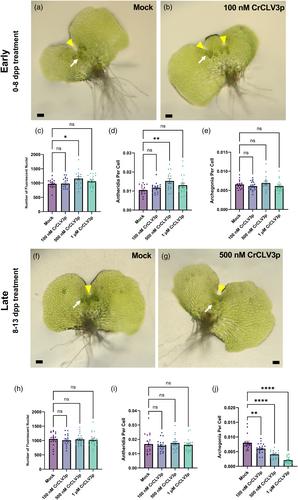
CLAVATA3/EMBRYO SURROUNDING REGION (CLE) peptides are 12–13 amino acid-long peptides that serve as positional signals in plants. The core CLE signaling module consists of a CLE peptide and a leucine-rich repeat receptor-like kinase, but in flowering plants, WUSCHEL-RELATED HOMEOBOX (WOX) transcription factors are also incorporated to form negative feedback loops that regulate stem cell maintenance in the shoot and root. It is not known when WOX genes were co-opted into CLE signaling pathways, only that mosses and liverworts do not require WOX for CLE-regulated stem cell activities. We identified 11 CLE-encoding genes in the Ceratopteris genome, including one (CrCLV3) most similar to shoot meristem CLE peptide CLAVATA3. We performed the first functional characterization of a fern CLE using techniques including RNAi knockdown and synthetic peptide dosage. We found that CrCLV3 promotes cell proliferation and stem cell identity in the gametophyte meristem. Importantly, we provide evidence for CrCLV3 regulation of the WOX gene CrWOXA during the developmental stage when female gametangium formation begins. These discoveries open a new avenue for CLE peptide research in the fern and clarify the evolutionary timeline of CLE-WOX signaling in land plants.
CLAVATA3/EMBRYO around REGION (CLE)肽是一种12-13个氨基酸长的肽,在植物中起着定位信号的作用。核心CLE信号模块由CLE肽和富含亮氨酸的重复受体样激酶组成,但在开花植物中,wuschell相关的HOMEOBOX (WOX)转录因子也被纳入其中,在茎和根中形成负反馈回路,调节干细胞的维持。目前尚不清楚WOX基因何时被选入CLE信号通路,只知道苔藓和苔类不需要WOX来进行CLE调节的干细胞活动。我们在角喙鸟基因组中鉴定了11个CLE编码基因,其中一个(CrCLV3)与茎分生组织CLE肽CLAVATA3最相似。我们使用包括RNAi敲除和合成肽剂量在内的技术对蕨类CLE进行了首次功能表征。我们发现CrCLV3在配子体分生组织中促进细胞增殖和干细胞身份。重要的是,我们提供了CrCLV3在雌性配子膜形成开始的发育阶段调控WOX基因CrWOXA的证据。这些发现为蕨类植物CLE肽的研究开辟了新的途径,并阐明了陆地植物CLE- wox信号的进化时间表。
期刊介绍:
Publishing the best original research papers in all key areas of modern plant biology from the world"s leading laboratories, The Plant Journal provides a dynamic forum for this ever growing international research community.
Plant science research is now at the forefront of research in the biological sciences, with breakthroughs in our understanding of fundamental processes in plants matching those in other organisms. The impact of molecular genetics and the availability of model and crop species can be seen in all aspects of plant biology. For publication in The Plant Journal the research must provide a highly significant new contribution to our understanding of plants and be of general interest to the plant science community.



 京公网安备 11010802042870号
京ICP备2023020795号-1
京公网安备 11010802042870号
京ICP备2023020795号-1

 分享
分享
 求助内容:
求助内容: 应助结果提醒方式:
 扫码关注我们
