Xiaohui Wang , Xinran Li , Baoquan Wang , Yanxia Xie , Xueru Cui , Jin Jiao , Jianwei Jiao , Yachao Zhang
{"title":"A label-free electrochemical biosensor based on graphene quantum dots-nanoporous gold nanocomposite for highly sensitive detection of glioma cell","authors":"Xiaohui Wang , Xinran Li , Baoquan Wang , Yanxia Xie , Xueru Cui , Jin Jiao , Jianwei Jiao , Yachao Zhang","doi":"10.1016/j.aca.2024.343555","DOIUrl":null,"url":null,"abstract":"<div><h3>Background</h3><div>Glioma accounts for 80 % of all malignant primary brain tumors with a high mortality rate. Histopathological examination is the current diagnostic methods for glioma, but its invasive surgical interventions can cause cerebral edema or impair neural functioning. Liquid biopsy proves to be an efficient method for glioma detection. However, the blood-brain barrier restricts the number of circulating tumor cells (CTCs) in the bloodstream, posing a challenge for sensitive detection of glioma CTCs. This study aims to use the unique characteristics of nanocomposites and the specificity of Angiopep2 (Ang-2) to develop a method that can sensitively identify glioma CTCs.</div></div><div><h3>Results</h3><div>Herein, a novel label-free impedimetric biosensor was successfully constructed for glioma CTCs detection by using graphene quantum dots (GQDs)-nanoporous gold (NPG) nanocomposites as the immobilized platform and the Ang-2 protein as biorecognition element. The GQDs was homogeneously assembled onto NPG, resulting in the creation of a novel GQDs-NPG nanocomposite with unique structure and function properties. Due to the high electron transfer efficiency of the GQDs-NPG nanocomposite, the developed biosensor exhibited a wild detection range from 1 to 1 × 10<sup>6</sup> cell mL<sup>−1</sup>, with a minimal detection limit of 1 cell mL<sup>−1</sup>. Additionally, the glioma cell biosensor demonstrated a strong anti-interference ability against multiple cell lines, and the stability of the biosensor remained at 96 % after 21 days of storage. Besides, the quantities of glioma cells detected in human serum samples by the glioma cell biosensor demonstrated outstanding consistency with the standard values added to the samples.</div></div><div><h3>Significance</h3><div>The study provided a novel GQDs-NPG nanocomposite and an electrochemical biosensor based on GQDs-NPG was firstly developed for glioma CTCs detection. The glioma cell biosensor showed high sensitivity, low detection limit, strong anti-interference ability, and good stability in complex biological matrix. The reliable detection of glioma cell was successfully realized in human serum, providing an excellent option for liquid biopsy of glioma CTCs identification and early diagnosis of glioma diseases.</div></div>","PeriodicalId":240,"journal":{"name":"Analytica Chimica Acta","volume":"1337 ","pages":"Article 343555"},"PeriodicalIF":6.0000,"publicationDate":"2025-02-01","publicationTypes":"Journal Article","fieldsOfStudy":null,"isOpenAccess":false,"openAccessPdf":"","citationCount":"0","resultStr":null,"platform":"Semanticscholar","paperid":null,"PeriodicalName":"Analytica Chimica Acta","FirstCategoryId":"92","ListUrlMain":"https://www.sciencedirect.com/science/article/pii/S0003267024013564","RegionNum":2,"RegionCategory":"化学","ArticlePicture":[],"TitleCN":null,"AbstractTextCN":null,"PMCID":null,"EPubDate":"2024/12/16 0:00:00","PubModel":"Epub","JCR":"Q1","JCRName":"CHEMISTRY, ANALYTICAL","Score":null,"Total":0}
引用次数: 0
Abstract
Background
Glioma accounts for 80 % of all malignant primary brain tumors with a high mortality rate. Histopathological examination is the current diagnostic methods for glioma, but its invasive surgical interventions can cause cerebral edema or impair neural functioning. Liquid biopsy proves to be an efficient method for glioma detection. However, the blood-brain barrier restricts the number of circulating tumor cells (CTCs) in the bloodstream, posing a challenge for sensitive detection of glioma CTCs. This study aims to use the unique characteristics of nanocomposites and the specificity of Angiopep2 (Ang-2) to develop a method that can sensitively identify glioma CTCs.
Results
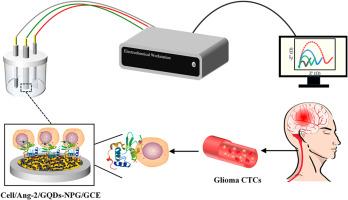
Herein, a novel label-free impedimetric biosensor was successfully constructed for glioma CTCs detection by using graphene quantum dots (GQDs)-nanoporous gold (NPG) nanocomposites as the immobilized platform and the Ang-2 protein as biorecognition element. The GQDs was homogeneously assembled onto NPG, resulting in the creation of a novel GQDs-NPG nanocomposite with unique structure and function properties. Due to the high electron transfer efficiency of the GQDs-NPG nanocomposite, the developed biosensor exhibited a wild detection range from 1 to 1 × 10⁶ cell mL−1, with a minimal detection limit of 1 cell mL−1. Additionally, the glioma cell biosensor demonstrated a strong anti-interference ability against multiple cell lines, and the stability of the biosensor remained at 96 % after 21 days of storage. Besides, the quantities of glioma cells detected in human serum samples by the glioma cell biosensor demonstrated outstanding consistency with the standard values added to the samples.
Significance
The study provided a novel GQDs-NPG nanocomposite and an electrochemical biosensor based on GQDs-NPG was firstly developed for glioma CTCs detection. The glioma cell biosensor showed high sensitivity, low detection limit, strong anti-interference ability, and good stability in complex biological matrix. The reliable detection of glioma cell was successfully realized in human serum, providing an excellent option for liquid biopsy of glioma CTCs identification and early diagnosis of glioma diseases.
期刊介绍:
Analytica Chimica Acta has an open access mirror journal Analytica Chimica Acta: X, sharing the same aims and scope, editorial team, submission system and rigorous peer review.
Analytica Chimica Acta provides a forum for the rapid publication of original research, and critical, comprehensive reviews dealing with all aspects of fundamental and applied modern analytical chemistry. The journal welcomes the submission of research papers which report studies concerning the development of new and significant analytical methodologies. In determining the suitability of submitted articles for publication, particular scrutiny will be placed on the degree of novelty and impact of the research and the extent to which it adds to the existing body of knowledge in analytical chemistry.




 京公网安备 11010802042870号
京ICP备2023020795号-1
京公网安备 11010802042870号
京ICP备2023020795号-1

 分享
分享
 求助内容:
求助内容: 应助结果提醒方式:
 扫码关注我们
