Jianwei Xiao , Junjie Gao , Songwei Li , Rui Wang , Chuang Deng , Yuntian Zhu , Zhaoxuan Wu
{"title":"Effects of Y solutes on the activation of the {112̄1}〈1̄1̄26〉 deformation twinning in MgY solid solution alloys","authors":"Jianwei Xiao , Junjie Gao , Songwei Li , Rui Wang , Chuang Deng , Yuntian Zhu , Zhaoxuan Wu","doi":"10.1016/j.actamat.2024.120648","DOIUrl":null,"url":null,"abstract":"<div><div>The <span><math><mrow><mrow><mo>{</mo><mn>1</mn><mspace></mspace><mn>1</mn><mspace></mspace><mover><mrow><mn>2</mn></mrow><mo>¯</mo></mover><mspace></mspace><mn>1</mn><mo>}</mo></mrow><mrow><mo>〈</mo><mover><mrow><mn>1</mn></mrow><mo>¯</mo></mover><mspace></mspace><mover><mrow><mn>1</mn></mrow><mo>¯</mo></mover><mspace></mspace><mn>2</mn><mspace></mspace><mn>6</mn><mo>〉</mo></mrow></mrow></math></span> deformation twin is common in nominally pure HCP Ti, Zr, Re, Co, but not in Mg. Rare-earth (RE) solutes such as Y and Gd at low atomic concentrations, however, can activate this twin mode and make it competitive to the regular <span><math><mrow><mrow><mo>{</mo><mn>1</mn><mspace></mspace><mn>0</mn><mspace></mspace><mover><mrow><mn>1</mn></mrow><mo>¯</mo></mover><mspace></mspace><mn>2</mn><mo>}</mo></mrow><mrow><mo>〈</mo><mover><mrow><mn>1</mn></mrow><mo>¯</mo></mover><mspace></mspace><mn>0</mn><mspace></mspace><mn>1</mn><mspace></mspace><mn>1</mn><mo>〉</mo></mrow></mrow></math></span> extension twin in Mg. Previously models have not explicitly revealed the role of RE solutes on twinning and the RE-effects remain poorly understood. Using a reduced-constraint (RC) slip path, DFT calculations and two newly-developed interatomic potentials for MgY and MgAl, we reveal the physical origin of the RE solute effects in activating the <span><math><mrow><mrow><mo>{</mo><mn>1</mn><mspace></mspace><mn>1</mn><mspace></mspace><mover><mrow><mn>2</mn></mrow><mo>¯</mo></mover><mspace></mspace><mn>1</mn><mo>}</mo></mrow><mrow><mo>〈</mo><mover><mrow><mn>1</mn></mrow><mo>¯</mo></mover><mspace></mspace><mover><mrow><mn>1</mn></mrow><mo>¯</mo></mover><mspace></mspace><mn>2</mn><mspace></mspace><mn>6</mn><mo>〉</mo></mrow></mrow></math></span> twin in MgY alloys with random and short range order solute states. The RC-path shows that localized slip in the <span><math><mrow><mo>〈</mo><mover><mrow><mn>1</mn></mrow><mo>¯</mo></mover><mspace></mspace><mover><mrow><mn>1</mn></mrow><mo>¯</mo></mover><mspace></mspace><mn>2</mn><mspace></mspace><mn>6</mn><mo>〉</mo></mrow></math></span> twinning direction simultaneously drives shear and <span><math><mrow><mo>〈</mo><mn>1</mn><mspace></mspace><mover><mrow><mn>1</mn></mrow><mo>¯</mo></mover><mspace></mspace><mn>0</mn><mspace></mspace><mn>0</mn><mo>〉</mo></mrow></math></span>-direction shuffle displacements on the corrugated <span><math><mrow><mo>{</mo><mn>1</mn><mspace></mspace><mn>1</mn><mspace></mspace><mover><mrow><mn>2</mn></mrow><mo>¯</mo></mover><mspace></mspace><mn>1</mn><mo>}</mo></mrow></math></span> twinning plane. The shuffle displacements are essential to reverse the asymmetry of <span><math><mrow><mo>{</mo><mn>1</mn><mspace></mspace><mover><mrow><mn>1</mn></mrow><mo>¯</mo></mover><mspace></mspace><mn>0</mn><mspace></mspace><mn>0</mn><mo>}</mo></mrow></math></span> atom-planes to satisfy the twin symmetry. However, such shuffle displacements are insufficient in pure Mg or MgAl, leaving twin nucleation to the multi-layer slip path with high energy barriers. Y-solutes are able to enhance the slip-driven shuffling to levels sufficient to reverse the <span><math><mrow><mo>{</mo><mn>1</mn><mspace></mspace><mover><mrow><mn>1</mn></mrow><mo>¯</mo></mover><mspace></mspace><mn>0</mn><mspace></mspace><mn>0</mn><mo>}</mo></mrow></math></span> atom-planes asymmetry, leading to spontaneous nucleation of multi-layer twin embryo with reduced energy barriers lower than that for the competing <span><math><mrow><mrow><mo>{</mo><mn>1</mn><mspace></mspace><mn>0</mn><mspace></mspace><mover><mrow><mn>1</mn></mrow><mo>¯</mo></mover><mspace></mspace><mn>2</mn><mo>}</mo></mrow><mrow><mo>〈</mo><mover><mrow><mn>1</mn></mrow><mo>¯</mo></mover><mspace></mspace><mn>0</mn><mspace></mspace><mn>1</mn><mspace></mspace><mn>1</mn><mo>〉</mo></mrow></mrow></math></span> extension twin in Mg. The RC-slip path and <span><math><mrow><mrow><mo>{</mo><mn>1</mn><mspace></mspace><mn>1</mn><mspace></mspace><mover><mrow><mn>2</mn></mrow><mo>¯</mo></mover><mspace></mspace><mn>1</mn><mo>}</mo></mrow><mrow><mo>〈</mo><mover><mrow><mn>1</mn></mrow><mo>¯</mo></mover><mspace></mspace><mover><mrow><mn>1</mn></mrow><mo>¯</mo></mover><mspace></mspace><mn>2</mn><mspace></mspace><mn>6</mn><mo>〉</mo></mrow></mrow></math></span> twin nucleation is directly demonstrated in atomistic simulations of a blunted cracks under mode-II loading. This slip driven, solute-modulated twin nucleation mechanism is expected to be general across all HCP metals and alloys.</div></div>","PeriodicalId":238,"journal":{"name":"Acta Materialia","volume":"285 ","pages":"Article 120648"},"PeriodicalIF":9.3000,"publicationDate":"2025-02-15","publicationTypes":"Journal Article","fieldsOfStudy":null,"isOpenAccess":false,"openAccessPdf":"","citationCount":"0","resultStr":null,"platform":"Semanticscholar","paperid":null,"PeriodicalName":"Acta Materialia","FirstCategoryId":"88","ListUrlMain":"https://www.sciencedirect.com/science/article/pii/S1359645424009960","RegionNum":1,"RegionCategory":"材料科学","ArticlePicture":[],"TitleCN":null,"AbstractTextCN":null,"PMCID":null,"EPubDate":"2024/12/16 0:00:00","PubModel":"Epub","JCR":"Q1","JCRName":"MATERIALS SCIENCE, MULTIDISCIPLINARY","Score":null,"Total":0}
引用次数: 0
Abstract
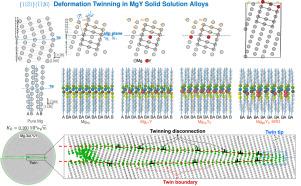
The deformation twin is common in nominally pure HCP Ti, Zr, Re, Co, but not in Mg. Rare-earth (RE) solutes such as Y and Gd at low atomic concentrations, however, can activate this twin mode and make it competitive to the regular extension twin in Mg. Previously models have not explicitly revealed the role of RE solutes on twinning and the RE-effects remain poorly understood. Using a reduced-constraint (RC) slip path, DFT calculations and two newly-developed interatomic potentials for MgY and MgAl, we reveal the physical origin of the RE solute effects in activating the twin in MgY alloys with random and short range order solute states. The RC-path shows that localized slip in the twinning direction simultaneously drives shear and -direction shuffle displacements on the corrugated twinning plane. The shuffle displacements are essential to reverse the asymmetry of atom-planes to satisfy the twin symmetry. However, such shuffle displacements are insufficient in pure Mg or MgAl, leaving twin nucleation to the multi-layer slip path with high energy barriers. Y-solutes are able to enhance the slip-driven shuffling to levels sufficient to reverse the atom-planes asymmetry, leading to spontaneous nucleation of multi-layer twin embryo with reduced energy barriers lower than that for the competing extension twin in Mg. The RC-slip path and twin nucleation is directly demonstrated in atomistic simulations of a blunted cracks under mode-II loading. This slip driven, solute-modulated twin nucleation mechanism is expected to be general across all HCP metals and alloys.
期刊介绍:
Acta Materialia serves as a platform for publishing full-length, original papers and commissioned overviews that contribute to a profound understanding of the correlation between the processing, structure, and properties of inorganic materials. The journal seeks papers with high impact potential or those that significantly propel the field forward. The scope includes the atomic and molecular arrangements, chemical and electronic structures, and microstructure of materials, focusing on their mechanical or functional behavior across all length scales, including nanostructures.




 京公网安备 11010802042870号
京ICP备2023020795号-1
京公网安备 11010802042870号
京ICP备2023020795号-1

 分享
分享
 求助内容:
求助内容: 应助结果提醒方式:
 扫码关注我们
