Dengke Wang, Ning Zhang, Yi Zhang, Le Chang, Haohao Tang, Wenming Zhang, Qiancheng Zhu
{"title":"Electric Field Sponge Effect of Conducting Polymer Interphases Boosts the Kinetics and Stability of Zinc Metal Anodes","authors":"Dengke Wang, Ning Zhang, Yi Zhang, Le Chang, Haohao Tang, Wenming Zhang, Qiancheng Zhu","doi":"10.1002/aenm.202404090","DOIUrl":null,"url":null,"abstract":"<p>Aqueous zinc (Zn) batteries (AZBs) are regarded as a prime choice for large-scale energy storage due to their high safety and low cost. Nevertheless, the issues of Zn dendrites and side reactions seriously limit the cycling stability of AZBs. Herein, it is found that the electric field sponge effect of poly (3,4-ethylenedioxythiophene) (PEDOT) as a model conducting polymer interphase can boost the kinetics and stability of Zn anodes. During Zn<sup>2+</sup> plating, the electron-rich conjugated π─π bonds can accelerate Zn<sup>2+</sup> migration and reduction. During Zn<sup>2+</sup> stripping, the electron-deficient conjugated π─π bonds can promote Zn<sup>2+</sup> transfer from the Zn substrate into electrolytes. The Coulombic attractive/repulsive force-regulated Zn<sup>2+</sup>-plating/stripping behavior is similar to the absorbing/squeezing processes of water from sponges, so the electric field sponge effect is proposed. This concept applies to other conducting polymer interphases, such as polyaniline and polypyrrole. Moreover, the presence of conducting polymer interphases effectively suppresses the water-induced side reactions on Zn. Consequently, the Zn@PEDOT electrode manifests a superior long lifespan of 5250 h (1 and 1 mAh cm<sup>−2</sup>) and an ultra-high current density tolerance of 80 mA cm<sup>−2</sup> and assures the coin-type and pouch-type Zn-based full batteries with excellent cycling stability.</p>","PeriodicalId":111,"journal":{"name":"Advanced Energy Materials","volume":"15 11","pages":""},"PeriodicalIF":25.5000,"publicationDate":"2024-12-15","publicationTypes":"Journal Article","fieldsOfStudy":null,"isOpenAccess":false,"openAccessPdf":"","citationCount":"0","resultStr":null,"platform":"Semanticscholar","paperid":null,"PeriodicalName":"Advanced Energy Materials","FirstCategoryId":"88","ListUrlMain":"https://advanced.onlinelibrary.wiley.com/doi/10.1002/aenm.202404090","RegionNum":1,"RegionCategory":"材料科学","ArticlePicture":[],"TitleCN":null,"AbstractTextCN":null,"PMCID":null,"EPubDate":"","PubModel":"","JCR":"Q1","JCRName":"CHEMISTRY, PHYSICAL","Score":null,"Total":0}
引用次数: 0
Abstract
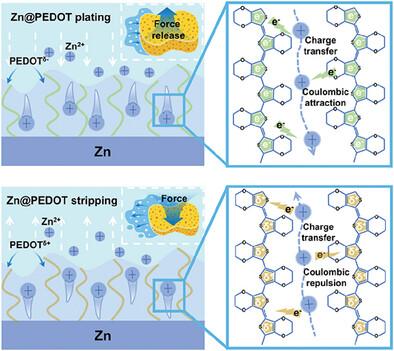
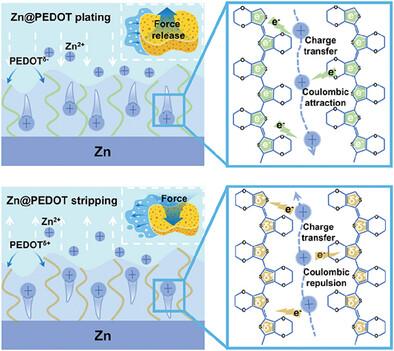
Aqueous zinc (Zn) batteries (AZBs) are regarded as a prime choice for large-scale energy storage due to their high safety and low cost. Nevertheless, the issues of Zn dendrites and side reactions seriously limit the cycling stability of AZBs. Herein, it is found that the electric field sponge effect of poly (3,4-ethylenedioxythiophene) (PEDOT) as a model conducting polymer interphase can boost the kinetics and stability of Zn anodes. During Zn2+ plating, the electron-rich conjugated π─π bonds can accelerate Zn2+ migration and reduction. During Zn2+ stripping, the electron-deficient conjugated π─π bonds can promote Zn2+ transfer from the Zn substrate into electrolytes. The Coulombic attractive/repulsive force-regulated Zn2+-plating/stripping behavior is similar to the absorbing/squeezing processes of water from sponges, so the electric field sponge effect is proposed. This concept applies to other conducting polymer interphases, such as polyaniline and polypyrrole. Moreover, the presence of conducting polymer interphases effectively suppresses the water-induced side reactions on Zn. Consequently, the Zn@PEDOT electrode manifests a superior long lifespan of 5250 h (1 and 1 mAh cm−2) and an ultra-high current density tolerance of 80 mA cm−2 and assures the coin-type and pouch-type Zn-based full batteries with excellent cycling stability.
水锌电池(azb)因其高安全性和低成本而被认为是大规模储能的首选。然而,锌枝晶和副反应问题严重限制了azb的循环稳定性。本研究发现,以聚(3,4-乙烯二氧噻吩)(PEDOT)为模型导电聚合物界面相的电场海绵效应可以提高Zn阳极的动力学和稳定性。在镀Zn2+过程中,富电子共轭π─π键可以加速Zn2+的迁移和还原。在剥离Zn2+过程中,缺电子共轭π─π键可以促进Zn2+从Zn衬底转移到电解质中。受库仑引力/排斥力调控的Zn2+电镀/剥离行为类似于海绵对水的吸收/挤压过程,因此提出了电场海绵效应。这一概念适用于其他导电聚合物界面,如聚苯胺和聚吡咯。此外,导电聚合物界面的存在有效地抑制了锌上水诱导的副反应。因此,Zn@PEDOT电极具有5250小时(1和1 mAh cm - 2)的超长寿命和80 mA cm - 2的超高电流密度容差,并确保硬币型和袋式锌基全电池具有出色的循环稳定性。
期刊介绍:
Established in 2011, Advanced Energy Materials is an international, interdisciplinary, English-language journal that focuses on materials used in energy harvesting, conversion, and storage. It is regarded as a top-quality journal alongside Advanced Materials, Advanced Functional Materials, and Small.
With a 2022 Impact Factor of 27.8, Advanced Energy Materials is considered a prime source for the best energy-related research. The journal covers a wide range of topics in energy-related research, including organic and inorganic photovoltaics, batteries and supercapacitors, fuel cells, hydrogen generation and storage, thermoelectrics, water splitting and photocatalysis, solar fuels and thermosolar power, magnetocalorics, and piezoelectronics.
The readership of Advanced Energy Materials includes materials scientists, chemists, physicists, and engineers in both academia and industry. The journal is indexed in various databases and collections, such as Advanced Technologies & Aerospace Database, FIZ Karlsruhe, INSPEC (IET), Science Citation Index Expanded, Technology Collection, and Web of Science, among others.







 京公网安备 11010802042870号
京ICP备2023020795号-1
京公网安备 11010802042870号
京ICP备2023020795号-1

 分享
分享
 求助内容:
求助内容: 应助结果提醒方式:
 扫码关注我们
