{"title":"Evaluation of Delirium Risk Factors in Intensive Care Patients.","authors":"Selin Erel, Eda Macit Aydın, Bijen Nazlıel, Lale Karabıyık","doi":"10.4274/TJAR.2024.241526","DOIUrl":null,"url":null,"abstract":"<p><strong>Objective: </strong>The negative effects of delirium in intensive care unit (ICU) patients necessitate the identification and management of risk factors. This study aimed to determine the incidence of delirium and its associated modifiable and non-modifiable factors in the ICU setting to provide valuable insights for better patient care and outcomes.</p><p><strong>Methods: </strong>Patients admitted to the ICU underwent delirium screening twice daily. Comprehensive records of modifiable and non-modifiable risk factors were maintained throughout the ICU stay.</p><p><strong>Results: </strong>The incidence of delirium was 32.5%. Age [odds ratio (OR) 1.04, confidence interval (CI) 1.02-1.06, <i>P</i> < 0.001)]. Illiteracy (OR 4, CI 1.19-13.35, <i>P</i>=0.02), hearing impairment (OR 3.37, CI 1.71-7.01, <i>P</i>=0.001), visual impairment (OR 3.90, CI 2.13-7.15, <i>P</i> < 0.001), hypertension (OR 2.56, CI 1.42-4.62, <i>P</i>=0.002), Sequential Organ Failure Assessment score (OR 1.21, CI 1.08-1.36, <i>P</i>=0.001), Acute Physiology and Chronic Health Evaluation II score (OR 1.20, CI 1.12-1.28, <i>P</i> < 0.001), presence of a nasogastric catheter/drain (OR 2.15, CI 1.18-3. 90, <i>P</i>=0.01), tracheal aspiration (OR 3.63, CI 1.91-6.90, <i>P</i> < 0.001), enteral nutrition (OR 2.54, CI 1.12-5.76, <i>P</i>=0.02), constipation (OR 1.65, Cl 1.11-2.45, <i>P</i>=0.02), oliguria (OR 1.56, Cl 1.06-2.28, <i>P</i>=0.02), midazolam infusion (OR 3. 4, Cl 1.16-10.05, <i>P</i>=0.02), propofol infusion (OR 2.91 Cl 1.03-8.19, <i>P</i>=0.04), albumin use (OR 2.39, Cl 1.11-5.14 <i>P</i>=0.02) and steroid use (OR 2.17, Cl 1.06-4.40, <i>P</i>=0.03) were found to be independent risk factors for delirium.</p><p><strong>Conclusion: </strong>This study highlights several risk factors contributing to delirium, such as age, sensory impairment, educational level, procedural interventions, and medications. Oral nutrition and mobilization are effective strategies for reducing delirium incidence in the ICU.</p>","PeriodicalId":23353,"journal":{"name":"Turkish journal of anaesthesiology and reanimation","volume":"52 6","pages":"213-222"},"PeriodicalIF":0.9000,"publicationDate":"2024-12-16","publicationTypes":"Journal Article","fieldsOfStudy":null,"isOpenAccess":false,"openAccessPdf":"https://www.ncbi.nlm.nih.gov/pmc/articles/PMC11650099/pdf/","citationCount":"0","resultStr":null,"platform":"Semanticscholar","paperid":null,"PeriodicalName":"Turkish journal of anaesthesiology and reanimation","FirstCategoryId":"1085","ListUrlMain":"https://doi.org/10.4274/TJAR.2024.241526","RegionNum":0,"RegionCategory":null,"ArticlePicture":[],"TitleCN":null,"AbstractTextCN":null,"PMCID":null,"EPubDate":"","PubModel":"","JCR":"Q3","JCRName":"ANESTHESIOLOGY","Score":null,"Total":0}
引用次数: 0
Abstract
Objective: The negative effects of delirium in intensive care unit (ICU) patients necessitate the identification and management of risk factors. This study aimed to determine the incidence of delirium and its associated modifiable and non-modifiable factors in the ICU setting to provide valuable insights for better patient care and outcomes.
Methods: Patients admitted to the ICU underwent delirium screening twice daily. Comprehensive records of modifiable and non-modifiable risk factors were maintained throughout the ICU stay.
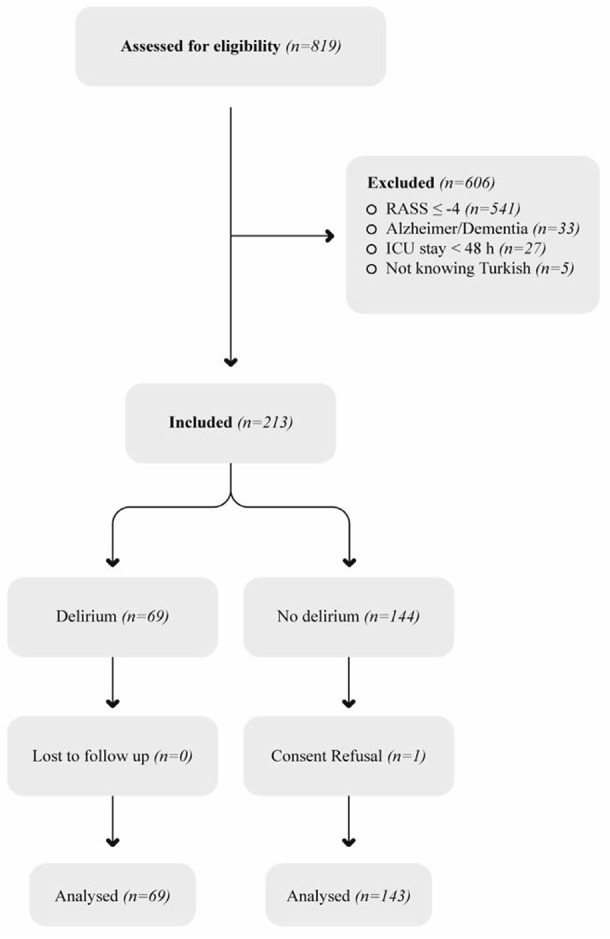
Results: The incidence of delirium was 32.5%. Age [odds ratio (OR) 1.04, confidence interval (CI) 1.02-1.06, P < 0.001)]. Illiteracy (OR 4, CI 1.19-13.35, P=0.02), hearing impairment (OR 3.37, CI 1.71-7.01, P=0.001), visual impairment (OR 3.90, CI 2.13-7.15, P < 0.001), hypertension (OR 2.56, CI 1.42-4.62, P=0.002), Sequential Organ Failure Assessment score (OR 1.21, CI 1.08-1.36, P=0.001), Acute Physiology and Chronic Health Evaluation II score (OR 1.20, CI 1.12-1.28, P < 0.001), presence of a nasogastric catheter/drain (OR 2.15, CI 1.18-3. 90, P=0.01), tracheal aspiration (OR 3.63, CI 1.91-6.90, P < 0.001), enteral nutrition (OR 2.54, CI 1.12-5.76, P=0.02), constipation (OR 1.65, Cl 1.11-2.45, P=0.02), oliguria (OR 1.56, Cl 1.06-2.28, P=0.02), midazolam infusion (OR 3. 4, Cl 1.16-10.05, P=0.02), propofol infusion (OR 2.91 Cl 1.03-8.19, P=0.04), albumin use (OR 2.39, Cl 1.11-5.14 P=0.02) and steroid use (OR 2.17, Cl 1.06-4.40, P=0.03) were found to be independent risk factors for delirium.
Conclusion: This study highlights several risk factors contributing to delirium, such as age, sensory impairment, educational level, procedural interventions, and medications. Oral nutrition and mobilization are effective strategies for reducing delirium incidence in the ICU.




 京公网安备 11010802042870号
京ICP备2023020795号-1
京公网安备 11010802042870号
京ICP备2023020795号-1

 分享
分享
 求助内容:
求助内容: 应助结果提醒方式:
 扫码关注我们
