{"title":"Bisquinoline-based fluorescent cadmium sensors","authors":"Yuji Mikata","doi":"10.1039/D4DT02788D","DOIUrl":null,"url":null,"abstract":"<p >Rational molecular design afforded fluorescent Cd<small><sup>2+</sup></small> sensors based on bisquinoline derivatives. Introduction of three methoxy groups at the 5,6,7-positions of the quinoline rings of BQDMEN (<em>N</em>,<em>N</em>′-bis(2-quinolylmethyl)-<em>N</em>,<em>N</em>′-dimethylethylenediamine) resulted in the reversal of metal ion selectivity in fluorescence enhancement from zinc to cadmium. Introduction of bulky alkyl groups and an <em>N</em>,<em>N</em>-bis(2-quinolylmethyl)amine structure, as well as replacement of one of the two tertiary amine binding sites with an oxygen atom and the use of a 1,2-phenylene backbone significantly improved the Cd<small><sup>2+</sup></small> specificity. The fluorescent cadmium ion selectivity could be explained by the differential binding with Cd<small><sup>2+</sup></small> and Zn<small><sup>2+</sup></small>, and the formation of a bis(μ-chloro) dinuclear cadmium complex in contrast to the mononuclear zinc complex.</p>","PeriodicalId":71,"journal":{"name":"Dalton Transactions","volume":" 12","pages":" 4848-4855"},"PeriodicalIF":3.3000,"publicationDate":"2024-12-17","publicationTypes":"Journal Article","fieldsOfStudy":null,"isOpenAccess":false,"openAccessPdf":"","citationCount":"0","resultStr":null,"platform":"Semanticscholar","paperid":null,"PeriodicalName":"Dalton Transactions","FirstCategoryId":"92","ListUrlMain":"https://pubs.rsc.org/en/content/articlelanding/2025/dt/d4dt02788d","RegionNum":3,"RegionCategory":"化学","ArticlePicture":[],"TitleCN":null,"AbstractTextCN":null,"PMCID":null,"EPubDate":"","PubModel":"","JCR":"Q2","JCRName":"CHEMISTRY, INORGANIC & NUCLEAR","Score":null,"Total":0}
引用次数: 0
Abstract
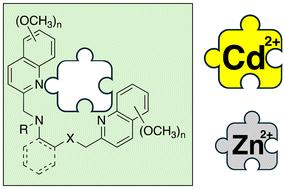
Rational molecular design afforded fluorescent Cd2+ sensors based on bisquinoline derivatives. Introduction of three methoxy groups at the 5,6,7-positions of the quinoline rings of BQDMEN (N,N′-bis(2-quinolylmethyl)-N,N′-dimethylethylenediamine) resulted in the reversal of metal ion selectivity in fluorescence enhancement from zinc to cadmium. Introduction of bulky alkyl groups and an N,N-bis(2-quinolylmethyl)amine structure, as well as replacement of one of the two tertiary amine binding sites with an oxygen atom and the use of a 1,2-phenylene backbone significantly improved the Cd2+ specificity. The fluorescent cadmium ion selectivity could be explained by the differential binding with Cd2+ and Zn2+, and the formation of a bis(μ-chloro) dinuclear cadmium complex in contrast to the mononuclear zinc complex.
期刊介绍:
Dalton Transactions is a journal for all areas of inorganic chemistry, which encompasses the organometallic, bioinorganic and materials chemistry of the elements, with applications including synthesis, catalysis, energy conversion/storage, electrical devices and medicine. Dalton Transactions welcomes high-quality, original submissions in all of these areas and more, where the advancement of knowledge in inorganic chemistry is significant.



 京公网安备 11010802042870号
京ICP备2023020795号-1
京公网安备 11010802042870号
京ICP备2023020795号-1

 分享
分享
 求助内容:
求助内容: 应助结果提醒方式:
 扫码关注我们
