Influence of carbon incorporation on the microstructure, morphology, hardness, Young modulus and corrosion resistance of TiAlCN coatings deposited via reactive-HiPIMS
Mohamed Lahouij , Nassima Jaghar , Matej Drobnič , Youssef Samih , Aljaž Drnovšek , Janez Kovač , Miha Čekada , Mohammed Makha , Jones Alami
{"title":"Influence of carbon incorporation on the microstructure, morphology, hardness, Young modulus and corrosion resistance of TiAlCN coatings deposited via reactive-HiPIMS","authors":"Mohamed Lahouij , Nassima Jaghar , Matej Drobnič , Youssef Samih , Aljaž Drnovšek , Janez Kovač , Miha Čekada , Mohammed Makha , Jones Alami","doi":"10.1016/j.apsusc.2024.162115","DOIUrl":null,"url":null,"abstract":"<div><div>TiAlCN coatings, designed as advanced alternatives to TiAlN for enhanced tribological performance, were deposited via reactive high-power impulse magnetron sputtering (HiPIMS) with acetylene flow rates varying between 0 and 10 sccm. The carbon content, ranging from 1 at.% to 58 at.%, significantly influenced the microstructure, hardness and Young modulus properties of the coatings. At lower carbon concentrations (up to 17 at.%), carbon atoms substituted nitrogen in the TiAlN lattice. However, higher levels of carbon led to the formation of TiAl(CN) nanocrystals and amorphous carbon phases. These structural changes resulted in a shift in the coating’s growth orientation from (1<!--> <!-->1<!--> <!-->1) to (200) and the presence of amorphous carbon at grain boundaries, which resulted in a steady decline in hardness and Young’s modulus. Additionally, the increased carbon content reduced the coatings’ corrosion resistance. These findings highlight the complex interplay between carbon content, microstructure, and performance, providing insights for optimizing TiAlCN coatings.</div></div>","PeriodicalId":247,"journal":{"name":"Applied Surface Science","volume":"686 ","pages":"Article 162115"},"PeriodicalIF":6.9000,"publicationDate":"2025-03-30","publicationTypes":"Journal Article","fieldsOfStudy":null,"isOpenAccess":false,"openAccessPdf":"","citationCount":"0","resultStr":null,"platform":"Semanticscholar","paperid":null,"PeriodicalName":"Applied Surface Science","FirstCategoryId":"88","ListUrlMain":"https://www.sciencedirect.com/science/article/pii/S0169433224028319","RegionNum":2,"RegionCategory":"材料科学","ArticlePicture":[],"TitleCN":null,"AbstractTextCN":null,"PMCID":null,"EPubDate":"2024/12/16 0:00:00","PubModel":"Epub","JCR":"Q2","JCRName":"CHEMISTRY, PHYSICAL","Score":null,"Total":0}
引用次数: 0
Abstract
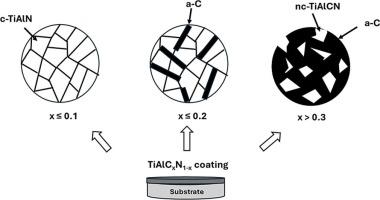
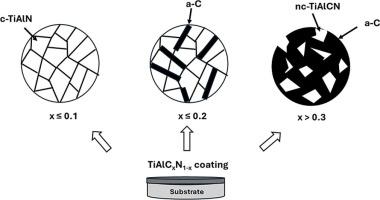
TiAlCN coatings, designed as advanced alternatives to TiAlN for enhanced tribological performance, were deposited via reactive high-power impulse magnetron sputtering (HiPIMS) with acetylene flow rates varying between 0 and 10 sccm. The carbon content, ranging from 1 at.% to 58 at.%, significantly influenced the microstructure, hardness and Young modulus properties of the coatings. At lower carbon concentrations (up to 17 at.%), carbon atoms substituted nitrogen in the TiAlN lattice. However, higher levels of carbon led to the formation of TiAl(CN) nanocrystals and amorphous carbon phases. These structural changes resulted in a shift in the coating’s growth orientation from (1 1 1) to (200) and the presence of amorphous carbon at grain boundaries, which resulted in a steady decline in hardness and Young’s modulus. Additionally, the increased carbon content reduced the coatings’ corrosion resistance. These findings highlight the complex interplay between carbon content, microstructure, and performance, providing insights for optimizing TiAlCN coatings.
TiAlCN涂层被设计为TiAlN的高级替代品,以增强摩擦学性能,通过反应性大功率脉冲磁控溅射(HiPIMS)沉积,乙炔流量在0到10 sccm之间变化。碳的含量,从1到。%至58%。%,显著影响涂层的显微组织、硬度和杨氏模量性能。在较低的碳浓度下(高达17 At .%),碳原子取代了TiAlN晶格中的氮。然而,较高的碳含量导致TiAl(CN)纳米晶和非晶碳相的形成。这些结构变化导致涂层的生长方向从(11 11)转变为(200),晶界处存在非晶态碳,导致硬度和杨氏模量稳步下降。此外,碳含量的增加降低了涂层的耐腐蚀性。这些发现强调了碳含量、微观结构和性能之间复杂的相互作用,为优化TiAlCN涂层提供了见解。
期刊介绍:
Applied Surface Science covers topics contributing to a better understanding of surfaces, interfaces, nanostructures and their applications. The journal is concerned with scientific research on the atomic and molecular level of material properties determined with specific surface analytical techniques and/or computational methods, as well as the processing of such structures.



 京公网安备 11010802042870号
京ICP备2023020795号-1
京公网安备 11010802042870号
京ICP备2023020795号-1

 分享
分享
 求助内容:
求助内容: 应助结果提醒方式:
 扫码关注我们
