A dual-initiating organic frustrated Lewis pair catalyst for living polymerizations of (bio)acrylates to facilitate the synthesis of metal-free multiblock copolymers†
Zhen-Hua Zhang , Yuyang Chen , Yuesheng Li , Miao Hong
{"title":"A dual-initiating organic frustrated Lewis pair catalyst for living polymerizations of (bio)acrylates to facilitate the synthesis of metal-free multiblock copolymers†","authors":"Zhen-Hua Zhang , Yuyang Chen , Yuesheng Li , Miao Hong","doi":"10.1039/d4py01067a","DOIUrl":null,"url":null,"abstract":"<div><div>The development of powerful catalysis or methodologies for the synthesis of fundamentally and technologically important multiblock copolymers is a perpetual task. Dual-initiating Lewis pair (LP) catalysts for living/controlled polymerizations of methacrylates have been demonstrated to be an effective approach towards all-acrylic multiblock copolymers. However, the utilization of metal-based Lewis acids (LAs) and complicated Lewis bases (LBs) that typically require laborious syntheses are essential. This article reports the first organic dual-initiating frustrated Lewis pair (FLP) catalysts consisting of tris(2,4-difluorophenyl)borane [B(2,4-F<sub>2</sub>C<sub>6</sub>H<sub>3</sub>)<sub>3</sub>] LA and commercially available 1,2-bis[(di-<em>tert</em>-butylphosphino)methyl]benzene (DP<sup><em>t</em></sup>Bu<sub>2</sub>) LB, which can mediate efficient and living polymerizations of various (bio)acrylates. Accordingly, all-acrylic multiblock copolymers (up to hepta blocks) with well-defined structures can be readily prepared <em>via</em> sequential monomer addition, thus successfully establishing DP<sup><em>t</em></sup>Bu<sub>2</sub>/B(2,4-F<sub>2</sub>C<sub>6</sub>H<sub>3</sub>)<sub>3</sub> FLP as a green/sustainable and user-friendly polymerization catalyst for the convenient synthesis of metal-free all-acrylic multiblock copolymers.</div></div>","PeriodicalId":100,"journal":{"name":"Polymer Chemistry","volume":"16 8","pages":"Pages 936-946"},"PeriodicalIF":3.9000,"publicationDate":"2025-01-23","publicationTypes":"Journal Article","fieldsOfStudy":null,"isOpenAccess":false,"openAccessPdf":"","citationCount":"0","resultStr":null,"platform":"Semanticscholar","paperid":null,"PeriodicalName":"Polymer Chemistry","FirstCategoryId":"92","ListUrlMain":"https://www.sciencedirect.com/org/science/article/pii/S1759995424004960","RegionNum":2,"RegionCategory":"化学","ArticlePicture":[],"TitleCN":null,"AbstractTextCN":null,"PMCID":null,"EPubDate":"","PubModel":"","JCR":"Q2","JCRName":"POLYMER SCIENCE","Score":null,"Total":0}
引用次数: 0
Abstract
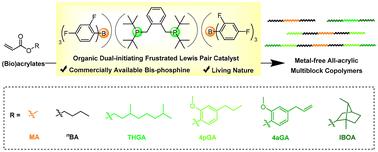
The development of powerful catalysis or methodologies for the synthesis of fundamentally and technologically important multiblock copolymers is a perpetual task. Dual-initiating Lewis pair (LP) catalysts for living/controlled polymerizations of methacrylates have been demonstrated to be an effective approach towards all-acrylic multiblock copolymers. However, the utilization of metal-based Lewis acids (LAs) and complicated Lewis bases (LBs) that typically require laborious syntheses are essential. This article reports the first organic dual-initiating frustrated Lewis pair (FLP) catalysts consisting of tris(2,4-difluorophenyl)borane [B(2,4-F2C6H3)3] LA and commercially available 1,2-bis[(di-tert-butylphosphino)methyl]benzene (DPtBu2) LB, which can mediate efficient and living polymerizations of various (bio)acrylates. Accordingly, all-acrylic multiblock copolymers (up to hepta blocks) with well-defined structures can be readily prepared via sequential monomer addition, thus successfully establishing DPtBu2/B(2,4-F2C6H3)3 FLP as a green/sustainable and user-friendly polymerization catalyst for the convenient synthesis of metal-free all-acrylic multiblock copolymers.
期刊介绍:
Polymer Chemistry welcomes submissions in all areas of polymer science that have a strong focus on macromolecular chemistry. Manuscripts may cover a broad range of fields, yet no direct application focus is required.



 京公网安备 11010802042870号
京ICP备2023020795号-1
京公网安备 11010802042870号
京ICP备2023020795号-1

 分享
分享
 求助内容:
求助内容: 应助结果提醒方式:
 扫码关注我们
