Yuxiang Zhou, Yue Yu, Hui Wang, Bi Shi, Ya-nan Wang
{"title":"Green Salt-Free High-Exhaustion Chrome Tanning Strategy: Biomass-Derived Aldehyde Acid–Chrome Tanning","authors":"Yuxiang Zhou, Yue Yu, Hui Wang, Bi Shi, Ya-nan Wang","doi":"10.1021/acs.iecr.4c03536","DOIUrl":null,"url":null,"abstract":"Conventional chrome (Cr) tanning systems generate substantial wastewater containing Cl<sup>–</sup> and Cr<sup>3+</sup>, which presents huge environmental challenges. This study proposes a sustainable alternative, biomass-derived aldehyde acid–chrome (AA–Cr) tanning, to mitigate Cl<sup>–</sup> and Cr<sup>3+</sup> pollution. Pretanning with 3 wt % AA effectively prevented acid-induced swelling of pelts in the absence of salts at a pickling pH of 1 to 4. The dialdehyde and carboxyl groups in AA facilitated the formation of a robust AA–Cr cross-linking network. Subsequent tanning with 3 wt % chrome tanning agent led to an exceptional Cr uptake rate that exceeded 98.5%, with the AA–Cr system exhibiting superior tanning performance compared to glyoxylic acid–Cr (GA–Cr). Compared to the Cr system, the AA–Cr system achieved 89.4% and 96.3% reductions in Cl<sup>–</sup> and Cr<sup>3+</sup> loads, respectively, while exhibiting enhanced biodegradability. Life cycle assessment revealed that the AA–Cr system demonstrates remarkably lower carbon emissions, reduced resource consumption, and diminished human toxicity. This study presents a feasible strategy for salt-free, high-exhaustion chrome tanning and provides novel insights into the molecular design of biomass-derived AA.","PeriodicalId":39,"journal":{"name":"Industrial & Engineering Chemistry Research","volume":"30 1","pages":""},"PeriodicalIF":3.9000,"publicationDate":"2024-12-16","publicationTypes":"Journal Article","fieldsOfStudy":null,"isOpenAccess":false,"openAccessPdf":"","citationCount":"0","resultStr":null,"platform":"Semanticscholar","paperid":null,"PeriodicalName":"Industrial & Engineering Chemistry Research","FirstCategoryId":"5","ListUrlMain":"https://doi.org/10.1021/acs.iecr.4c03536","RegionNum":3,"RegionCategory":"工程技术","ArticlePicture":[],"TitleCN":null,"AbstractTextCN":null,"PMCID":null,"EPubDate":"","PubModel":"","JCR":"Q2","JCRName":"ENGINEERING, CHEMICAL","Score":null,"Total":0}
引用次数: 0
Abstract
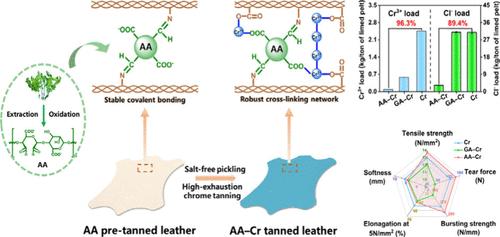
Conventional chrome (Cr) tanning systems generate substantial wastewater containing Cl– and Cr3+, which presents huge environmental challenges. This study proposes a sustainable alternative, biomass-derived aldehyde acid–chrome (AA–Cr) tanning, to mitigate Cl– and Cr3+ pollution. Pretanning with 3 wt % AA effectively prevented acid-induced swelling of pelts in the absence of salts at a pickling pH of 1 to 4. The dialdehyde and carboxyl groups in AA facilitated the formation of a robust AA–Cr cross-linking network. Subsequent tanning with 3 wt % chrome tanning agent led to an exceptional Cr uptake rate that exceeded 98.5%, with the AA–Cr system exhibiting superior tanning performance compared to glyoxylic acid–Cr (GA–Cr). Compared to the Cr system, the AA–Cr system achieved 89.4% and 96.3% reductions in Cl– and Cr3+ loads, respectively, while exhibiting enhanced biodegradability. Life cycle assessment revealed that the AA–Cr system demonstrates remarkably lower carbon emissions, reduced resource consumption, and diminished human toxicity. This study presents a feasible strategy for salt-free, high-exhaustion chrome tanning and provides novel insights into the molecular design of biomass-derived AA.
期刊介绍:
ndustrial & Engineering Chemistry, with variations in title and format, has been published since 1909 by the American Chemical Society. Industrial & Engineering Chemistry Research is a weekly publication that reports industrial and academic research in the broad fields of applied chemistry and chemical engineering with special focus on fundamentals, processes, and products.



 京公网安备 11010802042870号
京ICP备2023020795号-1
京公网安备 11010802042870号
京ICP备2023020795号-1

 分享
分享
 求助内容:
求助内容: 应助结果提醒方式:
 扫码关注我们
