{"title":"Ultra-fast prediction of D-π-A organic dye absorption maximum with advanced ensemble deep learning models","authors":"Mohamed M. Elsenety","doi":"10.1016/j.saa.2024.125536","DOIUrl":null,"url":null,"abstract":"<div><div>The quick and precise estimation of D-π-A Organic Dye absorption maxima in different solvents is an important challenge for the efficient design of novel chemical structures that could improve the performance of dye-sensitized solar cells (DSSCs) and related technologies. Time-Dependent Density Functional Theory (TD-DFT) has often been employed for these predictions, but it has limitations, including high computing costs and functional dependence, particularly for solvent interactions. In this study, we introduce a high-accuracy and rapid deep-learning ensemble method using daylight fingerprints as chemical descriptors to predict the absorption maxima (λ<sub>max</sub>) of D-π-A organic dyes in 18 different solvent environments. This study introduces a novel approach leveraging advanced ensemble deep learning of 10 models of multiple neural architectures including convolutional networks to demonstrate exceptional predictive power in capturing complex relationships between molecular structures with solvent interaction and absorption maximum. Leveraging a comprehensive range of molecular descriptors from organic dye fingerprints, we developed a highly accurate ensemble model with an R<sup>2</sup> of 0.94 and a mean absolute error (MAE) of 8.6 nm, which enhances predictive accuracy and significantly reduces computational time. Additionally, we developed a user-friendly web-based platform that allows for quick prediction of absorption maxima including solvent effect. This tool, which directly uses SMILES representations and advanced deep learning techniques, offers significant potential for accelerating the discovery of efficient dye candidates for various applications, including solar energy, environmental solutions, and medical research. This research opens the door to more effective next-generation dye design, which will facilitate rapid testing in a variety of fields and design an efficient new material.</div></div>","PeriodicalId":433,"journal":{"name":"Spectrochimica Acta Part A: Molecular and Biomolecular Spectroscopy","volume":"329 ","pages":"Article 125536"},"PeriodicalIF":4.6000,"publicationDate":"2025-03-15","publicationTypes":"Journal Article","fieldsOfStudy":null,"isOpenAccess":false,"openAccessPdf":"","citationCount":"0","resultStr":null,"platform":"Semanticscholar","paperid":null,"PeriodicalName":"Spectrochimica Acta Part A: Molecular and Biomolecular Spectroscopy","FirstCategoryId":"92","ListUrlMain":"https://www.sciencedirect.com/science/article/pii/S1386142524017025","RegionNum":2,"RegionCategory":"化学","ArticlePicture":[],"TitleCN":null,"AbstractTextCN":null,"PMCID":null,"EPubDate":"2024/12/9 0:00:00","PubModel":"Epub","JCR":"Q1","JCRName":"SPECTROSCOPY","Score":null,"Total":0}
引用次数: 0
Abstract
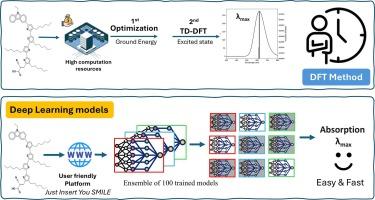
The quick and precise estimation of D-π-A Organic Dye absorption maxima in different solvents is an important challenge for the efficient design of novel chemical structures that could improve the performance of dye-sensitized solar cells (DSSCs) and related technologies. Time-Dependent Density Functional Theory (TD-DFT) has often been employed for these predictions, but it has limitations, including high computing costs and functional dependence, particularly for solvent interactions. In this study, we introduce a high-accuracy and rapid deep-learning ensemble method using daylight fingerprints as chemical descriptors to predict the absorption maxima (λmax) of D-π-A organic dyes in 18 different solvent environments. This study introduces a novel approach leveraging advanced ensemble deep learning of 10 models of multiple neural architectures including convolutional networks to demonstrate exceptional predictive power in capturing complex relationships between molecular structures with solvent interaction and absorption maximum. Leveraging a comprehensive range of molecular descriptors from organic dye fingerprints, we developed a highly accurate ensemble model with an R2 of 0.94 and a mean absolute error (MAE) of 8.6 nm, which enhances predictive accuracy and significantly reduces computational time. Additionally, we developed a user-friendly web-based platform that allows for quick prediction of absorption maxima including solvent effect. This tool, which directly uses SMILES representations and advanced deep learning techniques, offers significant potential for accelerating the discovery of efficient dye candidates for various applications, including solar energy, environmental solutions, and medical research. This research opens the door to more effective next-generation dye design, which will facilitate rapid testing in a variety of fields and design an efficient new material.
期刊介绍:
Spectrochimica Acta, Part A: Molecular and Biomolecular Spectroscopy (SAA) is an interdisciplinary journal which spans from basic to applied aspects of optical spectroscopy in chemistry, medicine, biology, and materials science.
The journal publishes original scientific papers that feature high-quality spectroscopic data and analysis. From the broad range of optical spectroscopies, the emphasis is on electronic, vibrational or rotational spectra of molecules, rather than on spectroscopy based on magnetic moments.
Criteria for publication in SAA are novelty, uniqueness, and outstanding quality. Routine applications of spectroscopic techniques and computational methods are not appropriate.
Topics of particular interest of Spectrochimica Acta Part A include, but are not limited to:
Spectroscopy and dynamics of bioanalytical, biomedical, environmental, and atmospheric sciences,
Novel experimental techniques or instrumentation for molecular spectroscopy,
Novel theoretical and computational methods,
Novel applications in photochemistry and photobiology,
Novel interpretational approaches as well as advances in data analysis based on electronic or vibrational spectroscopy.



 京公网安备 11010802042870号
京ICP备2023020795号-1
京公网安备 11010802042870号
京ICP备2023020795号-1

 分享
分享
 求助内容:
求助内容: 应助结果提醒方式:
 扫码关注我们
