Fan Wu , Dandan Wu , Qi Zuo , Jing Cao , Ning Kong , Kang Feng , Jianan Li , Shaojun Bai
{"title":"Study on the mechanism of ammonium carbamate in promoting the separation of chalcopyrite and arsenopyrite in oxidation systems","authors":"Fan Wu , Dandan Wu , Qi Zuo , Jing Cao , Ning Kong , Kang Feng , Jianan Li , Shaojun Bai","doi":"10.1016/j.apsusc.2024.162127","DOIUrl":null,"url":null,"abstract":"<div><div>Arsenopyrite frequently occurs alongside chalcopyrite and is characterized by its high arsenic content. The similar surface properties of arsenopyrite and chalcopyrite pose significant challenges to their separation via flotation. This study investigated the inhibitory effect of sodium hypochlorite (NaClO) on arsenopyrite and the activation mechanism of ammonium carbamate on chalcopyrite through a series of single-mineral and artificial mixed-mineral flotation experiments. Techniques employed include atomic force microscopy (AFM), scanning electron microscopy (SEM) with energy-dispersive X-ray spectroscopy (EDS), X-ray photoelectron spectroscopy (XPS), Zeta potential analysis, and adsorption experiments. The results from flotation indicated that NaClO oxidation significantly suppressed the arsenopyrite recovery to as low as 7.80%, while chalcopyrite recovery was reduced to 54.02%. Upon the addition of ammonium carbamate, the flotation recovery of chalcopyrite increased to 81.71%, while the recovery of arsenopyrite remained largely unaffected. Further analysis with AFM, SEM, EDS, Zeta potential, adsorption tests, and XPS revealed that NaClO facilitated the formation of a hydrophilic film on the surface of arsenopyrite, reducing the adsorption of the trap on the minerals, and suppressing the hydrophobicity of arsenopyrite. Conversely, ammonium carbamate did not activate arsenopyrite but enhanced the adsorption of butyl xanthate on chalcopyrite. The results indicated that the combination of NaClO and ammonium carbamate presents an effective method for the selective separation of arsenopyrite and chalcopyrite.</div></div>","PeriodicalId":247,"journal":{"name":"Applied Surface Science","volume":"686 ","pages":"Article 162127"},"PeriodicalIF":6.9000,"publicationDate":"2025-03-30","publicationTypes":"Journal Article","fieldsOfStudy":null,"isOpenAccess":false,"openAccessPdf":"","citationCount":"0","resultStr":null,"platform":"Semanticscholar","paperid":null,"PeriodicalName":"Applied Surface Science","FirstCategoryId":"88","ListUrlMain":"https://www.sciencedirect.com/science/article/pii/S0169433224028435","RegionNum":2,"RegionCategory":"材料科学","ArticlePicture":[],"TitleCN":null,"AbstractTextCN":null,"PMCID":null,"EPubDate":"2024/12/17 0:00:00","PubModel":"Epub","JCR":"Q2","JCRName":"CHEMISTRY, PHYSICAL","Score":null,"Total":0}
引用次数: 0
Abstract
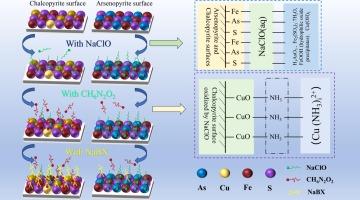
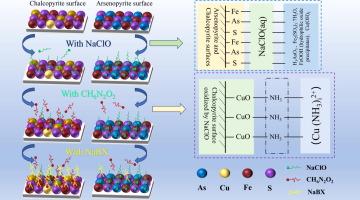
Arsenopyrite frequently occurs alongside chalcopyrite and is characterized by its high arsenic content. The similar surface properties of arsenopyrite and chalcopyrite pose significant challenges to their separation via flotation. This study investigated the inhibitory effect of sodium hypochlorite (NaClO) on arsenopyrite and the activation mechanism of ammonium carbamate on chalcopyrite through a series of single-mineral and artificial mixed-mineral flotation experiments. Techniques employed include atomic force microscopy (AFM), scanning electron microscopy (SEM) with energy-dispersive X-ray spectroscopy (EDS), X-ray photoelectron spectroscopy (XPS), Zeta potential analysis, and adsorption experiments. The results from flotation indicated that NaClO oxidation significantly suppressed the arsenopyrite recovery to as low as 7.80%, while chalcopyrite recovery was reduced to 54.02%. Upon the addition of ammonium carbamate, the flotation recovery of chalcopyrite increased to 81.71%, while the recovery of arsenopyrite remained largely unaffected. Further analysis with AFM, SEM, EDS, Zeta potential, adsorption tests, and XPS revealed that NaClO facilitated the formation of a hydrophilic film on the surface of arsenopyrite, reducing the adsorption of the trap on the minerals, and suppressing the hydrophobicity of arsenopyrite. Conversely, ammonium carbamate did not activate arsenopyrite but enhanced the adsorption of butyl xanthate on chalcopyrite. The results indicated that the combination of NaClO and ammonium carbamate presents an effective method for the selective separation of arsenopyrite and chalcopyrite.
期刊介绍:
Applied Surface Science covers topics contributing to a better understanding of surfaces, interfaces, nanostructures and their applications. The journal is concerned with scientific research on the atomic and molecular level of material properties determined with specific surface analytical techniques and/or computational methods, as well as the processing of such structures.




 京公网安备 11010802042870号
京ICP备2023020795号-1
京公网安备 11010802042870号
京ICP备2023020795号-1

 分享
分享
 求助内容:
求助内容: 应助结果提醒方式:
 扫码关注我们
