{"title":"Integrating Biological Early Warning Systems with High-Resolution Online Chemical Monitoring in Wastewater Treatment Plants","authors":"Ali Kizgin, Danina Schmidt, Julian Bosshard, Heinz Singer, Juliane Hollender, Eberhard Morgenroth, Cornelia Kienle, Miriam Langer","doi":"10.1021/acs.est.4c07316","DOIUrl":null,"url":null,"abstract":"Detection of micropollutants (MPs) in wastewater effluents using traditional toxicity tests or chemical analysis with discrete samples is challenging due to concentration dynamics. This study evaluates a continuous monitoring approach for detecting MPs in wastewater effluents using a combination of biological early warning systems (BEWS). Three BEWS with <i>Chlorella vulgaris</i>, <i>Daphnia magna</i>, and <i>Gammarus pulex</i> were operated in parallel in a full-scale municipal wastewater treatment plant. Concentrations of MPs were monitored by simultaneous online chemical analysis using high performance liquid chromatography-high resolution mass spectrometry (MS2Field). Over 5 weeks, behavioral changes observed in the BEWS occasionally exceeded acute toxicity thresholds, triggering alarms. These changes were related to MPs identified by the MS2Field, to abiotic factors, or to operational parameters of the BEWS. For one toxic event, behavioral responses were linked to a pesticide, not authorized in Switzerland, at concentrations close to literature EC<sub>50</sub> values. Verification tests confirmed that the pesticide in the effluent was the most likely cause for the organism response. The study demonstrates the potential of BEWS as a stand-alone technique for detecting contamination peaks in wastewater, and identifies key limitations and critical factors that need to be addressed to optimize the use of BEWS in wastewater monitoring.","PeriodicalId":36,"journal":{"name":"环境科学与技术","volume":"12 1","pages":""},"PeriodicalIF":11.3000,"publicationDate":"2024-12-18","publicationTypes":"Journal Article","fieldsOfStudy":null,"isOpenAccess":false,"openAccessPdf":"","citationCount":"0","resultStr":null,"platform":"Semanticscholar","paperid":null,"PeriodicalName":"环境科学与技术","FirstCategoryId":"1","ListUrlMain":"https://doi.org/10.1021/acs.est.4c07316","RegionNum":1,"RegionCategory":"环境科学与生态学","ArticlePicture":[],"TitleCN":null,"AbstractTextCN":null,"PMCID":null,"EPubDate":"","PubModel":"","JCR":"Q1","JCRName":"ENGINEERING, ENVIRONMENTAL","Score":null,"Total":0}
引用次数: 0
Abstract
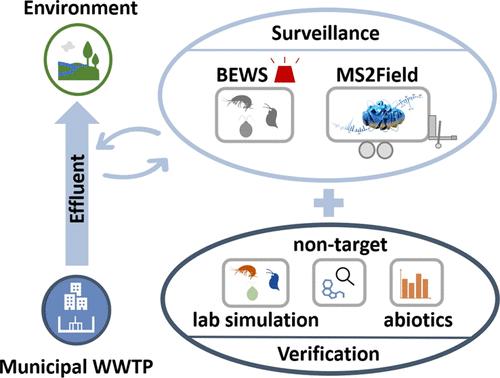
Detection of micropollutants (MPs) in wastewater effluents using traditional toxicity tests or chemical analysis with discrete samples is challenging due to concentration dynamics. This study evaluates a continuous monitoring approach for detecting MPs in wastewater effluents using a combination of biological early warning systems (BEWS). Three BEWS with Chlorella vulgaris, Daphnia magna, and Gammarus pulex were operated in parallel in a full-scale municipal wastewater treatment plant. Concentrations of MPs were monitored by simultaneous online chemical analysis using high performance liquid chromatography-high resolution mass spectrometry (MS2Field). Over 5 weeks, behavioral changes observed in the BEWS occasionally exceeded acute toxicity thresholds, triggering alarms. These changes were related to MPs identified by the MS2Field, to abiotic factors, or to operational parameters of the BEWS. For one toxic event, behavioral responses were linked to a pesticide, not authorized in Switzerland, at concentrations close to literature EC50 values. Verification tests confirmed that the pesticide in the effluent was the most likely cause for the organism response. The study demonstrates the potential of BEWS as a stand-alone technique for detecting contamination peaks in wastewater, and identifies key limitations and critical factors that need to be addressed to optimize the use of BEWS in wastewater monitoring.
期刊介绍:
Environmental Science & Technology (ES&T) is a co-sponsored academic and technical magazine by the Hubei Provincial Environmental Protection Bureau and the Hubei Provincial Academy of Environmental Sciences.
Environmental Science & Technology (ES&T) holds the status of Chinese core journals, scientific papers source journals of China, Chinese Science Citation Database source journals, and Chinese Academic Journal Comprehensive Evaluation Database source journals. This publication focuses on the academic field of environmental protection, featuring articles related to environmental protection and technical advancements.




 京公网安备 11010802042870号
京ICP备2023020795号-1
京公网安备 11010802042870号
京ICP备2023020795号-1

 分享
分享
 求助内容:
求助内容: 应助结果提醒方式:
 扫码关注我们
