Andrew Groover, N. Michele Holbrook, Andrea Polle, Anna Sala, Belinda Medlyn, Craig Brodersen, Jarmila Pittermann, Jessica Gersony, Katarzyna Sokołowska, Laura Bogar, Nate McDowell, Rachel Spicer, Rakefet David-Schwartz, Stephen Keller, Timothy J. Tschaplinski, Yakir Preisler
{"title":"Tree drought physiology: critical research questions and strategies for mitigating climate change effects on forests","authors":"Andrew Groover, N. Michele Holbrook, Andrea Polle, Anna Sala, Belinda Medlyn, Craig Brodersen, Jarmila Pittermann, Jessica Gersony, Katarzyna Sokołowska, Laura Bogar, Nate McDowell, Rachel Spicer, Rakefet David-Schwartz, Stephen Keller, Timothy J. Tschaplinski, Yakir Preisler","doi":"10.1111/nph.20326","DOIUrl":null,"url":null,"abstract":"<p>Droughts of increasing severity and frequency are a primary cause of forest mortality associated with climate change. Yet, fundamental knowledge gaps regarding the complex physiology of trees limit the development of more effective management strategies to mitigate drought effects on forests. Here, we highlight some of the basic research needed to better understand tree drought physiology and how new technologies and interdisciplinary approaches can be used to address them. Our discussion focuses on how trees change wood development to mitigate water stress, hormonal responses to drought, genetic variation underlying adaptive drought phenotypes, how trees ‘remember’ prior stress exposure, and how symbiotic soil microbes affect drought response. Next, we identify opportunities for using research findings to enhance or develop new strategies for managing drought effects on forests, ranging from matching genotypes to environments, to enhancing seedling resilience through nursery treatments, to landscape-scale monitoring and predictions. We conclude with a discussion of the need for co-producing research with land managers and extending research to forests in critical ecological regions beyond the temperate zone.</p>","PeriodicalId":214,"journal":{"name":"New Phytologist","volume":"245 5","pages":"1817-1832"},"PeriodicalIF":8.1000,"publicationDate":"2024-12-17","publicationTypes":"Journal Article","fieldsOfStudy":null,"isOpenAccess":false,"openAccessPdf":"https://onlinelibrary.wiley.com/doi/epdf/10.1111/nph.20326","citationCount":"0","resultStr":null,"platform":"Semanticscholar","paperid":null,"PeriodicalName":"New Phytologist","FirstCategoryId":"99","ListUrlMain":"https://nph.onlinelibrary.wiley.com/doi/10.1111/nph.20326","RegionNum":1,"RegionCategory":"生物学","ArticlePicture":[],"TitleCN":null,"AbstractTextCN":null,"PMCID":null,"EPubDate":"","PubModel":"","JCR":"Q1","JCRName":"PLANT SCIENCES","Score":null,"Total":0}
引用次数: 0
Abstract
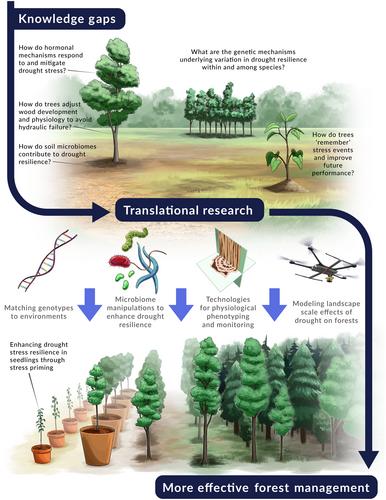
Droughts of increasing severity and frequency are a primary cause of forest mortality associated with climate change. Yet, fundamental knowledge gaps regarding the complex physiology of trees limit the development of more effective management strategies to mitigate drought effects on forests. Here, we highlight some of the basic research needed to better understand tree drought physiology and how new technologies and interdisciplinary approaches can be used to address them. Our discussion focuses on how trees change wood development to mitigate water stress, hormonal responses to drought, genetic variation underlying adaptive drought phenotypes, how trees ‘remember’ prior stress exposure, and how symbiotic soil microbes affect drought response. Next, we identify opportunities for using research findings to enhance or develop new strategies for managing drought effects on forests, ranging from matching genotypes to environments, to enhancing seedling resilience through nursery treatments, to landscape-scale monitoring and predictions. We conclude with a discussion of the need for co-producing research with land managers and extending research to forests in critical ecological regions beyond the temperate zone.
期刊介绍:
New Phytologist is an international electronic journal published 24 times a year. It is owned by the New Phytologist Foundation, a non-profit-making charitable organization dedicated to promoting plant science. The journal publishes excellent, novel, rigorous, and timely research and scholarship in plant science and its applications. The articles cover topics in five sections: Physiology & Development, Environment, Interaction, Evolution, and Transformative Plant Biotechnology. These sections encompass intracellular processes, global environmental change, and encourage cross-disciplinary approaches. The journal recognizes the use of techniques from molecular and cell biology, functional genomics, modeling, and system-based approaches in plant science. Abstracting and Indexing Information for New Phytologist includes Academic Search, AgBiotech News & Information, Agroforestry Abstracts, Biochemistry & Biophysics Citation Index, Botanical Pesticides, CAB Abstracts®, Environment Index, Global Health, and Plant Breeding Abstracts, and others.





 京公网安备 11010802042870号
京ICP备2023020795号-1
京公网安备 11010802042870号
京ICP备2023020795号-1

 分享
分享
 求助内容:
求助内容: 应助结果提醒方式:
 扫码关注我们
