{"title":"Photovoltaic-Driven Battery Deionization System for Efficient and Sustainable Seawater Desalination","authors":"Xiaosong Gu, Wenfei Wei, Xuezhen Feng, Ranhao Wang, Songhe Yang, Zhenzhong Zeng, Hong Chen","doi":"10.1021/acs.est.4c11467","DOIUrl":null,"url":null,"abstract":"Seawater desalination via electrochemical battery deionization (BDI) has shown significant potential for freshwater production. However, its widespread application has been limited by the high energy costs involved. To facilitate the commercialization of BDI technology, it is crucial to develop innovative integrated BDI systems that utilize sustainable energy sources and assess their practical performance for desalination of natural seawater. In this study, we construct the first photovoltaic-driven battery deionization system, termed PV-BDI, capable of continuously and simultaneously removing multiple ions from natural seawater. The system successfully produced freshwater with a total dissolved solids (TDS) level of 704 mg L<sup>–1</sup>, meeting the maximum acceptable TDS limits recommended by the World Health Organization (WHO) for drinking water standards, which specify a maximum TDS limit of 1000 mg L<sup>–1</sup>. The mass-specific energy consumption for salt removal to obtain drinking water from natural seawater via this system has been reduced to 0.036 kW·h kg<sup>–1</sup>, surpassing the performance of other state-of-the-art PV-driven electrochemical-based desalination technologies such as electrodialysis and capacitive deionization (0.068–2.100 kW·h kg<sup>–1</sup>). This work presents a pioneering proof-of-concept integrated PV-BDI system and demonstrates its practical performance for desalinating natural seawater, thereby laying the foundation for expanding BDI systems in the near future for environmentally friendly and sustainable industrial-scale seawater desalination.","PeriodicalId":36,"journal":{"name":"环境科学与技术","volume":"23 1","pages":""},"PeriodicalIF":11.3000,"publicationDate":"2024-12-19","publicationTypes":"Journal Article","fieldsOfStudy":null,"isOpenAccess":false,"openAccessPdf":"","citationCount":"0","resultStr":null,"platform":"Semanticscholar","paperid":null,"PeriodicalName":"环境科学与技术","FirstCategoryId":"1","ListUrlMain":"https://doi.org/10.1021/acs.est.4c11467","RegionNum":1,"RegionCategory":"环境科学与生态学","ArticlePicture":[],"TitleCN":null,"AbstractTextCN":null,"PMCID":null,"EPubDate":"","PubModel":"","JCR":"Q1","JCRName":"ENGINEERING, ENVIRONMENTAL","Score":null,"Total":0}
引用次数: 0
Abstract
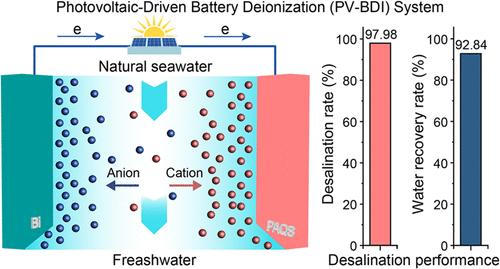
Seawater desalination via electrochemical battery deionization (BDI) has shown significant potential for freshwater production. However, its widespread application has been limited by the high energy costs involved. To facilitate the commercialization of BDI technology, it is crucial to develop innovative integrated BDI systems that utilize sustainable energy sources and assess their practical performance for desalination of natural seawater. In this study, we construct the first photovoltaic-driven battery deionization system, termed PV-BDI, capable of continuously and simultaneously removing multiple ions from natural seawater. The system successfully produced freshwater with a total dissolved solids (TDS) level of 704 mg L–1, meeting the maximum acceptable TDS limits recommended by the World Health Organization (WHO) for drinking water standards, which specify a maximum TDS limit of 1000 mg L–1. The mass-specific energy consumption for salt removal to obtain drinking water from natural seawater via this system has been reduced to 0.036 kW·h kg–1, surpassing the performance of other state-of-the-art PV-driven electrochemical-based desalination technologies such as electrodialysis and capacitive deionization (0.068–2.100 kW·h kg–1). This work presents a pioneering proof-of-concept integrated PV-BDI system and demonstrates its practical performance for desalinating natural seawater, thereby laying the foundation for expanding BDI systems in the near future for environmentally friendly and sustainable industrial-scale seawater desalination.
期刊介绍:
Environmental Science & Technology (ES&T) is a co-sponsored academic and technical magazine by the Hubei Provincial Environmental Protection Bureau and the Hubei Provincial Academy of Environmental Sciences.
Environmental Science & Technology (ES&T) holds the status of Chinese core journals, scientific papers source journals of China, Chinese Science Citation Database source journals, and Chinese Academic Journal Comprehensive Evaluation Database source journals. This publication focuses on the academic field of environmental protection, featuring articles related to environmental protection and technical advancements.



 京公网安备 11010802042870号
京ICP备2023020795号-1
京公网安备 11010802042870号
京ICP备2023020795号-1

 分享
分享
 求助内容:
求助内容: 应助结果提醒方式:
 扫码关注我们
